



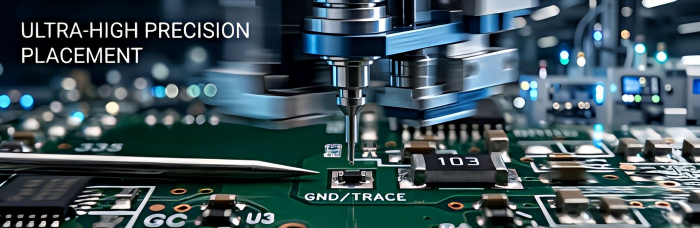
It is well known that the development of electronics has led to a growing trend towards producing ever smaller and lightweight electronic devices with greater functionality. These needs have led to using ultra-miniature components of 01005 size (0.4 mm x 0.2 mm). While this allows creating denser layouts with improved electrical characteristics, there is a wide range of additional challenges that arise due to the use of these components in SMT production. Placement accuracy plays an important role in determining performance, yield, and reliability of an SMT production line.
Characteristics of 01005 Components and Associated Production Challenges
01005 components are much smaller and lighter than the traditional ones (0402 or 0603). This leads to the following features:
Very tight tolerances (often below ±10 µm)
Small surface of soldering pads, thus not allowing any deviations
High sensitivity to various mechanical and electromagnetic effects
Moreover, the very small weight of 01005 components increases their vulnerability to displacement in both placement and reflow stages.
Accuracy Needs of SMT Assembly Systems
In SMT, placement accuracy is defined by how accurately a component is placed on a printed circuit board (PCB) pad compared to its designated coordinates. In the case of 01005 devices, the allowable tolerance is exceedingly low:
Tolerance within a 20-50 µm range could cause insufficient solder wetting
Even small variations could create issues like tombstoning and bridges
High density design will require microns of accuracy
Such high demands are placed on pick-and-place equipment, vision systems, and calibration. Standard SMT assembly systems, meant for placing large-sized components, might be unable to consistently provide such accuracy levels.
Key Factors Affecting SMT Line Accuracy with 01005 Placement
Cumulative Errors in Placement Process
The process of SMT component placement consists of several factors, such as:
Identification of fiducials and board alignment
Pickup device placement accuracy
Nozzle centering and vacuum stabilization
Machine accuracy
Each of these elements creates an insignificant amount of error, but for 01005 packages, any small errors get accumulated and become quite critical.
Limitations of Solder Paste Printing
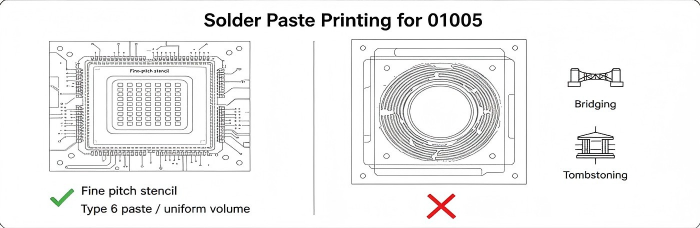
Solder deposition is very vital in component placement stability. For 01005 components:
The ratio of aperture size and area need to be optimized accurately
Lack of consistency in the volume of paste may result in uneven wetting forces
Too much or too little paste will result in greater chances of bridging or tombstoning
To ensure uniform deposition to facilitate precise placement, fine-pitch stencil design and high-quality paste (i.e. ultra-fine particle sizes) are crucial.
Placement Force and Speed Control
The parameters of proper placement can have a severe impact on accuracy:
Overforce can result in component movement or entrapment in solder paste
Fast placement rate may cause vibration and lessen positioning accuracy
Lack of adequate vacuum control can lead to mis-pick or misalignment
These parameters are important to optimize to obtain consistent and reliable placement results.
Decreased Self-Alignment in Reflow
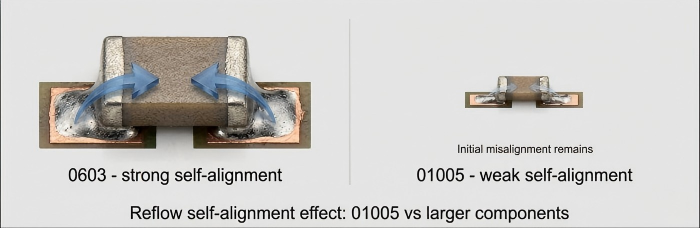
In traditional SMT operations, molten solder offers a self-aligning effect which aids in correcting minor alignment mistakes. However, for 01005 components:
Smaller solder volumes greatly decrease the self-alignment force
Any misalignments larger than a very small parameter cannot be repaired
The movement of components during reflow is less predictable
This causes the accuracy of initial placement to be much more important than when larger components are to be used in an assembly.
Environmental and Static Effects
The 01005 components are very sensitive to environmental factors:
HVAC systems can lead to displacement of air
Components can be attracted or repelled by the presence of the static electricity
Changes in temperature and humidity influence the behavior of solder paste
To reduce these external influences, it is necessary to have a controlled production environment.
Effect on SMT Line Performance
Yield and Defect Rates
Placement error is directly proportional to increased defect rates, such as:
Tombstoning
Short circuits and bridging
Open solder joints
Misaligned components detected after reflow
Minor variations can drastically lower the yield at the first pass, raising the scrap and rework expenses.
Inspection Challenges
The small size of 01005 components makes it difficult to inspect them:
AOI systems demand a more sophisticated resolution and improved algorithms
False calls and defects missed are increased
Verification can be done by X-ray inspection
This adds to inspection time and equipment.
Investment and Equipment Capability
The 01005 components are difficult to handle without the use of sophisticated SMT equipment, including:
High resolution vision aligners
Nozzles that are precise and are used in tiny parts
Improved movement with less vibration
Next-generation equipment and continuous calibration have to be invested by manufacturers to keep lines accurate.
Throughput and Efficiency
With higher accuracy demands:
Placement speeds might be required to be decreased
Calibration of machines should be done more often
Other inspection and rework procedures are added
These are the factors which can adversely affect the overall SMT line efficiency when not dealt with adequately.

Methods to Enhance Accuracy of Placement of 01005 Components
Advanced Equipment and Vision Systems
Placement accuracy can also be greatly enhanced by the use of high-precision pick-and-place machines, which have a multi-camera alignment system and real-time correction.
Maximized Solder Paste Printing
Apply very fine solder paste (e.g., Type 6 or Type 7)
Maximize stencil thickness and aperture design
Introduce tough printing process controls
Process Parameter Optimization
Adjust placement force, speed, and vacuum
Minimize machine vibration by maintaining and adjusting
Use closed loop feedback
Environmental Control
Do not allow a change in temperature and humidity
Enforce the use of electrostatic discharges (ESD) protection
Limit air movement disruptions in important regions
Data-Driven Process Control
Based on data analytics and real time monitoring, manufacturers can:
Early identify trends and deviations
Keep on enhancing the accuracy of placement
Minimize batch to batch variation
Future Trends in 01005 SMT Manufacturing
With further miniaturization of components, SMT processes are moving towards:
AI-assisted placement optimization
Higher-resolution inspection technologies
Whole smart factory solutions.
These innovations are to meet the growing accuracy requirements and remain efficient and scalable.
01005 placement is critical for the precision of SMT lines owing to the incredibly tiny size and narrow tolerances of the 01005 component. Any slight variation during the printing, placement, and reflow steps will result in defective products and low yields. Ensuring repeatability necessitates accurate machinery, a well-optimized manufacturing process, and proper environmental management.
PCBCart provides state-of-the-art SMT technologies and years of expertise with 01005s and other ultra-miniature components. Through rigorous process management and quality control, we can guarantee high precision and dependable output.
Helpful Resources
• Some Handy Methods in Evaluating SMT Assembler’s Capabilities
• PCB Design Elements Influencing SMT Manufacturing
• Elements Influencing SMT Soldering Quality and Improvement Measures
• Printed Circuit Boards Assembly (PCBA) Process


