



A box build assembly scope of work needs to settle four things in writing: which documents govern the build, which parts each side supplies, what gets tested, and what counts as a pass. Disputes on box builds rarely start on the line. They start with an assumption nobody wrote down, such as who buys the label or whether "tested" meant a power-on check or a full functional run.
This article is about drafting that scope. For what tends to go wrong after the scope is agreed, see our box build risk checklist. The checklist assumes a scope already exists.
What does "box build" cover, and what doesn't it?
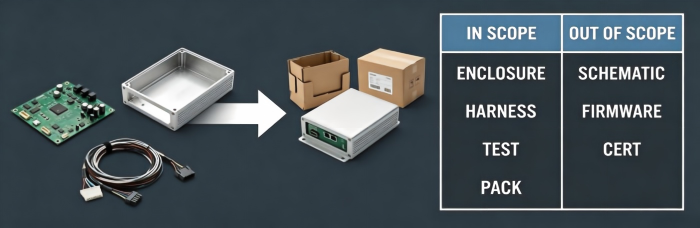
Box build covers everything between a finished PCBA and a unit that can ship. That can be a board in an enclosure with a connector panel, or a system built from many sub-assemblies, cables and mechanical parts. The box build capabilities listed on our site include cable assemblies, wiring harnesses, electro-mechanical assemblies, higher-level integration of high-mix products, component sourcing, environmental and functional testing, and custom packaging.
"Box" is the trap. To a project manager it means the finished product; to a factory it can mean a board plus an enclosure. Describe the unit as it leaves the dock: what is inside, what is in the carton, what is printed on it.
Three things usually sit outside the scope unless you add them. We do not provide schematic design, so mechanical and electrical design must arrive finished. Loading a supplied firmware image is a scope item, but writing or debugging it is not; state the procedure and confirm with our engineering team how it fits the line. And certification is its own program, so name who holds the certificate and which unit configuration it covers. A short "out of scope" list stops a reasonable assumption on one side from becoming an unpriced task on the other.
Which documents define the build?
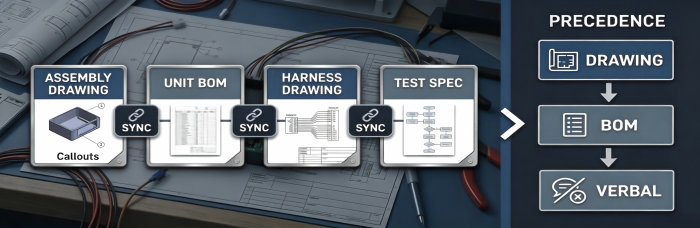
The build is defined by documents, not by the quote email. We usually ask for four.
Assembly drawing. It shows the final unit, part order, fastener positions and orientation. Keep it at the same revision as the BOM. A drawing at Rev C with a BOM at Rev B is easy to create and slow to find on the line.
Unit-level BOM. The PCBA BOM is not enough. Add enclosure parts, fasteners, cables, connectors, labels, packaging and loose-pack items, and mark each line as customer-supplied or factory-sourced.
Harness and cable drawings. For each cable: connector part numbers at both ends, a pin-to-pin wiring table, wire gauge and color, length with tolerance, and routing notes. A wiring diagram without a length tolerance leaves the operator guessing.
Test specification. The one people leave out most often. It lists each test, the fixture or equipment, the pass criteria and what to record.
Add one sentence on precedence, for example: "The assembly drawing governs over the BOM, and the BOM governs over verbal instruction." The order matters less than having one. When documents conflict mid-build, the line stops and asks.
Who supplies enclosures, cables and labels?
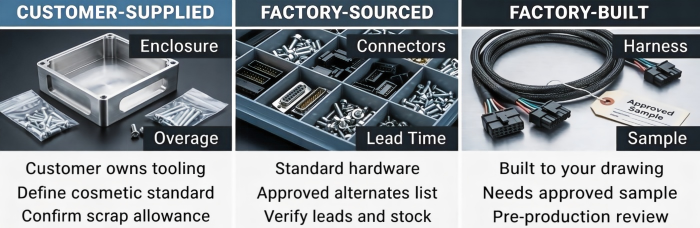
Every line of the box build BOM needs an owner, and you can mix arrangements by line. Customer-supplied (consigned) parts suit custom enclosures from your own tooling vendor; settle overage for scrap and setup, incoming inspection rules, and who pays for a shortage. Factory-sourced parts suit standard connectors, fasteners and off-the-shelf cable; settle approved alternates and confirm lead time before the PO. Factory-built parts, such as custom harnesses made to your drawing, need a complete drawing and an approved sample before the full lot.
Enclosures. If you supply them, state quantity with overage and the cosmetic acceptance standard. "No visible scratches" is not a standard; use a reference sample or a written defect definition. If we source the enclosure, confirm whether it is a stock part or needs tooling, since that changes lead time and tool ownership.
Cables. Name the manufacturer part number for bought cables, not a description.
Labels. Everyone treats labels as trivial, so they fall through the cracks. Define artwork source, content (model, revision, serial format, ratings, regulatory marks), material, and placement with a tolerance. If you need per-unit serial labels or serial numbers recorded against the unit, confirm the procedure with our engineering team first.
Substitutions. No substitution without written approval, and a shortage of a consigned part is reported before the line starts, not after.
How will finished units be tested and accepted?
Define acceptance as a list of checks with pass criteria, not "unit works." There are usually three layers.
Board level. Depending on the product we use 3D AOI, offline X-ray for hidden joints, and ICT or flying probe, as listed on our box build page. Say which you expect and whether results stay with the unit record.
Unit-level functional test. Describe the sequence: power-up, interface checks, load or stimulus, and the readings that pass. If you supply the fixture or software, say who maintains it. If we build the fixture from your spec, it becomes its own scope item. If a test depends on instrument accuracy, state the tolerance and confirm with our engineering team how it will be verified.
Environmental testing. It is listed on our box build page, but profiles are project-specific. Send the profile you want and confirm with our engineering team what can be run and recorded.
Then write down five acceptance rules:
What gets inspected, and how often: every unit for function, sampling for cosmetic and dimensional checks, or both.
What counts as a defect, with a reference sample for cosmetics.
What happens on failure: whether rework is allowed, whether retest is required, how failed units are tagged.
What records ship with the units: per-serial test results, a summary, or nothing. Records you do not ask for tend not to exist.
Who accepts, and the window for raising a rejection after receipt.
On a first build, a first-article unit that you inspect and sign before the lot proceeds is worth the delay. It is the cheapest point to find that the drawing and the physical part disagree.
What does a box build scope-of-work template look like?
Each row should end up with a name, a document reference or a value. A row still marked "TBD" at quote time is a risk you are carrying.
| Item | What to specify | Owner |
|---|---|---|
| Unit definition | Part number, revision, quantity, variants, end point of build | Customer |
| Governing documents | Assembly drawing, BOM, harness drawings, test spec, with revisions and precedence | Customer |
| Supplied vs. sourced | Owner of each BOM line: enclosure, cables, labels, packaging | Agreed per line |
| Test | Sequence, fixtures, pass criteria, environmental profile, records | Customer specifies, factory executes |
| Acceptance | Sampling, defect definitions, rework rules, acceptance window | Both |
| Change control | How revisions and substitutions are requested and approved | Both |
| Out of scope | Design, firmware development, certification, anything else excluded | Both |
FAQ
Can we start with the PCBA and add the box build later?
Yes, and for a new product it is often sensible. The risk is that the board is designed without knowing the final mechanical constraints. If you split it, record what the later stage will need (connector orientation, reachable test points, serial marking location) so the board does not need a revision.
Who decides if a cosmetic defect on a customer-supplied enclosure is acceptable?
You do, but before the build, not during it. A reference sample or photos of acceptable and unacceptable examples keep the call consistent across operators and lots.
Do we need a separate test specification if the PCBA already passed ICT?
Yes. ICT confirms the board was built correctly. It says nothing about the cables, the display, or how the unit behaves with its power supply and load.
How should design changes after the build starts be handled?
Through a written change request that cites the document and revision. State that work on affected units pauses until approval, and decide who bears the cost of units already built to the old revision.
What should we send for a box build quote?
The assembly drawing, unit-level BOM with supplied and sourced lines marked, harness drawings, test specification, packaging requirements, and expected quantities. Each missing document becomes an assumption on the quote.


