



Printed Circuit Board (PCB) assembly is a high accuracy-based manufacturing process in which each activity affects the reliability of the end product. Solder paste stencil printing is among the most fundamental SMT processes. The stencil printing process defines the amount of solder that is on hand, the location of that solder and the stability of components in reflow before components are placed or soldered.
Minor changes in paste volume or alignment can cause some faults, including shorts, weak joints or component failure. With PCB designs being pushed to finer pitches and higher densities, stencil printing control is now necessary to ensure the yield and to minimize rework.
Why Stencil Printing Is Important in PCB Assembly
Stencil printing applications apply solder paste to the pads of PCB through a series of accurately-cut apertures with a metal squeegee blade. This process has a direct impact on the accuracy of:
Solder joint conductivity and strength
Reflow self-alignment of components
First-pass success rate and assembly yield
Product reliability in the long term
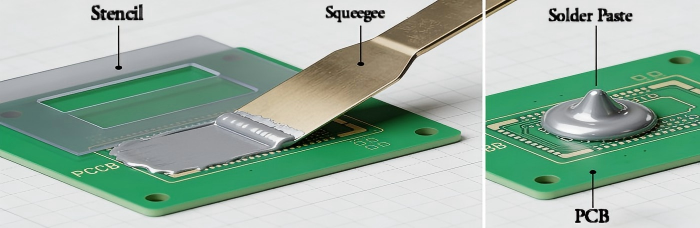
Since downstream operations cannot correct the deficient paste deposits, most SMT defects are in fact at the printing phase. There are three key factors to successful printing:
Adequate stencil design and thickness
Constant printing command (speed, pressure, angle)
Solder paste in good condition, clean equipment
Defects are soon revealed when any of these variables changes
Common Stencil Printing Defects
Inadequate or Oversize Solder Paste
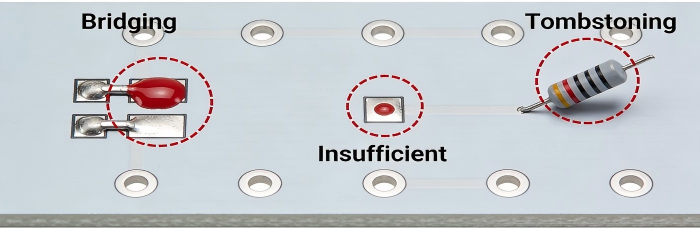
One of the most common stencil printing issues is incorrect volume of the paste. An insufficient amount of paste leads to poor or defective solder joints, whereas excess paste makes bridging and contamination more likely.
Causes
Wrong size of aperture or stencil thickness
Inappropriate squeegee pressure adjustments
High solder paste viscosity or material expiry
Poor release of stencils due to blocked apertures
Solutions
Optimize aperture design, usually by 10-20% of components with fine pitch
Ensure constant squeegee pressure and regular printing speed
Keep solder paste in stores under optimal conditions and leave it to stabilize temperature before use
Introduce a regular routine stencil cleaning to avoid obstruction
The basis of consistent solder joints lies in constant paste volume
Solder Bridging
The solder bridges occur when neighboring pads accidentally get in contact with excess solder, resulting in the electrical shorts post-reflow.
Causes
Excess deposition of solder paste
Stencil alignment error on PCB pads
Over printing pressure pushing paste under stencil
Lack of uniformity of paste layers on the board
Solutions
Better stencil alignment with fiducial-based vision systems
Use narrow aperture when using fine-pitch devices
Maximize squeegee pressure to avoid paste bleed
monitor volume consistency using solder paste inspection (SPI) systems.
Bridging tends to occur particularly in high-density assemblies, and is required to be managed at the printing stage.
Cold or Weak Solder Joints
Cold solder pad Cold solder pad takes place when solder fails to wet pads or component leads, leading to unreliable electrical connection.
Causes
Many cold joints may be caused by printing problems, although they are visibly formed after reflow:
Lack of or uneven deposition of paste
Infected pads or corroded parts
Poor reflow thermal characteristics and inconsistent paste volume
Solutions
Calibrate printers with uniform paste deposits
Confirm solder paste freshness and handling processes
Optimize paste alloy reflow temperature profiles
Check proper component location prior to reflow
Solder paste deposits that are stable enable the melting and flow of the solder in a uniform fashion during heating.
Tombstoning
Tombstoning is a substitution effect in which small passive elements stand on one pad and are lifted vertically during reflow to leave a hole in the circuit.
Causes
Different amounts of solder paste between component pads
Asymmetrical pad or aperture design
Irregular heating in reflow
Solutions
Keep a constant deposition of paste on the two pads
Apply symmetrical stencil aperture models
Provide proper positioning and thermal profiles
Tombstoning is a problem that appears as a result of a reflow, but its origin is frequently inaccurate stencil printing
Paste Smearing or Spillage
Smearing is the dispersion of solder paste beyond the target pad areas, polluting adjacent ones and exposing the system to the risk of a short-circuit.
Causes
Poor stencil-to-PCB contact
High squeegee speed or squeegee pressure
Stencil underside residual paste
Flexing of PCB lacks support
Solutions
Board support tooling should be used properly to keep it flat
Slow down printing rate and permit controlled rolling of paste
Use automatic under-stencil cleaning cycles
Keep snap-off distance to the minimum in modern contact printing
Stencil and PCB should be separated and cleaned completely before making direct deposits
Streaking or Stencil Drag
Stencil drag presents itself in the form of streaks or irregular solder paste lines on the surface of the PCB.
Causes
Wrong squeegee angle or damaged blades
Overpressure during printing
Stencil surfaces that are dry or contaminated
Solutions
Keep the squeegee angle at 45° to 60°
Change old blades on a regular basis
Improve cleaning frequency of stencils
Confirm that there is smooth rolling of the paste during the print
Visual inspection at an early stage assists in the detection of streaking prior to defect spreading downstream.
Best Practice for Process Control and Troubleshooting
In case stencil printing defects are detected, a systematic method can be used to detect root causes fast:
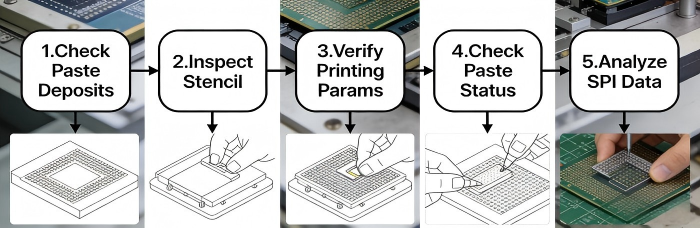
Check deposits of paste and then examine placement or reflow.
Cleanliness, flatness and aperture state of check stencil.
Check printing parameters on recent changes.
Check solder paste storage record and viscosity.
Use SPI data trends to examine failures.
It is much better to prevent process control rather than rectify defects after assembly.
Stencil Printing Defects Prevention
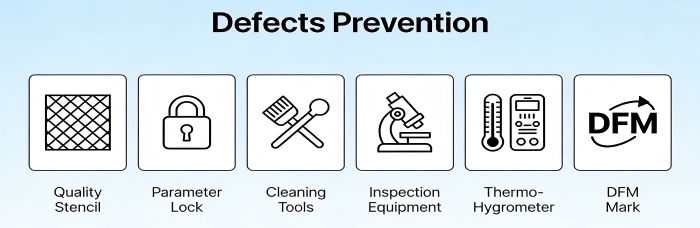
High-yield PCB assembly is dependent upon disciplined process control:
High-quality laser-cut or electroformed stencils should be used
Lock and standardize validated printer settings
Wipe stencils after 5-10 prints on thick boards
Conduct pre-mass production inspection
Keep the environment correct (temperature and humidity)
Work together with Design for Manufacturability (DFM) reviews
Pad geometry and spacing can be used to eliminate many printing issues during design
Successful PCB assembly is based on stencil printing. Poor solder, bridging, cold joints, tombstoning, smearing and stencil drag are all generally caused by differences in stencil design, printing parameters or material handling.
PCBCart leverages decades of experience in PCB fabrication and assembly, with the additive approach of high-quality stencil printing, quality control, and full DFM support to reduce the risks of production at the earliest stage. Our team of professional engineers aids in the optimization of designs to manufacturability without compromising assembly performance and rapid turnaround. Request a quote to let PCBCart help you take your project to the next production stage with confidence.


