



A consigned PCB assembly kit is ready to be built if all components are in a package that the SMT line is capable of loading, all packages contain the same component number as listed in your Bill of Materials, moisture sensitive components are still in their dry packs, and each line item has extra components to make up for any placement losses during assembly. Lack of any of those will hold the build up waiting on your kit, often after the boards have already been produced.
Below is how you should pack, label, and inventory your kit in order for it to go straight to the line.

What packaging is usable by the SMT line?
Full reels, trays, and tubes in their original packaging require the least preparation, while partial reels and cut tape are acceptable when the tape is intact and sufficiently long. Loose bulk components are the type that is most prone to delaying the process.
The following SMT formats are listed on our consigned assembly web page: reels, tubes, trays, partial reels, cut tape, and bulk. Acceptable does not mean equal: a full reel is ready for placement as received, while a short cut tape strip loses components even before reaching the board.
| Format | What it needs to load cleanly | What usually goes wrong | What we ask for |
|---|---|---|---|
| Full reel | Nothing extra | Manufacturer label removed or covered by a customer sticker | Keep the original reel label visible; add your own label beside it |
| Partial reel | An intact tape end | Tape cut flush to the last part, or torn | Leave the tape end intact and write the remaining quantity on the reel |
| Cut tape | One strip long enough to load | Strips cut into one-board pieces, spliced with tape, or several short strips per part number | One continuous, unspliced strip per line item; confirm the minimum usable length with our engineering team |
| Tray | Parts seated in their pockets | Parts shifted out of pockets in transit; pin 1 not consistent | Original tray with a cover tray, strapped and sealed; all parts in the same orientation |
| Tube | Parts in order, same orientation | End stoppers missing, parts slid out or reversed | Stoppers in both ends; every part facing the same way |
| Bulk (loose) | Each part handled individually | No polarity reference, mixed values in one bag, bent leads, no ESD protection | Avoid for polarized, fine-pitch or ESD-sensitive parts; one part number per bag |
Cut tape is what causes most kits to have problems. The suppliers will ship small quantities cut tape, which can be several pieces from various orders. Typically, we will request one continuous piece for each line item and that none of the ends should be cut off and no pieces be taped together. When you are purchasing new parts for a consigned build, then buying a full reel of inexpensive passives is sometimes cheaper than the time spent handling short pieces.
Leaded IC's, connectors, and sockets need to be packaged just as carefully. They should be shipped in their original packaging, either tray or tube. Components that have been removed from the packaging and put into a bag may come to us with bent or out-of-plane leads. And that becomes a soldering issue rather than a receiving issue. Sensitive IC's should ship in ESD shielding bags.
If you are sending kits for multiple orders, separate the orders. If you have a box with the components for two projects, then someone has to separate the box before construction can begin on either.
How do you mark your consigned kit?
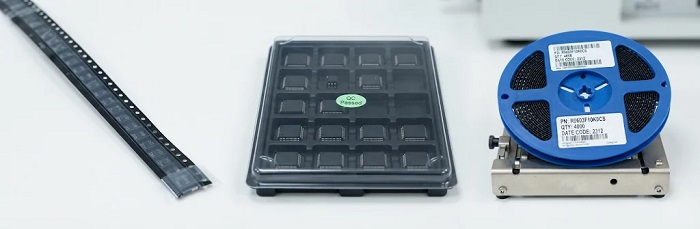
All containers must have labels that identify which line of your bill of materials (BOM) they belong to, so you can use part numbers, not physical appearance, to identify them.
For all reels, trays, tubes, or bags, you should have a label showing your internal part number (if your BOM includes it), the manufacturer part number, and the quantity inside. The label from the manufacturer that has the date code and lot number should still be visible. If lot codes are necessary for traceability, then any label stuck over the original will make problems that cannot be solved afterwards.
Then include a kit list in the package and also email it out to them. It will have the same line numbers as your Bill of Materials (BOM). It should list the part number (internal), manufacturer part number, description, quantity per board, build quantity, quantity shipped, packaging (reel, tray, cut tape etc.), MSL level, approved alternates, and “notes” like “pre-programmed” or “blank, program at assembly.” Having the three quantity fields next to each other will immediately show any shortages.
If you are doing partial consignment, mark clearly which BOM lines you are supplying and which you want us to buy. A blank cell in a “supplied by” column is one of the usual reasons we email a customer during BOM review.
That review happens early. After an assembly order is paid, we run a DFM check on the design files and a BOM confirmation, and we email you if anything is unclear. A kit list that matches the confirmed BOM line for line keeps the questions at that stage, before parts are on a truck.
Externally, mark the cartons ("box 2 of 3") and write the order number on each one. We assemble our product at our manufacturing facilities located in Hangzhou, China and Thailand, therefore, please make sure to verify the delivery address and the person clearing the shipment of importation before we ship out the kit. Any carton that remains at the custom is considered a short kit from the production line perspective.
How do you ship moisture-sensitive parts in a consigned kit?
Keep moisture sensitive components inside their original moisture barrier bags with the desiccant and humidity indicator card, and if the moisture barrier bag has been opened, make sure to note the time and duration of that.
Plastic packaged IC’s, BGAs, QFNs and several power devices have moisture sensitivity level classification according to IPC/JEDEC J-STD-020 & J-STD-033. On the caution label on the moisture barrier bag is indicated the MSL, floor life after opening the bag and baking condition beyond floor life. These figures are associated with the component, and therefore the label is the authority, not the universal law.
There are three cases that might arise with consigned MSDs:
• Sealed bag, intact: ship in this condition. There’s no need to open and count the items; the quantity stated on the label will suffice for the kit listing.
• Bag opened to count or split a reel: the bag should be re-sealed with a fresh desiccant and indicator card and a note of the opening date and total exposure time included on the bag.
• Bag opened with no history, or the indicator card shows moisture: the components must be considered exposed and may require baking according to the label instructions prior to being able to be reflowed. This process will take additional time, and the bake conditions may not be suitable for components that are still taped or in low temperature reels. Please confirm with our engineering department.
Place the MSL rating on the kit list, making it easier to recognize that it is dry pack material. Don't please separate a sealed reel of MSL 3 material into two shipments in order to save on mailing costs; the second half comes with an unknown exposure history.
How many extra parts should you send?
Please send overages on all parts based on the part type and packaging method and not on quantity per board times build quantity. In case of costly or allocated components, please consult us before shipping.
Every Surface Mount Technology (SMT) build will lose components due to routine reasons such as the beginning of the tape, drops during pick-ups, multiple handling of the components. An exact count kit is actually a short kit.
We do not have one overage percentage to provide since the correct overage percentage varies depending on the package size, presentation, and build quantities. Here’s the reasoning:
| Part type and form | How to think about overage |
|---|---|
| Chip resistors and capacitors on reel | Small, cheap, and the most likely to be lost. Sending a full or generous partial reel is usually simpler than a counted strip. |
| Small ICs, diodes and transistors on cut tape | Allow for the start of the strip and the first and last pockets. Short strips lose proportionally more. |
| BGAs, fine-pitch QFPs and high-value parts in trays | Losses are lower, but cost per part is high. Agree the count with our engineering team before shipping. |
| Through-hole parts | Losses are low; a few spares cover bent leads. |
| Devices programmed at assembly | Add spares for parts that fail programming or verification. |
Our rule of thumb for buyers: if the part is cheap, overage is cheaper than a hold. If the part is expensive or on allocation, talk to us first, and we’ll work out with you what that line needs.
What puts a consigned job on hold?
Nearly every hold comes from a mismatch between what the confirmed BOM says and what arrived in the box.
| Trigger | Why it holds the build | How to avoid it |
|---|---|---|
| Short quantity on any line | The line cannot be set up for the full build | Check quantity shipped against quantity per board × build quantity, plus overage |
| Wrong package (0603 shipped for an 0402 footprint, SOIC for TSSOP) | The part does not fit the land pattern | Order by full manufacturer part number, including the package suffix |
| Unlabeled or unidentifiable parts | Parts cannot be matched to a BOM line until you identify them | Label every container and keep the manufacturer label visible |
| Opened MSD bag with no exposure record | Parts must be treated as exposed and may need baking | Keep bags sealed, or record opening date and exposure time |
| Alternate part supplied without notice | The part does not match the confirmed BOM | List alternates on the kit list and approve them in writing |
| Parts not rated for lead-free reflow | Our soldering process is lead-free | Check the rated peak reflow temperature on the datasheet before ordering |
| Kit arrives in pieces, or held at customs | A partial kit cannot be built | Ship complete, agree import handling in advance, or tell us which lines follow and when |
These costly shortages are the package mismatch and the short quantity on the long-lead item, since fixing the problem requires that you locate more inventory. This is the reason why procurement of parts for consigned build must always begin from the build date backwards: distributor lead time, transit to you, transit to us, and a bit of margin. The one-cent capacitor on long lead time can shut down a board as effectively as the FPGA.
Consigned kitting checklist
Do this before sealing the carton.
1. Each line on the BOM you are supplying has its corresponding package. The kit list identifies those lines that we will be sourcing.
2. Each package indicates your part number, manufacturer part number and quantity. The manufacturer’s label is visible.
3. The cut tape is a single piece of tape that is continuous and unspliced. It is not trimmed.
4. Partial reels have a complete tape and the remaining quantity is indicated on the reel.
5. The trays have their cover trays and all parts are placed in their pockets, orientated in the same direction.
6. The tubes have end stoppers on both ends.
7. Lead components, connectors and sockets come in their original packaging. Polarized parts, fine pitch components and ESD sensitive components do not come in loose packages.
8. Moisture sensitive parts are in sealed bags containing the desiccant and the indicator card. The opened bags have the date and time of opening noted on them.
9. The quantity supplied is equal to quantity per board x build quantity plus overage. We have agreed on the quantity for high value lines.
10. Package suffixes of part numbers of the manufacturer correspond to the footprints on the board.
11. Approved alternates are on the kit list.
12. The devices for programming at assembly are labeled, and the firmware/programming info has been sent.
13. Each order is packed individually, the cartons are numbered according to the order number, and shipping address/import info is confirmed.
14. Kit list is in box #1 and in your email to us.
FAQ
Can I consign only my expensive or hard-to-find parts and let you buy the rest?
Yes. That is partial consignment, and it suits a BOM where one FPGA or long-lead sensor sits among commodity parts. By default we buy the remaining parts from authorized distributors. If you prefer that we buy from channels you recommend, we can, but we cannot guarantee the quality of parts from sources you choose.
How far ahead should I buy parts for a consigned build?
Work back from the date you want the build to start. For each line, add the distributor’s quoted lead time, shipping to your site, shipping to our factory and a margin for slips. Lines with long or unstable lead times set the date, so check those first, and consider whether any of them should move to us as sourced lines instead.
Is bulk packaging ever a good choice for SMT parts?
Bulk is on our accepted list, but it trades your packaging time for more handling at our end. It is reasonable for large, non-polarized parts. For anything small, polarized or fine-pitch, buy it on tape or in trays if you can, and ask us before shipping it loose.
Can you program microcontrollers that I consign blank?
Yes, IC programming is one of the services we offer with consigned and partial consigned assembly. Send the firmware file, the target device and the verification method with your order, and include programming spares in the overage for that line.
Does consigning parts change how my quote is prepared?
It changes what the quote covers. Assembly price is quoted from your Gerber files and BOM; consigned lines are not priced for purchasing, but we still need the complete BOM to check footprints and placement. Mark consigned lines in the BOM before you request the quote.
Helpful Resources
• Components Sourcing: how we buy parts for turnkey and partial consigned builds
• Panel Requirements for PCB Assembly
• PCB Pre-order Checklist


