



Paying for a stencil, test fixture, or programming setup as part of an NRE fee doesn't automatically mean you own it — ownership has to be established explicitly in your contract or purchase order, and most buyers only discover this gap when they try to leave a supplier and find the tooling doesn't come with them.
"Paid For" Isn't the Same as "Owned"
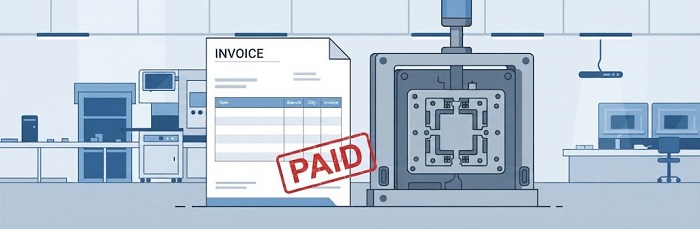
Every PCBA order that includes a new design typically carries some one-time engineering cost baked into the first run: a stencil, possibly a dedicated test fixture, programming setup for any firmware-loaded parts. These show up on the invoice as a line item, and it's natural to assume that paying the fee means you now own the physical thing it produced. But an invoice for a fee is not, by itself, a transfer of title. Unless a contract or purchase order explicitly states that ownership of the tooling passes to the buyer, the default assumption in a lot of supplier agreements is that the tooling remains the supplier's property, built and held specifically to produce your design on their line.
This isn't necessarily an attempt to lock a buyer in. A supplier that builds a stencil to their own tooling standards, calibrated to their own printer, has a reasonable case that the physical asset is theirs even though the buyer paid the cost of producing it — much like paying a locksmith to cut a key doesn't mean you now own the key-cutting machine. But the ambiguity matters enormously the moment a buyer wants to switch suppliers, and it's a question worth resolving long before that moment arrives.
What Actually Falls Under "Tooling" Here
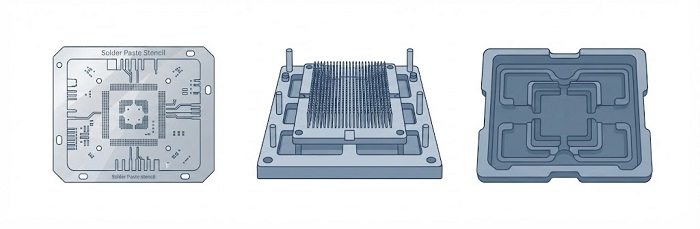
The category is broader than just the solder-paste stencil. It typically includes any dedicated test fixture (bed-of-nails ICT fixtures, custom functional-test jigs), programming setups and configuration files for any parts requiring firmware upload during assembly, and occasionally custom carrier trays for unusually shaped components. Each represents a genuine one-time engineering investment, and each raises the same ownership question independently — a contract that clarifies stencil ownership doesn't automatically clarify who owns a custom ICT fixture built for the same design, so it's worth confirming ownership for each tooling type on a design, not just the most visible one.
Why This Only Becomes a Problem When You Try to Leave
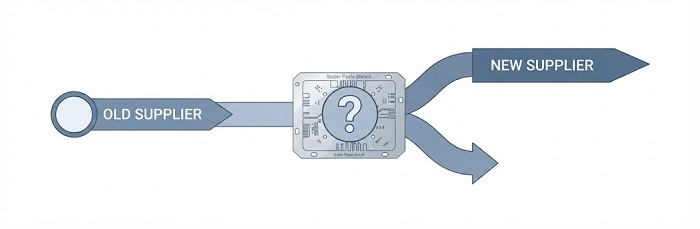
A buyer with a design running fine at one supplier for several years rarely thinks to ask who owns the tooling, because the question doesn't matter day-to-day — it stays where it is, gets pulled out and reused every reorder, and everyone's satisfied. The problem surfaces specifically when that relationship ends: a new supplier needs a stencil for the same design, and the buyer discovers the outgoing supplier considers it their own asset, built to their own specifications, not something that transfers. Even where a supplier is willing to release the tooling in good faith, a stencil built to one supplier's frame dimensions and printer calibration often can't be used directly on another supplier's line anyway — so the practical question usually isn't "can I take this stencil with me" so much as "am I paying for a new one regardless, and did I already pay for this one once."
That second question is the one worth having answered before it comes up, since the honest answer at that point is often "yes, you're paying for it again" — a reasonable outcome if the buyer went in understanding tooling doesn't automatically transfer, and a frustrating one if they assumed otherwise.
Consider an illustrative case: a buyer has reordered the same design from the same supplier for three years without ever discussing tooling ownership, since the topic never came up while the relationship was working well. When the buyer eventually decides to move production to a different supplier for unrelated pricing reasons, they ask for the stencil to be shipped to the new facility and are told, for the first time, that the outgoing supplier's standard terms treat all NRE-funded tooling as their own property. Nothing dishonest happened here — the buyer simply never asked, and the supplier never volunteered an answer to a question nobody raised. The practical result is a new stencil fee at the new supplier, on top of whatever the original stencil cost years earlier, which could have been anticipated (and potentially negotiated differently) with one clear question asked at the very beginning of the relationship.
What to Put in Writing Before Your First Order
The fix here isn't complicated, it's just usually skipped. Before placing a first order on a new design, it's worth asking a supplier directly: does ownership of the stencil and any dedicated fixtures pass to the buyer once the NRE fee is paid, or does it remain the supplier's? Get the answer in writing, ideally as a specific line in the purchase order or a standing agreement, rather than relying on an assumption either way. If ownership does transfer, it's also worth asking about retention: will the supplier store and reuse it between reorders on the buyer's behalf, or does the buyer need to arrange their own storage and shipping to move it elsewhere. If ownership doesn't transfer, that's not unreasonable on its own, but it changes how the NRE fee should be thought of — less a one-time purchase and more a recurring cost of doing business with that specific supplier. This is also worth revisiting for designs already in production with no documented terms — it's reasonable to raise the question mid-relationship and ask that it be clarified going forward, even years after the original NRE invoice was settled.
A Note on the Legal Side of This
None of the above is legal advice, and it isn't meant to substitute for it. Tooling-ownership language is contract language, and how it's actually worded — and how enforceable it is in a given jurisdiction — is a question for a buyer's own legal counsel, not a general buyer-education framework. What's worth taking from this article isn't a specific clause to copy, but the habit of asking the ownership question explicitly, in writing, before the first invoice for a new design's tooling goes out — rather than discovering the answer only when already trying to leave.
FAQs
1. If I paid for a stencil years ago, can I ask a supplier to release it retroactively? You can ask, but there's no guarantee — if ownership was never specified at the time, the supplier is within their rights to say no, which is exactly why this is worth clarifying upfront rather than after the fact.
2. Does a written ownership clause guarantee a stencil is usable on a different supplier's equipment? No — even a stencil a buyer legally owns may not physically fit or calibrate correctly on another supplier's printer, since frame dimensions and tensioning aren't universally standardized.
3. Should I expect to pay for new tooling every time I switch suppliers, even with a clear ownership clause? Often yes, for practical rather than legal reasons — budgeting for new tooling as part of any supplier transition is more realistic than assuming existing tooling will simply carry over.
4. Does this ownership question apply the same way to programming files as it does to physical fixtures? Not exactly — programming files are more like data than physical property, so the more relevant question there is usually about format and portability rather than legal title.
5. Is it reasonable to negotiate a lower NRE fee in exchange for the supplier retaining ownership? It's a reasonable point to raise — some suppliers price NRE differently depending on who ends up owning the result, so it's worth asking rather than assuming the fee is fixed regardless of the ownership outcome.
Ready to clarify tooling ownership before your next NRE-bearing order? Request a PCB Assembly quote and ask the ownership question in writing as part of your RFQ.


