



With the ongoing advancement of electronic products in speed and complexity, along with reduced dimensions, PCB will be required to provide closer tolerances and enhanced reliability. PCB imaging is one of the most important fabrication processes since it determines the copper circuitry directly impacting the control of impedance, signal integrity, and yield performance. There are two common imaging technologies popular today in PCB fabrication: Traditional Photolithography, and Laser Direct Imaging (LDI). Both print the pattern of a transfer onto photoresisted copper, although they have very different workflow, flexibility, precision capability and the economics of production.
PCB Imaging in Modern Manufacturing
PCB imaging transforms digital layout data into physical copper traces with exposure, development and etching. The imaging may be deviated leading to trace width variation, poor registration of the layers, or instability in the electricity.
In the case of multilayer and HDI boards, imaging should be able to guarantee:
Accuracy of fine line width and spacing.
Accurate layer-to-layer registration.
Constant impedance of high-speed circuits.
Large output and low quality defects.
With circuit density, imaging precision becomes a decisive factor in manufacturability.
Traditional Photolithography: The Industry Standard
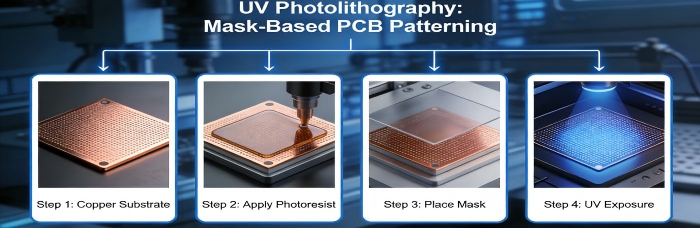
PCB imaging has been decades-old based on traditional photolithography. It transfers patterns on photoresist by exposure to ultraviolet light using a photomask with the circuit artwork.
Basic Process Overview
Treat copper laminate with photoresist.
Place the photomask on the panel.
Expose using UV light.
Form the pattern by developing the resist.
Etch unwanted copper.
Strip remaining resist.
Since the whole panel is open at once, this process promotes effective batch production.
Advantages of Traditional Photolithography
Economy of High Volume Production
After photomasks are manufactured, they may be used again and again, which lowers the unit cost when large quantities are produced.
Mature andStable Process
Much development over decades has established standard materials, stable processes, and skilled workers.
Large Stable Design Throughput
Full-panel exposure allows rapid processing when the design of the circuit is not changed.
Advanced Applications Restrictions
Photolithography is limited as feature sizes decrease:
UV diffraction and mask quality limited resolution.
Alignment issues in multilayer HDI structures.
New masks needed each change of design.
Possibility of defects due to mask pollution.
With specialized systems, it becomes harder and harder to maintain consistent features below about 50 um.
Laser Direct Imaging (LDI): Digital Precision Manufacturing
Digitally Controlled Laser exposure replaces physical masks with Laser Direct Imaging. The design data of PCB is entered directly to the imaging system and the laser beams are focused onto the photoresist surface without the involvement of tooling.
How LDI Works
The system loads digital design files.
Lasers that are precisely scan the panel.
Circuit areas are only exposed where necessary.
Etching and development are standard processes.
This maskless workflow lowers the mechanical variability and enhances the accuracy of imaging.
Advantages of LDI Technology
Advanced Accuracy and Determination
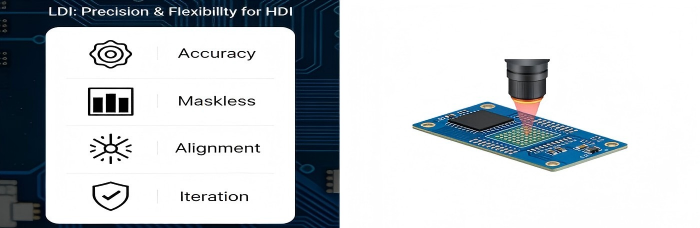
LDI can be used to facilitate very fine geometries, typically in the 10-25 um scale. This is necessary in HDI boards, microvias, and fine-pitch components.
Elimination of Photomasks
Manufacturers are advantaged with no masks as they have:
No tooling fabrication cost
No mask alignment errors
Faster production startup
Design revisions to be implemented immediately.
This significantly increases the flexibility in the prototyping and product iteration.
Better Multilayer Registration
Digital alignment enhances layer-to-layer accuracy, which aids to limit the impedance stability and minimize scrap rates in intricate builds.
Faster Design Iteration
Due to the data-driven nature of exposure, changes in design can be deployed immediately to reduce development cycles and time to market.
Less Process Variability
LDI helps to increase yield and even quality because it reduced the possibility of mask-related contamination and distortion.
Challenges and Trade-Offs of LDI
LDI has its practical considerations, additional to its technical virtues:
Increased capital investment as a result of improved laser systems.
Very large simple batches may have throughput decreased by scanning exposure.
Needs expert technical support and care.
In some cases of high-volume, low-complexity projects, photolithography can still be cost effective using traditional methods.
LDI vs. Traditional Photolithography
Despite the fact that both technologies carry out the same imaging process, they have varying operational characteristics.
Traditional photolithography utilizes UV exposure by using a physical mask, necessitating tooling development and mechanical centering. The LDI employs digital exposure to laser with no masks, making it an easy setup with less error due to alignment.
Photolithography is limited by optical diffraction and mask accuracy in terms of precision. LDI supports finer line widths and tighter spacing, which makes it more appropriate to HDI and high-density layouts.
In terms of flexibility, photolithography needs new masks when the design is changed, which is more expensive and has long lead time. LDI provides the option of making instant design adjustments by changing digital data.
Multilayer alignment requires more difficulty to position masks as the density goes up. LDI also increases the consistency of registration by digital positioning control.
Photolithography can be used to offer greater panel throughput in high-volume production of simple designs. Nonetheless, with engineering changes and setup time factored in, LDI tends to provide quicker overall turnaround with builds that are more complex.
Why HDI Development Is Driving LDI Adoption
High-Density Interconnect technology allows the creation of compact and high-performance electronics with microvias, dense routing, and smaller trace sizes. Consumer electronics, automotive systems, aerospace, and medical devices are some of the industries which are increasingly using these advanced designs.
These applications require:
Smaller feature sizes
Reduced impedance tolerance
Higher signal speeds
Better multilayer alignment
LDI is specifically designed to meet these technical requirements, so it is an imaging system of choice in high-technology PCB manufacturing.
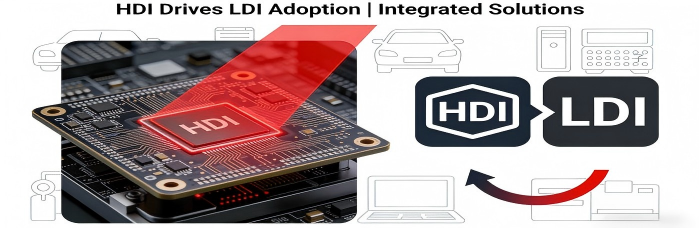
Laser Direct Imaging and traditional photolithography are necessary in modern PCB manufacturing. Photolithography is still very effective and cost effective when it comes to stable and large scale production of conventional boards. LDI offers the accuracy of precision, flexibility and registration demanded by HDI and high-performance designs.
PCBCart integrates both LDI and traditional imaging to match your project needs with precision, speed, and cost efficiency. Our experienced engineering team ensures reliable quality from prototype to mass production. Request a quote today to optimize your next PCB project.


