



Signal integrity is of significant concern in current PCB design, particularly the high-speed and high-frequency circuits. The higher the data rate, the more sensitive the signal to the effects of impedance mismatch, electromagnetic interference (EMI), and crosstalk. These problems may cause reflection, distortion of signals, and even board failure, unless they are carefully designed. Controlled impedance transmission lines are used to overcome this, and the most common structures used by designers are microstrip and stripline. To design reliable high-performance PCBs, it is important to understand the differences between them.
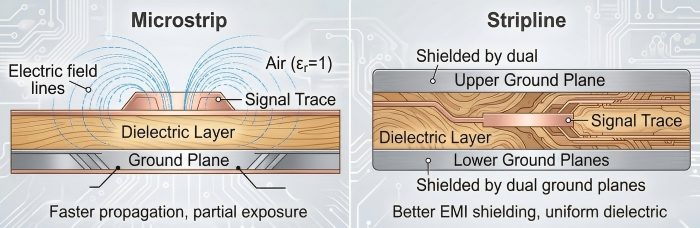
Microstrip and Stripline: Basic Concepts
Microstrip is a routed transmission line on the outermost layer of a PCB, usually with a reference plane directly underneath. It is partly transmitted across the dielectric PCB by its electromagnetic field and partly by air above it. This is a propagation environment with a mixed environment that leads to a lower effective dielectric constant, which enables the signal to travel faster than in a fully enclosed trace.
Stripline, on the other hand, is placed between two ground planes within the PCB. The dielectric material entirely encircles the signal trace, providing a homogeneous electromagnetic environment. Although the signals travel slower in stripline than in microstrip because of the larger effective dielectric constant, the shielding against EMI and crosstalk is better in the enclosed structure.
These physical location dissimilarities directly influence the electrical performance, complexity of fabrication, and applications of each type of transmission line.
Signal Behavior and Impedance Characteristics
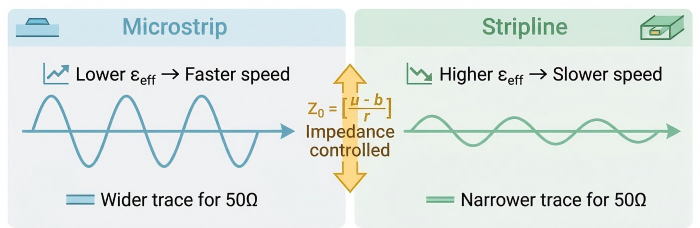
A major design consideration in high-speed PCB design is controlled impedance which guarantees that signals travel without impairments and distortions. Both stripline and microstrip can be controlled in terms of impedance, yet their structural characteristics are different, resulting in different behaviors.
Common substrates such as FR-4 have effective dielectric constant of between 2.5 and 3.5 in microstrip. Since part of electromagnetic field passes through air (a dielectric constant of 1), microstrip signals move more rapidly. The trace width necessary to achieve a target impedance of 50 ohms, etc., is usually a little more general, thus necessitating less fabrication and increasingly less etching tolerance. Microstrip traces are also simple to measure and probe when developing or testing.
Stripline however, has an effective dielectric constant that is very close to that of the dielectric material and is commonly in the range of 4.0-4.5. The fully embedded environment slows down signals, but the impedance is more predictable, as the dielectric around is uniform. The stripline traces are thinner than the microstrip with the same impedance resulting in the necessity to make fabrication very precise. Notwithstanding this, the entire enclosed design ignores variations due to outside influences and enhances uniformity of the signal throughout the board.
Considerations of EMI, Crosstalk, and Noise
The high-speed PCB design challenges include electromagnetic interference and crosstalk. Microstrip traces are more exposed to EMI and radiations because they are on the PCB surface. The signals, when coupled to adjacent traces or external sources, can cause noise on the sensitive circuits. This weakness renders microstrip to be applicable in scenarios in which noise is moderate or where signals are not as critical.
There is a great benefit of stripline here. Having the trace sandwiched between two reference planes shields the trace against external sources of noise. This leads to low radiation and significantly low crosstalk with other traces. This has led to stripline being a popular selection in high-density multilayer boards, high-speed digital circuits, or noise-sensitive RF circuits.
Production and Economical Costs
Microstripes can be made easier and less expensive. It can be manufactured, examined, and assessed more easily since it is situated on the outer parts of the PCB. Prototyping is also easier to modify or debug using microstrip, so it is preferable when cost or frequency is much lower.
The stack-up used in stripline necessitates a multilayer PCB, which is more complicated and expensive to manufacture. Accurate positioning of the ground planes and smaller trace widths require finer tolerances and buried traces are more difficult to probe or rework. In multilayer, high performance boards, however, extra expense is compensated due to better EMI control and signal integrity.
Although these are varied, the fundamentals of PCB fabrication are similar in photoresist coating, imaging and etching. Stripline costs are primarily due to multilayer assembly, and not to etching.
Practical Applications
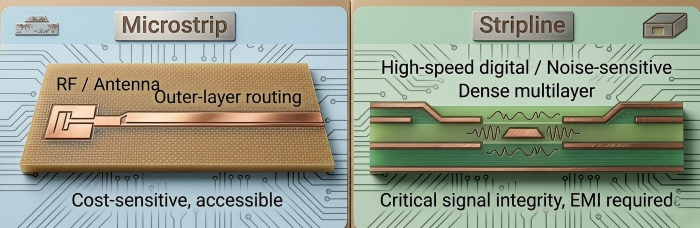
Microstrip: This is most often used in RF parts, antennas, and outer-layer routing where it must be accessible and cost-effective. Useful when dealing with low-frequency, or less noise-sensitive signals.
Stripline: Typically employed when signal paths are critical and high speed, noise-sensitive, or dense multilayer. gives constant impedance and good EMI.
Both may be applied in differential pair structure to increase the performance of high-speed signals, either as edge-coupled or broadside-coupled.
Choosing Between Microstrip and Stripline
Use of microstrip or stripline hinges on a number of factors:
Frequency Range: Microstrip can usually be used at lower frequencies (<5 GHz). Where EMI is critical, stripline is used in high frequency signals.
Noise Sensitivity: Stripline is more suitable in circuits which are particularly sensitive to interference or crosstalk.
Cost Factors: Microstrip lowers the fabrication cost and complexity.
Accessibility: Microstrip traces on the outer-layer are simpler to probe and edit in testing.
Signal Performance: Microstrip has superior propagation, whereas stripline has better signal integrity and EMI protection.
Practically, a mixed system is frequently employed: microstrip is typically used as the outer-layer routing where accessibility and cost reduction are the main concerns, and stripline is applied to important inner-layer signals to ensure similar impedance and minimize noise.
In PCB design, microstrip and stripline complement each other as transmission line designs. Microstrip is simple, less expensive and provides quicker signal transmission, whereas stripline has a better EMI protection, constant impedance, and higher frequencies of operation. Knowledge of their differences can guide the designers to achieve the highest signal integrity, manufacturing efficiency, and general PCB reliability.
To find high-quality PCB solutions, PCBCart, specializing in EMS, PCB assembly, and PCB fabrication, provides end-to-end solutions, including a stack-up planning and impedance control, as well as all the way up to production and assembly. We will make sure that high-speed and high-density PCBs are able to comply with the stringent performance and reliability demands.
Contact PCBCart Today for Reliable PCB Assembly and Fabrication


