



In modern electronics manufacturing, high-density Surface Mount Technology (SMT) assembly enables compact, high-performance products across industries such as automotive, medical, and consumer electronics. Nevertheless, the smaller the size of the component and the more sophisticated the packaging, the higher the risk associated with moisture has become among the most serious threats to product reliability. The management of these risks is through Moisture Sensitivity Level (MSL). Unmishandled absorbed moisture may cause reflow soldering errors, decreased manufacturing yields and post-manufacturing latent failure.
Understanding MSL and Moisture Behavior
Its standard, the IPC/JEDEC J-STD-020, assigns electronic components to categories according to their sensitivity to exposure to moisture. Ratings are MSL 1 (least sensitive) to MSL 6 (most sensitive), and each level requires the allowable exposure time, which is also referred to as floor life, in controlled environmental conditions (usually ≦30℃ and ≦60% relative humidity).
Components that have higher MSL (BGAs, QFNs, and fine-pitch ICs) are especially susceptible, due to their plastic encasing that enables diffusion of moisture to internal structures. This moisture quickly evaporates out when subjected to high temperatures during reflow (typically not much more than 260℃ in lead-free processes), and this causes internal pressure.
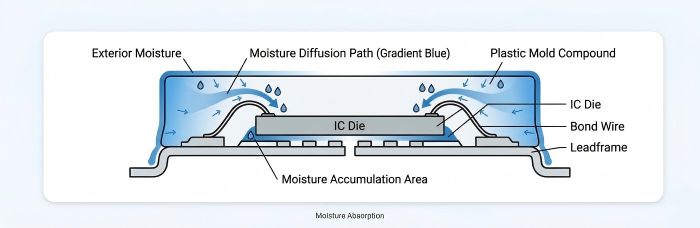
This results in the so-called popcorn effect, capable of resulting in:
Package cracking
Inter-layer delamination
Wire bond damage
Latent failures and internal microfractures
These risks are still greatly magnified in high-density SMT assemblies when thermal stress and proximity are enhanced.
Risks of Moisture in the Lifecycle of Manufacturing
During SMT Assembly
Moisture may take effect in various areas of PCB assembly:
Popcorning and Cracking: Vaporized moisture increases fast when refloating.
Solder Joint Defects: Moisture affects the solder paste behavior resulting in voids or weak joints.
PCB Delamination and Warping: Epoxy substrates cannot retain moisture and swell in heat.
Signal Integrity Problems: Signal propagation in high density circuits can be slowed by moisture, which can raise the conductivity.
Also, solder paste viscosity and stencil printing consistency are also influenced by high humidity, which lowers process stability.
During Rework Processes
Rework creates repetitive thermal cycles, which enhances the probability of damage caused by moisture:
Parts that are above floor life need to be reworked.
Even internal stress can be triggered in the shape of localized heating in case moisture is left.
The mishandling can result in defects that cannot be detected under the eye.
Internal failures may need advanced inspection techniques like X-ray or acoustic inspection.
Post-Assembly and Field Use
Even when it is assembled, the issue of moisture is still a problem:
Corrosion and Oxidation: Metal can be corroded by the combination of moisture and ionic contaminants.
Delamination Growth: Microcracks that are already in place may propagate with time.
Electrical Failures: Leakage currents or short circuit may be caused by moisture.
Long-term risk is further increased in humid or temperature-variable conditions of environmental exposure.
PCB-Level Moisture Challenges
Even printed circuit boards are also susceptible to moisture absorption. FR-4, resin systems, and glass fiber layers have the ability to retain moisture that can:
Lead to thermal cycle internal stress.
Cause interlayer delamination.
Minimize insulation resistance and electric performance.
PCB design, such as the density of via, copper plane structure, or the structure of the layer, affects moisture diffusion. Trapped moisture can also require a long, long time to evaporate in high density boards making removal more difficult and internal breakages more likely.
Key Strategies for Mitigating MSL Risks
Appropriate Storage and Dry Packaging
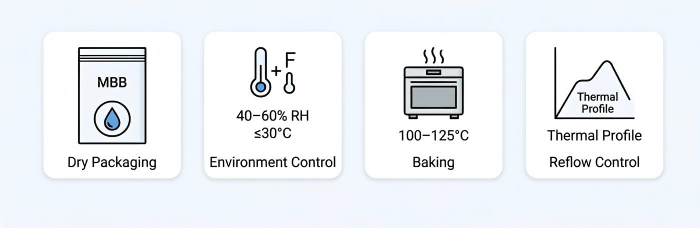
The moisture sensitive devices (MSDs) are to be put in moisture barrier bags (MBBs) with desiccants and humidity indicator cards (HICs).
Best practices include:
Going below 10% RH in storing sensitive parts.
Checking on integrity of packaging at the point of receipt.
Long-term storage under dry conditions with the use of dry cabinets or the nitrogen store.
Strict Floor Life Control
It is important to monitor exposure time on opening MBBs:
Apply barcode or MES systems in real time monitoring.
Use FIFO (First-In, First-Out) inventory control.
Unused components have to be resealed.
Moisture-related defects are majorly caused by failure to control floor life.
Managed Baking Processes
When excessive exposure occurs, the excess moisture is removed by baking:
Common conditions: 100-125℃ 24-48 hours (depending on level of MSL)
Use manufacturer instructions in order to prevent the destruction of parts.
Do not over bake, the solderability or PCB finishes can be ruined.
Baking cannot replace correct storage, but rather it should be a remedial action.
Production Control of the Environment
It is necessary to keep the production environment balanced:
Ideal relative humidity: 40-60% RH
Moisture absorption is increased by high humidity (>60%).
Warm and dry conditions (Low humidity<30%) enhance the risks of electrostatic discharge (ESD).
A controlled environment provides mitigation of moisture as well as ESD.
Process and Reflow Control
Thermal profiling should be taken under good care:
Progressive ramp-up rates eliminate thermal shock.
Localized stress is reduced by uniform heating.
Compareability is made sure with correct oven calibration.
Stable processes play a major role in minimizing failures caused by moisture.
Moisture Resistance Design
The risks can be addressed with the help of design:
Where possible, use the select components with the lower MSL ratings.
PCB Design minimizes moisture retention.
Think of vertical orientation of boards in applications.
Apply proper surface finishes and protective finishes.
An effective solution to environmental moisture can be offered by conformal coatings (e.g. acrylic or silicone).
Advanced Moisture Mitigation Technologies
In the case of high reliability-applications, advanced solutions consist of:
Dry cabinets (<5% RH): Increase the shelf life of components.
Storage systems: Get rid of moisture and oxidation.
Vacuum lamination: Minimise internal holes in PCB fabrication.
Automated tracking systems: Take care of MSL requirements.
These technologies will promote consistency and minimization of human error in complicated manufacturing set-ups.
The Significance of Prevention over Correction
Although moisture exposure can be solved through baking and rework, prevention is the best solution. Over-handling, heating and restoring can add to costs, and cycle time; and can incur extra risks.
Through the adoption of sound moisture control measures early in the design process, i.e. during the choice of materials, storage and assembly, the manufacturers can greatly enhance yield and scrap rate, as well as, long term reliability.
Reducing the risks of Moisture Sensitivity Level (MSL) in high density SMT assembly involves an interdisciplinary approach to the lifecycle. Since component storage and PCB fabrication to assembly, rework, and protection of final products, each of these steps should be strictly regulated to avoid failures caused by moisture.
With the ongoing changes in electronic devices to become even more dense and entangled, the idea of managing the related moisture is no longer a choice, it is a necessity in quality and reliability.
PCBCart provides services for EMS, PCB assembly, and PCB fabrication. We will will assist customers in minimizing MSL risks and delivering the high-quality and consistent results in advanced SMT applications with a strong focus on process control, environmental management, and compliance with industry standards.
Get Reliable PCB Assembly with Expert MSL Risk Control


