



In surface‑mount technology (SMT) assembly, solder paste printing is widely recognized as the largest single source of assembly defects, responsible for more than 60% of quality issues in high‑volume production lines. Among all printing parameters, PCB stencil thickness stands out as one of the most critical yet often underestimated factors. It directly governs the volume of solder paste deposited onto PCB pads, which in turn determines the mechanical strength, electrical conductivity, and long‑term reliability of every solder joint. This article explains the core principles of stencil thickness, how it interacts with aperture design to control solder volume, common defects caused by incorrect thickness, and practical guidelines for selecting the optimal stencil for your PCB assembly project.
What Is PCB Stencil Thickness?
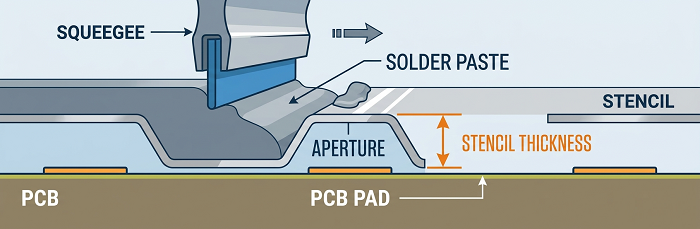
PCB stencil thickness refers to the vertical depth of the precision metal foil—typically high‑grade stainless steel—used in the stencil printing process. The stencil is perforated with precisely machined apertures that align with component pads on the PCB. During printing, a squeegee pushes solder paste through these apertures, leaving a defined volume of paste on each pad. The thickness of the foil acts as a fixed mold for the paste: thicker stencils hold more paste, while thinner stencils limit deposition.
Standard stencil thicknesses in modern SMT assembly range from 0.08 mm (3 mils) to 0.25 mm (10 mils). The choice depends heavily on component package size, pin pitch, pad geometry, and assembly density. For fine‑pitch components, even a 0.02–0.03 mm difference in thickness can lead to dramatic changes in solder volume and defect rates.
How Stencil Thickness Directly Controls Solder Paste Volume
The relationship between stencil thickness and solder volume follows a basic geometric principle:Solder Paste Volume = Aperture Area × Stencil Thickness
This linear relationship means that increasing stencil thickness directly increases the amount of paste transferred. For example, a 1 mm² aperture with a 0.12 mm stencil deposits 0.12 mm³ of paste. Increasing thickness to 0.15 mm raises volume by 25%, to 0.15 mm³. While this change may seem minor, it can easily cause bridging between closely spaced fine‑pitch pads. Conversely, insufficient thickness leads to inadequate paste, weak joints, and open circuits.
To support consistent printing, industry standards define two key ratios that must be balanced with stencil thickness:
Aspect Ratio = Aperture Width ÷ Stencil Thickness
Recommended ≥ 1.5 for reliable paste release
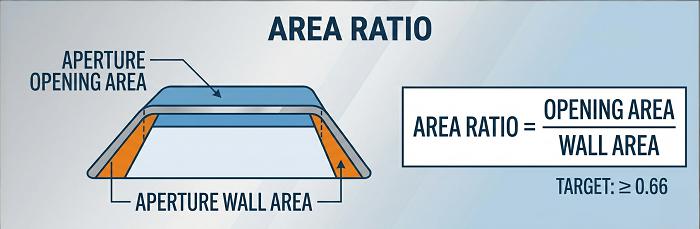
Area Ratio = (Aperture Length × Aperture Width) ÷ [2 × (Length + Width) × Thickness]
Recommended ≥ 0.66 for consistent paste transfer
When these ratios are too low, solder paste adheres to the aperture walls instead of transferring cleanly to the pad, resulting in insufficient or uneven deposits regardless of printing speed or pressure.
Typical Stencil Thickness Values and Recommended Applications
Different components require specific solder volumes to form reliable joints. The table below matches common stencil thicknesses with typical applications to help guide selection:
| Stencil Thickness (mm) | Stencil Thickness (mils) | Typical Solder Volume (mm³/pad) | Ideal Applications |
| 0.10 | 4 | ~0.25–0.35 | Fine‑pitch QFPs, 0201/01005 chips, micro‑BGAs |
| 0.125 | 5 | ~0.35–0.45 | General‑purpose SMT, 0402/0603 components |
| 0.15 | 6 | ~0.45–0.55 | Medium‑pitch ICs, standard connectors |
| 0.175 | 7 | ~0.55–0.65 | Large BGAs, mixed‑technology boards |
| 0.20 | 8 | ~0.65–0.75 | Large passives, power connectors |
| 0.25 | 10 | ~0.75–1.00+ | Power components, through‑hole paste‑in‑hole |
This range covers nearly all standard and high‑density SMT assemblies used in consumer electronics, industrial controls, automotive systems, and telecom devices.
How Incorrect Stencil Thickness Causes Solder Defects
Improper stencil thickness disrupts the delicate balance of solder volume, leading to predictable and costly defects.
Problems Caused by Excessively Thick Stencils
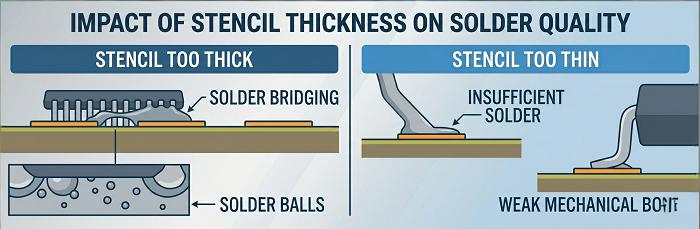
Bridging: Excess paste spreads between adjacent pads during reflow, creating short circuits. This is especially common with fine‑pitch components below 0.5 mm pitch.
Solder Balls: Uncontrolled paste forms small spheres outside the joint area, risking electrical leakage or contamination.
Tombstoning: Uneven paste volume between component terminals causes one side to lift during reflow.
Excessive Voiding: Trapped gasses cannot escape efficiently from large volumes of paste, weakening thermal and mechanical performance.
Problems Caused by Excessively Thin Stencils
Insufficient Solder: Joints lack enough material to fully wet pads and component leads, resulting in high electrical resistance or open circuits.
Weak Mechanical Bonds: Thin joints fail under thermal cycling, vibration, or mechanical stress, leading to early‑life failures.
Poor Wetting: Incomplete coverage reduces metallurgical bonding, creating cold joints or head‑in‑pillow defects in BGAs.
Low Assembly Yield: Inconsistent paste deposition increases rework rates and reduces production efficiency.
Many defects blamed on reflow profile or component quality actually originate from poor stencil thickness selection early in the process.
Optimizing Stencil Thickness for Mixed‑Technology Boards
Modern PCBs often integrate both tiny fine‑pitch ICs and large connectors or power components on the same board. A single fixed thickness rarely satisfies both requirements. In such cases, stepped stencils provide an effective solution.
Stepped stencils feature regions of different thicknesses on the same foil: thinner sections (e.g., 0.10 mm) for fine‑pitch areas to prevent bridging, and thicker sections (e.g., 0.15 mm) for large components to ensure sufficient solder volume. This tailored approach optimizes paste deposition across the entire board, significantly improving yield in complex mixed assemblies.
Additional best practices to complement stencil thickness selection:
Use laser‑cut, electropolished stencils for clean, burr‑free apertures and consistent paste release.
Apply nano‑coating to reduce paste adhesion, especially for small apertures with lower area ratios.
Match solder paste particle size to stencil thickness: Type 4 or 5 pastes for fine‑pitch stencils below 0.12 mm.
Validate printing with solder paste inspection (SPI) to measure volume, height, and alignment in real time.
How to Select the Right Stencil Thickness for Your Project
Follow this practical workflow to choose the optimal stencil thickness:
1. Identify Component Mix: Classify components as fine‑pitch (<0.5 mm pitch), standard, or large/power.
2. Check Pad and Aperture Ratios: Ensure aspect ratio ≥1.5 and area ratio ≥0.66 for all critical apertures.
3. Start with Baseline Thickness: Use 0.125 mm for general SMT, 0.10 mm for fine‑pitch, and 0.15 mm for larger parts.
4. Test and Validate: Print test boards, inspect joints visually and via X‑ray, and adjust thickness as needed.
5. Use Stepped Stencils When Needed: For mixed assemblies, implement multi‑level thickness to balance all regions.
Taking the time to optimize stencil thickness during prototyping prevents costly defects during mass production and improves long‑term product reliability.
Conclusion
Stencil thickness is far more than a minor assembly parameter—it is a foundational control for solder volume, joint quality, and overall production yield. By understanding how thickness interacts with aperture design, area ratios, and component requirements, engineers and manufacturers can drastically reduce printing defects, lower rework costs, and produce more robust electronic assemblies.
Whether you are working on compact consumer devices, high‑reliability automotive systems, or complex industrial equipment, mastering stencil thickness ensures consistent, high‑quality solder joints that stand up to real‑world conditions.
For professional stencil design, precision laser‑cut stencils, stepped stencil solutions, and end‑to‑end PCB assembly support tailored to your specific requirements, PCBCart delivers reliable, high‑quality tools and services to optimize your printing process and assembly results. Backed by advanced manufacturing, strict quality control, and experienced engineering support, PCBCart helps you achieve ideal solder volume control and exceptional PCB assembly performance across prototyping and high‑volume production alike.
Helpful Resources
• Area Ratio Calculation in Solder Paste Stencil Design
• Stencil Design Requirement on QFN Components for Optimal Performance of PCBA
• Common Defects in PCB Assembly and How to Prevent Them
• Elements Influencing SMT Soldering Quality and Improvement Measures
• Advanced PCB Assembly Service


