



In the ever-evolving world of electronic manufacturing, surface-mount technology (SMT) stands as the cornerstone of attaching electronic components to printed circuit boards (PCBs). At the heart of SMT solder paste printing lies the stencil, a critical tool that deposits solder paste onto the PCB to act as both the adhesive and conductive medium for component attachment. Traditional stencils feature a uniform thickness, which works well for PCBs with components that have consistent solder paste requirements. However, as PCB designs become more complex, with a mix of fine-pitch devices, large connectors, and stand-off components all on a single board, the need for precise control over solder paste volume in different areas has given rise to a specialized solution: step stencils.
A step stencil is a precision-engineered metal sheet, almost always crafted from a high-quality stainless steel alloy, that departs from the one-size-fits-all thickness of standard stencils. It starts with a base or primary thickness, and specific regions are intentionally stepped up (thickened) or stepped down (thinned) to tailor the amount of solder paste deposited on corresponding areas of the PCB. The direct correlation between stencil thickness and solder paste deposit height—where a 0.004” thick stencil results in a 0.004” tall solder paste deposit—makes this localized thickness adjustment the key to delivering the exact solder paste volume each component needs for reliable soldering. This ability to create multiple thickness levels on a single stencil addresses the core challenge of modern PCB manufacturing: achieving consistent, defect-free solder joints across a board with diverse component solder requirements.
Core Types of Step Stencils
Step stencils are categorized into three main types, each designed to solve a specific solder paste volume challenge on mixed-component PCBs. Each type leverages localized thickness modification to ensure optimal solder deposition, eliminating common issues like insufficient paste for large components or excess paste that causes bridging and short circuits in fine-pitch areas.
Step-Down Stencils
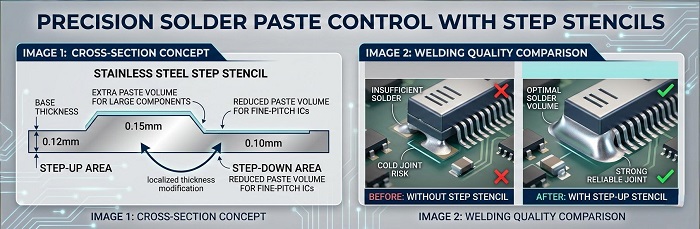
Step-down stencils feature localized thinned sections on an otherwise thicker base stencil, making them ideal for PCBs that combine fine-pitch devices with components requiring a higher volume of solder paste. For example, a 0.006” thick stencil may be perfect for the majority of a board’s components, but printing a 0.016” pitch QFN (Quad Flat No-leads) component with this thickness leads to poor paste release, clogged apertures, and excessive solder that causes short circuits. By stepping down the stencil thickness to 0.004” only in the QFN area, the stencil deposits the precise amount of solder paste needed for the fine-pitch device while maintaining the optimal volume for all other components. In metric terms, this often means etching a stencil from a base 0.12mm down to 0.1mm in specific regions to reduce solder paste volume exactly where required.
Step-Up Stencils
Step-up stencils incorporate thickened sections on a thinner base stencil, designed to deliver extra solder paste to components that need it most, such as those with stand-offs, pin-in-paste requirements, large connectors, headers, or USB ports. These components demand a higher volume of solder to form strong, reliable joints, and a standard thin stencil would leave them with insufficient paste, leading to cold solder joints and mechanical instability. The manufacturing of step-up stencils typically involves chemical etching to thin most of the stencil to a base thickness (e.g., from 0.12mm to 0.1mm) while leaving selected regions at the original thicker dimension, ensuring these high-demand components receive the adequate solder paste volume.
Dual-Process Stencils
A more specialized variant, dual-process stencils, are engineered to apply both solder paste and surface mount adhesive (SMA) on different regions of the same PCB in a single printing process. To prevent cross-contamination and interference between the solder paste and adhesive, these stencils use a stepped design: the steel sheet is thinned in the solder paste application areas, creating physical separation from the laser-drilled through-holes that dispense SMA. This design streamlines the manufacturing process by eliminating the need for separate printing steps for paste and adhesive, boosting productivity while maintaining precision for both materials.
How Step Stencils Are Manufactured
Crafting step stencils is a highly precise process that combines advanced fabrication techniques to create accurate, durable thickness variations while maintaining the sharp, clean apertures essential for consistent solder paste release. The production workflow adheres to strict quality standards, with multiple stages to ensure the final stencil meets the exact specifications of complex PCB designs. Additionally, manufacturers have a choice of core fabrication methods—laser cutting, chemical etching, and high-speed milling—each with its own advantages for creating stepped features.
Standard Production Workflow
All step stencils follow a rigorous multi-step production process to achieve their precise stepped features and apertures:
Surface Preparation: The stainless steel foil is thoroughly cleaned to remove all contaminants, oils, and debris that could compromise the etching or cutting process.
Coating: A uniform layer of photosensitive ink is applied to the foil, which acts as the medium for pattern transfer during the etching stage.
Drying: The photosensitive coating is cured and dried to ensure stability and prevent smudging or damage during subsequent steps.
Exposure: Ultraviolet (UV) light is used to expose the photosensitive ink, creating a permanent pattern that outlines the stepped features and aperture locations on the stencil.
Developing: Unexposed areas of the photosensitive ink are washed away, revealing the exact layout for chemical etching and aperture cutting.
Chemical Etching: Selective etching is performed to create the stepped-up or stepped-down features, removing material from specific regions to achieve the desired thickness variations.
Laser Cutting: High-precision laser technology is used to cut the apertures into the stencil, ensuring sharp edges and exact dimensions for consistent solder paste release.
Finishing & Inspection: The stencil undergoes a final polishing step to remove burrs from aperture walls, enhancing durability and paste release. A comprehensive inspection follows to verify thickness accuracy, aperture dimensions, and overall quality before the stencil is approved for use.
Key Fabrication Techniques
Manufacturers select fabrication techniques based on the project’s precision requirements, volume, and design complexity, with three primary methods dominating step stencil production:
Chemical Etching: This method is fast and cost-effective for creating basic stepped features, involving covering non-etched areas with a protective film and using chemical solutions to thin selected regions. While it is efficient for high-volume production, it offers slightly lower precision compared to other methods and requires careful chemical handling and disposal.
Laser Cutting/Welding: Laser technology delivers exceptional precision for aperture cutting and can also be used to weld additional material to create step-up features—even on existing stencils. It is ideal for fine-pitch and complex designs but has limitations in depth accuracy; as the laser cuts deeper into the stainless steel, it may bend or “walk,” reducing precision for larger thickness variations.
High-Speed Milling: The most precise of the three methods, high-speed CNC milling creates stepped features by removing material with micro-precision cutting tools, maintaining consistent depth and location accuracy even for complex designs (with runout as low as sub-3 microns). It eliminates the thermal degradation of the stainless steel structure associated with laser cutting and requires no costly or messy chemical handling. Milling also features automated part location and surface scanning, which compensates for material thickness variances, ensuring deadly accurate stepped features every time.
Critical Design Considerations for Step Stencils
Designing an effective step stencil requires careful attention to detail to maximize productivity, minimize defects, and ensure seamless integration with SMT printing equipment. Even small design oversights can lead to printing issues like uneven paste deposition, blade wear, or solder shorts, making these considerations essential for a successful stencil design.
Step Location: Squeegee Side vs. Board Side
Stepped features can be placed on either the squeegee side (the side the printing blade passes over) or the board side (the side that contacts the PCB), and each choice has tradeoffs:
Squeegee Side Steps: Placing step-up features on the squeegee side delivers precise solder volume control, as the printing blade directly interacts with the thickened section to deposit more paste. However, constant contact with the stepped edge can cause the printing blade to deform over time, leading to inconsistent printing. Designers must consider print direction and setup to ensure a smooth transition between step levels and minimize blade stress.
Board Side Steps: Step-down features on the board side prevent blade wear and deformation, as the blade only contacts the uniform top surface of the stencil. The downside is that thinned sections can create small gaps between the stencil and the PCB, increasing the risk of solder paste bridging and shorts—especially for tiny 0402 components or 0.2mm pitch fine-pitch devices. Sufficient clearance must be designed around board side steps to maintain proper gasketing for nearby components.
Thickness Control
A fundamental design rule for step stencils is that the total thickness difference between the base stencil and stepped sections should not exceed 0.025mm. This strict limit ensures smooth printing, as larger variations cause the printing blade to skip or apply uneven pressure across the stencil surface. Adhering to this guideline is critical for high-precision PCB assembly, where even minor inconsistencies in solder paste volume can lead to costly defects and rework.
Lead Time and Cost
Step stencils are a custom solution, and their fabrication adds a short lead time (typically one to two extra days) compared to standard stencils, along with a moderate increase in cost due to the additional fabrication steps and precision engineering. For this reason, it is critical to finalize stencil specifications and design upfront—getting the design right the first time eliminates costly rework, delays, and wasted materials in the SMT production process.
Benefits of Step Stencils
Step stencils have become an indispensable tool in modern electronic manufacturing, offering a range of benefits that address the limitations of standard uniform-thickness stencils. Their ability to tailor solder paste volume to individual component needs directly translates to improved production quality, higher productivity, and greater design flexibility for PCB engineers and manufacturers.
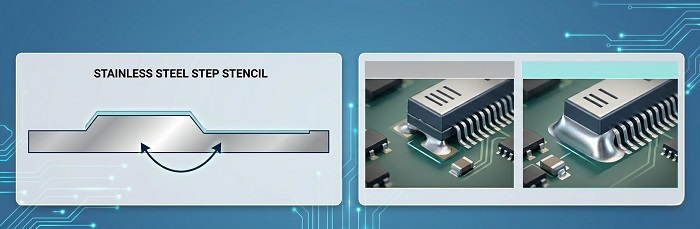
Precision Solder Paste Volume Control: The primary benefit of step stencils is their ability to deliver the exact amount of solder paste each component requires, eliminating the two most common SMT printing defects: insufficient paste (cold joints, poor mechanical strength) and excess paste (bridging, short circuits). This precision ensures reliable solder joints across the entire PCB, even with the most mixed and complex component layouts.
Support for Complex PCB Designs: As electronics shrink and become more powerful, PCBs are packed with a diverse range of components—from ultra-fine-pitch ICs to large power connectors—all on a single board. Step stencils make these complex designs manufacturable, allowing engineers to push the boundaries of miniaturization and functionality without compromising on production quality.
Increased Production Efficiency: Dual-process step stencils streamline production by combining solder paste and adhesive application into a single step, reducing the number of manufacturing operations and saving valuable production time. Even standard step-up/step-down stencils eliminate the need for manual solder touch-ups or rework, which are time-consuming and introduce human error.
Versatility and Customization: Step stencils support multiple thickness levels on a single sheet, and stepped features can be combined with relief areas (e.g., for PCB barcode labels or connectors) to further customize the stencil for a specific PCB design. Fabrication techniques like laser welding even allow for modifications to existing stencils, adding flexibility for design iterations or last-minute changes.
Reduced Overall Defect Rates: By eliminating the root causes of SMT printing defects, step stencils significantly reduce the rate of defective PCBs in production. This not only saves the cost of reworking or scrapping defective boards but also improves overall production yield and shortens time-to-market for electronic products.
Partnering for Perfect Step Stencil Integration in PCB Manufacturing
Mastering the use of step stencils is only one part of creating high-quality, reliable PCBs—equally important is partnering with a PCB manufacturing and assembly expert that understands how to integrate step stencils seamlessly into the entire production process. For businesses seeking precision, reliability, and efficiency in both PCB fabrication and assembly, PCBCart stands as the ideal partner.
Specializing in professional PCB fab and comprehensive PCB assembly services, PCBCart combines deep expertise in SMT manufacturing with state-of-the-art equipment to leverage the full potential of step stencils for complex PCB designs. Whether you require step stencils for fine-pitch consumer electronics, high-power industrial PCBs with large connectors, or dual-process printing for adhesive and solder paste application, PCBCart’s engineering team works closely with clients to design and implement step stencil solutions that align with exact production requirements. From stencil specification and fabrication oversight to precise SMT printing and final assembly, PCBCart delivers end-to-end quality control, ensuring that every PCB benefits from the precision of step stencils to achieve defect-free solder joints and reliable performance. With a focus on customization, speed, and quality, PCBCart is the trusted partner for turning complex PCB designs into high-quality, manufacturable electronic products.
Helpful Resources
• Preorder Checklist for PCB Assembly Projects
• PCB Component Sourcing Guide
• Free DFM Check
• Process Control Measures to Stop Defects in SMT Assembly
• PCBCart Quality Certifications Overview
• Prototype PCB Assembly Services


