



In modern healthcare, medical electronics should perform perfectly under harsh conditions and with longer life cycles. Since implantable chips to diagnostic systems, even the smallest bug can be disastrous. Consequently, the Zero-Defect Strategy has transformed into a quality ideal into an essential necessity, which entails combining design perfection, sophisticated manufacturing, and anticipatory quality control in order to achieve a long-term stability.
The Increasing Complexity of Medical Electronics
Some of the most challenging medical electronic systems include medical implants and monitoring devices, particularly with respect to integrated circuits (ICs). They also need to be reliable and last 10-20 years without failure unlike consumer devices, and are frequently used in biologically hostile conditions.
Complexity is being driven by a number of factors:
Small volumes, large amounts of mix production, which restricts economies of scale
Strict regulatory provisions and approval processes
Limitations on materials and packaging Biocompatibility and sterilization
Combination of connectivity, AI, and cloud-based diagnostics
This combination leaves defect prevention rather than defect detection as the only option in the long term.
Quality Control to Zero-Defect Manufacturing (ZDM)
Old quality systems concentrated on detecting the defects after they had taken place. This reactive approach is no longer adequate in high-reliability industries in the modern era, however. Zero-Defect Manufacturing (ZDM) is a shift to a preventative, predictive and ongoing optimization throughout the product lifecycle.
Contemporary ZDM models usually incorporate:
Planned, assuring, controlling and looping of improvement
Industry 4.0 technologies made real-time data collection possible
Predictive analytics and machine learning to be able to detect potential failure patterns in advance
Reciprocal feedback systems between design, production and field performance information
At its most basic level, ZDM is constructed on an essential engineering principle: quality cannot be ensured into a product it needs to be created and built into it.

Design-Centric Defect Prevention
A Zero-Defect Strategy starts on the first level of development: system and circuit design. Flaws in design in medical electronics are especially hazardous since they frequently spread over into systemic failures which can be difficult to correct once deployed.
The most important design methodologies are:
Failure Mode and Effects Analysis (FMEA): to identify and prevent possible risks in a systematic way and early
Fault-Tolerant Structures: such as redundancy, self-checking, and error correction
Ultra-Low-Power Design Methods: the key to the implantable and battery-powered devices
Biocompatibility and Corrosion Resistance Material Engineering: ensuring the stability over the long term in human environments
Another engineering technique, a shift-left, also enhances defect prevention by shifting validation and risk-identification to the earlier design cycle. This has a major effect on the downstream correction costs and shortening the development cycles with enhanced reliability.
Manufacturing Excellence and Process Control
Even the most solid design may not succeed when there is variability in manufacturing or uncontrolled process variation. This is a major risk in PCB and IC production where microscopic failures may lead to a massive system failure.
Strategies of critical manufacturing involve:
Statistical Process Control (SPC)
SPC is used to maintain production processes consistent, and this is done through constant monitoring of important parameters including temperature, pressure and material consistency. Defect propagation is avoided by early detection of deviations.
In-Process Inspection
In modern manufacturing there are several inspection layers, which are:
Surface-level defect detection Automated Optical Inspection (AOI)
Hidden solder joints X-ray inspection and internal structure
Functional verification by In-Circuit Testing (ICT)
The techniques enable the detection of defects at different levels as opposed to detecting them at the end.
Batch Consistency Management
The PCB manufacturing process is sensitive to any small differences in batches, which may cause extensive reliability problems. The observation in the industry indicates that much of the electronic failure is due to PCB-level defects, and it is necessary to control the process strictly.
Supplier and Material Control
Zero-defect manufacturing heavily depends on a stable supply chain. This includes:
Selection and auditing of suppliers
Complete tracking of parts and materials
Counterfeit prevention mechanisms
Monitoring of supplier performance over long term
High-level Testing and Reliability Checking
Testing in medical electronics is much more than functional verification. It will have to function as years of real-life operation in condensed periods.
Key Validation Methods:
Accelerated Life Testing (ALT)
Very Rapid Stress Screening (VRS)
Environmental testing (thermal, humidity, vibration)
Sterilization compatibility testing
Medical ICs are frequently tested at 100% of wafer and die, as opposed to the consumer electronics which are sampled.
Packaging and Long-term Stability Challenges

The issue of packaging is a decisive factor in the case of long-term reliability and especially with implantable devices.
Major challenges include:
Water intrusion and corrosion
Implantation mechanical stress
Wearing out due to sterilization procedures
Solutions involve:
Hermetic sealing (e.g. titanium enclosures)
Biomimetic coating like parylene
High-technology barrier material and multi-layered encapsulation
The strategies have made the devices able to stay in the tough biological conditions decades.
Predictive Analytics and Data-Driven Quality
The future of Zero-Defect Strategy is closely related to data intelligence. With the help of large-scale production and field data, manufacturers can shift to predictive quality management instead of reactive quality control.
Modern systems utilize:
Historical defect database used to analyse trends
Anomaly detection AI-based inspection systems
Digital twins to model behaviors of products in varying conditions
Predictive maintenance that looks ahead to predict failures
Such models may play an important role in the PCB production, improving the accuracy of the yield prediction, and decreasing the unpredictable downtime or failure in the field.
Cross-Industry Insights: Pharma and Electronics
Other high-reliability sectors, such as pharmaceutical manufacturing, have extensively embraced the zero-defect philosophy, with process control and product safety being as important in that sector.
Shared principles include:
Strict process standardization
Constant control of key parameters
Extensive regulatory adherence measures
Complete traceability of the life cycle of raw materials to end product
Two industries support the main conclusion that it is always more effective, safe and less expensive to avoid defects rather than to fix them once they happen.
Building a Zero-Defect Culture
Technology does not help to ensure zero defects. Coherence in the organization is also significant to attainment of long-term stability.
Cultural elements such as:
Engineering, production and quality assurance end to end accountability
Close collaboration between regulatory compliance and engineering processes
Constant upgrading attitude of all levels of operation
Investment in infrastructure on workforce training and digital transformation
A systematic, systems-oriented engineering strategy-combining risk management, traceability and verification at the earliest phases have been found to notably enhance success rates in the medical device engineering.
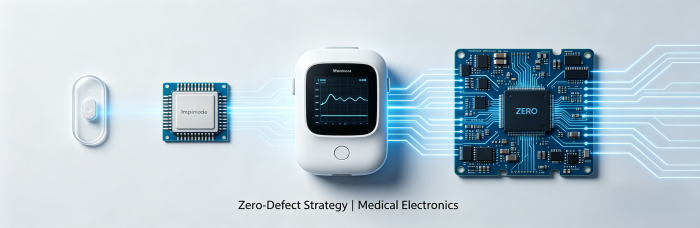
Zero Defect Strategy is important in guaranteeing sustained stability in medical electronics due to the need for reliability in this application field. This approach focuses on avoiding errors at the design, manufacturing, and testing stages in order to ensure consistent performance of devices over time.
PCBCart supports the above needs by offering reliable printed circuit board fabrication and assembly services. With the help of effective material control and tracking, cutting-edge inspection methods like AOI and X-ray inspections, as well as stable batch production processes, PCBCart could enhance reliability and stability in medical electronic devices.
Helpful Resources
• A Guide to Medical PCB Fabrication and Assembly
• Essential Standards for Medical PCB Assembly
• How to Ensure the Quality of PCBs
• Manufacturing Concerns of Electronics Products Used in Extreme Environment


