



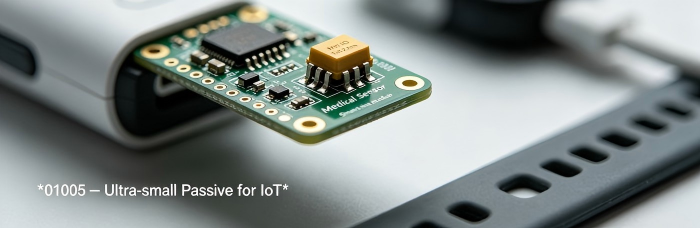
The Internet of Things (IoT) is an emerging technology that has placed a new burden on electronics designers to develop electronics that are smaller, lighter and more energy efficient than ever before. From wearable fitness trackers to small and lightweight medical sensors and smart home modules, modern IoT devices must deliver a great deal of functionality in extremely small form factors. In order to satisfy these requirements, designers are increasingly using ultra small surface mount components such as the 01005 resistors and capacitors (0.4 mm × 0.2 mm). Among the smallest commercially available, these components allow designers to shrink their boards, improve high-frequency performance and make lighter devices. Their very small size poses specific challenges for assembly, however, which require careful planning, specific equipment and strict quality control.
Why 01005 Components Are Vital for Miniature IoT Devices
The 01005 components are at the cutting edge of component miniaturisation, and have several advantages that make them very attractive in IoT applications.
Maximum Space Efficiency: 01005 components fit the small form factor of printed circuit boards (PCBs), an essential requirement in wearables, implantable medical devices and portable sensors.
Better Electrical Performance: Smaller passives ensure lower parasitic inductance and capacitance, which leads to improved signal integrity and high-frequency response. This is particularly critical in RF circuits and for high speed digital designs.
Weight Reduction: Reducing size of components leads to the reduction in weight of devices which is important in portable/handheld applications like battery-powered IoT devices.
Future-proofing Designs: 01005 components can be used to create boards that are ready to accommodate future functionalities, future-proofing designs.
These are important benefits, but 01005 assembly is very difficult. Yield and reliability can be impacted by minor deviations in handling, placement and/or thermal processing.
Core Challenges in 01005 Component Assembly
Holding and Placing Accuracy
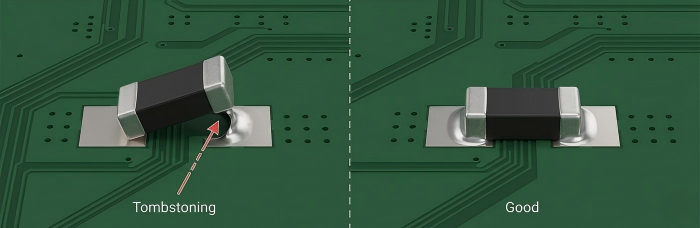
The diminutive size of 01005 components makes them extremely difficult to handle manually. Traditional pick and place machines might not have the accuracy needed to prevent misalignment, tombstoning (when the end of the component lifts off the pad during soldering) or component skipping. Just a few micrometers of deviation can lead to a failed joint.
Solution: Advanced high precision pick and place systems are required. Today, placement accuracy of less than 10 µm, and vision-guided placement and alignment is used to reliably place ultra-small components. Micro-grippers or vacuum-assisted tools ensure gentle and secure handling of components to minimize damage risks when placing components.
Solder Paste Printing Accuracy
To achieve high-quality, reliable solder joints, it is very important to be able to deposit solder paste accurately when soldering 01005 components. Too much solder paste creates the possibility of bridging between pads and too little solder paste can result in weak soldered joints or open circuits. Fine resolution is hard to maintain with traditional stencils and solder pastes.
Solution: Ultra-fine apertures laser-cut stencils are recommended for precise solder paste deposition. In addition, micro-dispensing systems can be used for localized paste application in high-density areas. The use of solder pastes with high definition requirement, low slump and uniform viscosity ensures the reliability of the joints during the entire reflow process.
Reflow Profiling Challenges
The thermal mass of 01005 components is very low, making them susceptible to high and low rates of heating and cooling during reflow soldering. Solder voids, cold joints or component cracking can occur when the thermal profile is not correct.
Solution: It is necessary to use carefully planned reflow profiles with fast, yet controlled, ramp up, soak and cooling rates. The thermal profiling is done by the sensors placed on the PCB and the sample components, which will make sure that each component will reach the right temperature without over heating. When there are various profiles in a single board, it can create differential thermal stresses, potentially reducing solder integrity.
Inspection and Quality Assurance
The size of the 01005 components makes it impossible to effectively inspect them by a human operator. Some defects including tombstoning, misalignment, solder bridging or inadequate wetting, can be ignored using a normal inspection device.
Solutions: Automated optical inspection (AOI) systems and X-ray inspection (AXI) are key to the identification of placement and soldering defects. AXI is able to detect hidden or bottom mounted joints, AOI is able to detect misaligned or missing components, both achieve full solder coverage. By combining both AOI and AXI, rework and first pass yield can be reduced, which is vital in high volume production of IoT devices.
Environmental and Handling Sensitivity
Moisture absorption, electrostatic discharge (ESD) and mechanical stress are more likely to impact small components. Improper handling, storage, or board handling during assembly can lead to cracked components, delamination, or premature failure, impacting long-term device reliability.
Solution: Apply high level of ESD protection during assembly, use moisture barrier packaging, and store components in controlled environments with controlled humidity. Thermal relief and stress reduction features in the design of PCBs that surround ultra-small passives create greater reliability during operation.
Best Practices for Reliable 01005 Assembly
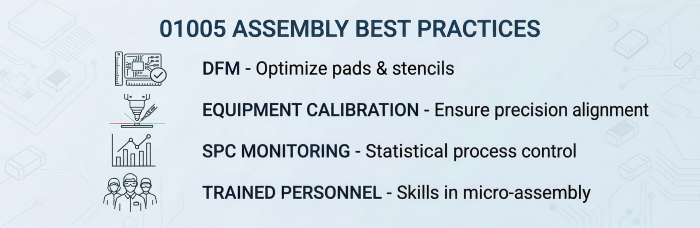
For 01005 assembly to meet high quality standards in every miniature IoT device produced, the following best practices should be followed:
Design for Manufacturability: Optimize pad sizes, solder mask openings and spacing for inspection access. Reduce stress on components during operation of the board.
Ultra-Small Parts Handling: Make sure pick-and-place machines, reflow ovens and inspection systems can reliably take care of ultra-small parts.
Process Monitoring: Monitor solder paste deposition, reflow profile and environmental conditions using statistical process control. The equipment is calibrated regularly in order to ensure consistency.
Advanced Inspection: Use AOI and AXI to detect defects. Adapt assembly process using autofeedback loops.
Trained Personnel: The skill of trained Personnel can minimize human error and enhance the quality of the assembly.
The integration of 01005 components into miniaturized IoT devices helps engineers push the limits of compact design, performance and low weight. Although there are some challenges that come with assembly (like handling and solder paste accuracy, reflow profiling, and thorough inspection), they can be overcome through careful design, special equipment, and disciplined process control.
With the size of the IoT devices shrinking whilst their functionality and complexity is growing, being able to assemble ultra-small components such as passives is crucial to manufacturing reliable and quality products. The following are some of the challenges faced in PCB assembly that can be addressed by professional PCB assembly services. From design to fabrication and assembly, PCBCart provides a wide range of solutions to help engineers convert complex designs into high-performance, reliable IoT products.
Helpful Resources
• PCB Design Tips to Better Take Advantage of PCBCart's Assembly Capabilities And Save Cost
• Elements Influencing SMT Soldering Quality and Improvement Measures
• SMT Assembly Procedure and Its Development Trend
• HDI PCB Fabrication


