



For medical electronics manufacturers, the cost of an escape defect is more than just scrap, rework, or warranty claims; it includes patient safety and regulatory risk. Patients' monitors, ventilator control boards, and diagnostic devices can have an inadequate solder joint, a lifted lead, or a poor connection that passes functional testing, but it is not discovered until the product is in service. In the case of manufacturers that have to deal with high reliability medical PCBAs, each inspection has to go beyond discovering defects and prevent them from happening.
The need for this has caused the industry to move away from 2D inspection systems to more sophisticated 3D SPI (Solder Paste Inspection) and 3D AOI (Automated Optical Inspection). These technologies, working together, deliver dimensional measurement, process feedback, and traceable quality data that allow the detection of much more defects and control of the process during the SMT assembly process.
The Limitations of Traditional 2D Inspection
In the conventional 2D SPI and AOI systems, the assemblies are mainly judged by their image contrast, surface appearance and their pattern recognition. They are useful for a wide range of applications, but are becoming less and less applicable as PCBAs are made with smaller components, tighter process windows and finer pitches.
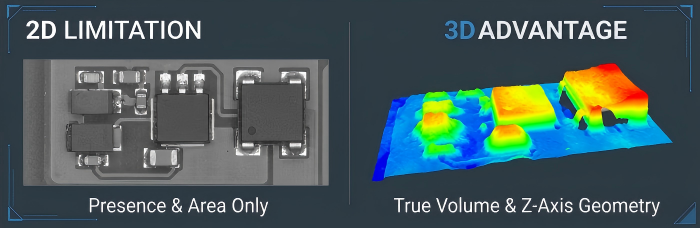
Three types of defects are shown as examples of the problems associated with 2D visual inspection.
Solder Volume Deficiencies
A 2D SPI system can verify if solder paste is present in the appropriate area and if it is or is not in the correct position. It can't directly measure the height of the deposits or volume of deposits.
This means that a paste deposit in a 2D image may look OK but may be undersized to create a good solder joint during reflow. The defect can be created during the printing process, but might not be detected until later in the manufacturing process when rework is more expensive and root cause analysis is more challenging.
Cold Joints and Incomplete Wetting
Another difficulty may be due to cold joints or poor coalescence of solder joints. In a large number of instances, these joints do not meet the metallurgical bonding requirement, but they are still visually pleasing.
Due to the fact that external appearance is assessed in 2D AOI and not three-dimensional geometry, it can be difficult to determine such conditions with only image features. These weaknesses can be manifested as intermittent or permanent failures under thermal cycling, vibration, and sterilisation stress and other environmental stresses that are common in medical products.
Coplanarity Defects and Tombstoning
A third restriction is the defects along the Z axis. These leads may be lifted off the board, a component may have non-coplanar legs, and a tombstoned chip resistor may seem fine from above, but actually have a high vertical difference.
These conditions may not be reliably identified with a 2D inspection system, unless the height is measured directly. However, these defects can have a deleterious effect on solder joint integrity and reliability.
3D SPI: Preventing Defects at the Source
The major advantage of 3D SPI is that it measures the volume of solder paste deposits in addition to conducting a 2D analysis.
The system creates a 3D model of each solder paste deposit as it is printed, via structured-light profilometry. The measured parameters include volume, height, area, positional offset and shape of the deposit and are compared to defined process limits.
This will give much more complete information about the quality of the print. 3D SPI will not only verify the presence of paste on a pad, it will also verify whether the right amount of material has been deposited to create an acceptable solder joint after reflow.
This added information is particularly important for medical assemblies that frequently feature fine pitch packages, miniature passive components and dense layouts.
Closed-Loop Process Control
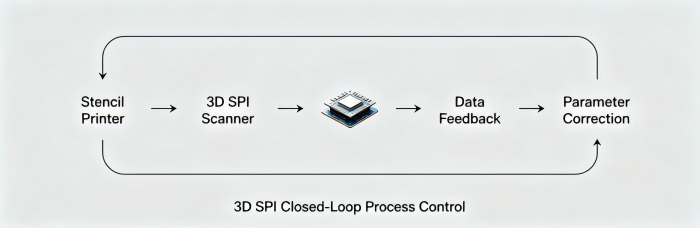
Modern manufacturers, 3-D SPI systems offer advantages over defect detection. The inspection data can be directly transferred to the stencil printer, thus forming a closed-loop process control system.
The system can detect process drift in the volume of paste, its alignment and print quality, before it starts to cause a large number of defects. Corrective measures can range from print alignment correction, print parameters, and/or printer settings, depending on the platform configuration.
This closed loop process makes SPI a process control tool instead of just a quality check. The system prevents the creation of defects, rather than identifying them after they have happened.
Controlling the soldering of the solder paste at the printing stage is one of the factors that can significantly affect downstream soldering quality and hence the yield and reliability of SMT.
3D AOI: Verifying Assembly Quality After Reflow
3D SPI is used to prevent defects before reflow, 3D AOI is used to ensure the quality of the completed assembly after soldering.
While the traditional 2D AOI measures the intensity and appearance of an image, 3D AOI measures the height (or z values) of an image using a laser to build a topographic map of the assembled board. Each inspected feature has a measurable z-axis value, allowing for dimensional inspection instead of just visual.
This will enable the system to assess real-world joint geometry and component placement with much greater precision.
Detection of Insufficient Solder
The capability of 3D AOI can detect unacceptable solder conditions that can be seen as acceptable in 2D image. By measuring solder joint height and shape, 3D AOI can detect the insufficient solder conditions that may appear as acceptable in a conventional 2D image.
The system does not only identify the surface appearance of the solder joint, but also uses the geometry of the solder joint and defined acceptance criteria to also improve the detection of underfilled or poorly formed connections.
Lifted Lead Detection
3D AOI directly measures the height difference between component leads and corresponding PCB pads, for gull-wing packages and other components.
Lifted leads that may not be detected during traditional inspection can be more easily identified since the measurement is based on actual geometry and not image interpretation.
Tombstone Detection
The system compares the height of the differences between component terminations for chip components. This enables a complete and partial tombstone defect to be spotted, even when it looks visually fine from a "top down" view.
Solder Bridge Detection
Three-dimensional height mapping also helps to detect solder bridges between neighboring conductors. This is especially useful for fine-pitch assemblies in which lighting conditions and surface reflections may make it difficult for conventional 2D inspection to be performed.
Although 3D AOI offers great benefit in the geometric aspect of defect detection, there are some characteristics of the metal that cannot be completely assessed by optical inspection that may require other verification techniques for highly critical applications.
Inspection Data as Traceable Quality Evidence
When FDA, ISO 13485, and other medical quality-system requirements are in place, inspection results must be objective and retrievable evidence that products are of good quality.
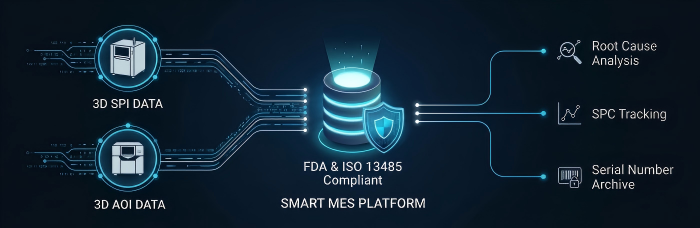
Modern 3D inspection systems provide detailed measurement data for every board such as dimensional data, inspection data and traceability data associated to unique serial numbers.
These records, when connected to a MES platform, provide a full manufacturing history that facilitates regulatory compliance, root cause analysis, corrective action and long-term tracking of products.
Creating a Unified Defect Prevention System
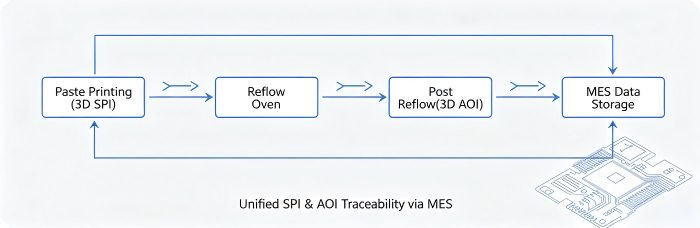
The best results are obtained when 3D SPI and 3D AOI are put together as a single inspection system instead of as individual inspection stations.
SPI data is used for monitoring process variation prior to reflow and AOI data is used for verifying the quality of final assembly after the soldering process. If both datasets are made available to a manufacturer via a common MES environment, then the manufacturer has visibility in the complete SMT process.
Both trends noticed during paste inspection and repeated AOI results may be linked to downstream assembly defects, and repeated AOI results can help point to root cause issues concerning printing, stencil condition, placement accuracy, or reflow performance.
This continuous feedback process enhances the understanding of the process, enable quicker corrective action and minimise defect escapes and (unnecessary) false calls.
Process Discipline Remains Essential
No amount of sophisticated inspection equipment can ensure quality alone! Inspection technology has to work in a structured quality framework for medical electronics manufacturing.
Three aspects are key:
PFMEA (Process Failure Mode and Effects Analysis) to coordinate the inspection strategy with product risk and critical failure modes.
SPC (Statistical Process Control) to track and detect trends before defects can be created.
FAI (First Article Inspection) to establish validated process baselines before full-scale production begins.
These practices place inspection results into use as process control and not just as a record of pass/fail.
For medical PCBAs, inspection is much more than a final quality gate. It is a key component of the manufacturing quality system. PCBCart inspection products, such as 3D SPI with closed-loop printer feedback and post-reflow 3D AOI, are not optional add-on products or program-level options — they are the built-in infrastructure for all PCBA programs, built into our Smart MES platform where they provide full lot inspection traceability and laser-marked serial number archiving.
Our engineering team collaborates with medical hardware R&D and quality teams for DFM review up to production qualification; setting up SPI accept windows and AOI defect models for every program based on different component mix, joint types and end-use risk profile. We're happy to discuss your program with you if you need an EMS partner to provide you with evidence of the solder joints, board-level closed-loop process data and MES-archived inspection records for each and every assembly; and if you have the process discipline to support it.


