



Blood analyzers and diagnostic hardware rely on highly stable, low-noise PCBA for precision electrochemical and optical sensing. Even minor solder joint anomalies—especially voids under BGA/QFN devices—can degrade electrical connectivity, impair thermal dissipation, and trigger premature field failures. Lead-free SMT (predominantly SAC305, Sn96.5/Ag3/Cu0.5) exacerbates voiding due to higher reflow temperatures (240°C–250°C), elevated solder surface tension, and aggressive flux volatilization. As an IATF 16949-certified EMS provider, we apply automotive-grade zero-defect protocols to medical instrumentation, delivering BGA void rates consistently below 10% via targeted stencil optimization, precision reflow profiling, and rigorous X-ray inspection.
The Physics of Void Formation in Lead-Free SMT
Voiding in lead-free solder joints is driven by gas entrapment during reflow, with three core gas sources:
Flux Volatilization: Solder paste (≈50% flux by volume) releases CO₂, H₂O, and organic vapors at 150°C–220°C.
Moisture Outgassing: PCB substrates (FR-4) and components absorb moisture; at >200°C, water vapor expands violently.
Oxide Reduction: Flux reacts with Cu/OSP/ENIG surfaces, generating micro-gases.
Critical Lead-Free Aggravators
Higher Surface Tension: SAC305 (≈4.60×10⁻³ N/260°C) is 15% higher than Sn-Pb, impeding bubble buoyancy and escape.
Narrow Thermal Window: SAC305 liquidus = 217°C; peak reflow = 235°C–245°C (±5°C tolerance), leaving minimal margin for degassing.
Prolonged High Heat: Extended time above liquidus (TAL = 60–90s) increases flux decomposition and gas generation.
For blood analyzers, BGA/QFN voids >10% risk electrical resistance drift (impacting low-level sensor signals) and thermal hotspots (undermining LED/laser stability).
Strategy 1: Stencil Aperture Optimization for Void Reduction
Stencil design directly controls solder volume and gas escape pathways—critical for fine-pitch BGAs (0.4–0.8mm pitch) in diagnostic PCBA. Our optimized stencil rules:
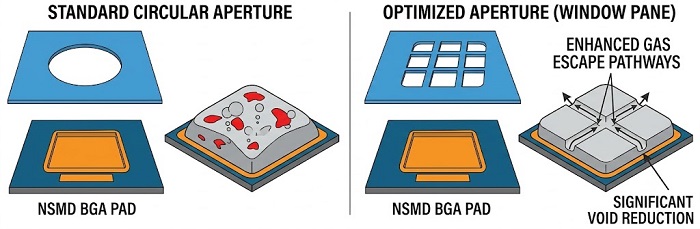
1. Aperture Geometry (NSMD Pads Preferred)
Standard Circular → Window Pane / Home Plate: Split large circular apertures into 4 smaller squares (window pane) or rounded rectangles (home plate). Reduces solder volume by 20–30% and creates gas escape channels.
Aperture Size: 80–90% of BGA pad diameter (NSMD pads; solder mask opening > Cu pad by 0.05–0.1mm).
2. Stencil Thickness & Material
Thickness: 100–120μm for 0.4–0.8mm pitch BGAs (balances deposit volume and release).
Material: Electropolished stainless steel (superior paste release, reduced micro-voids).
3. Solder Paste Selection
Low-Void SAC305 Paste: Flux with ≤8% volatiles (reduced gas generation) and high-temperature stability (245°C compatible).
Activity Level: Medium-High (ROM1/ROL0) for medical-grade finishes (ENIG/ImAg/OSP).
Strategy 2: Precision Lead-Free Reflow Profiling
Reflow profile is the single most impactful process lever for void control. We deploy a Ramp-Soak-Spike (RSS) profile optimized for SAC305 and medical PCBA thermal mass:
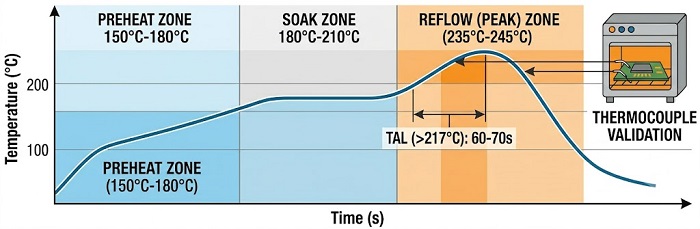
1. Preheat Zone (150°C–180°C, 60–90s)
Ramp Rate: 1.0–1.5°C/s (≤2°C/s to avoid rapid flux boiling).
Purpose: Uniformly heat assembly, remove bulk moisture, and activate flux gradually. Critical for blood analyzer boards with dense BGA/QFN arrays and mixed thermal masses.
2. Soak Zone (180°C–210°C, 60–90s)
Temperature: 190°C ±5°C (below SAC305 liquidus, above flux activation threshold).
Purpose: Complete flux activation, dissolve oxides, and fully outgas volatiles before solder melting. Extended soak (90s) reduces voids by 30–40% in high-thermal-mass diagnostic boards.
3. Reflow (Peak) Zone (235°C–245°C, 10–20s)
Peak Temperature: 240°C ±5°C (SAC305 optimal; ≤250°C to prevent component degradation).
TAL (Time Above Liquidus, >217°C): 60–70s (balances solder wetting and gas escape).
Atmosphere: Nitrogen (O₂ ≤500ppm) for medical PCBA—improves wetting by 20% and reduces voids by 50%.
4. Cooling Zone (217°C → 75°C, 2.0–3.0°C/s)
Controlled Ramp: Avoid rapid cooling (>4°C/s) which traps residual gas.
Purpose: Solidify solder uniformly, minimize thermal stress, and prevent micro-cracks.
Profile Validation
Thermocouple Placement: Directly under BGA balls and at board thermal extremes (critical for blood analyzer PCBA with large BGAs).
First-Article X-Ray: Verify void distribution and adjust profile before mass production.
Strategy 3: Off-Line X-Ray Inspection & 10% Void Rate Target
For medical diagnostic hardware, we enforce stricter criteria than IPC-A-610 Class 3 (25% max voids):
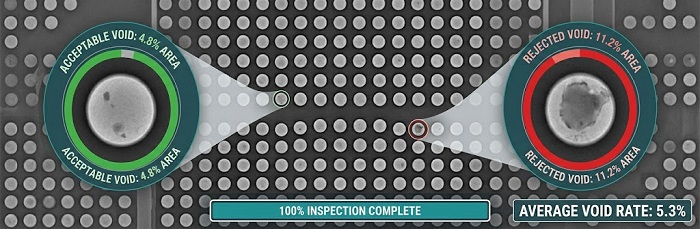
1. Inspection Setup
Equipment: Off-line 2D/3D X-Ray (5μm resolution) with automated void analysis software.
Coverage: 100% inspection of all BGA/QFN devices (critical for blood analyzers’ precision circuitry).
2. Acceptance Criteria (Medical Grade)
Max Void Area: ≤10% of individual BGA ball area.
No Central Voids: Voids excluded from central 50% of BGA ball (thermal/mechanical stress hotspot).
Average Void Rate: ≤5% across all balls in a BGA (statistical process control).
3. Closed-Loop Corrective Action
Void Rate 5–10%: Adjust reflow soak time +10s or peak temperature +5°C.
Void Rate >10%: Re-evaluate stencil design, solder paste, or PCB surface finish.
Results & Reliability Validation
For blood analyzer PCBA (0.4mm pitch BGAs, ENIG finish), our integrated process delivers:
BGA Void Rate: Consistently 3–8% (well below 10% target).
Void Distribution: 95% of voids <5% area, no central voids.
Reliability: 1000× temperature cycles (-40°C → 125°C) with no electrical failures or resistance drift.
Compliance: IPC-A-610 Class 3 compliant, with full MES traceability (component lot/serial number).
Conclusion
Lead-free SMT voiding in blood analyzers and diagnostic hardware is solvable via stencil optimization, precision reflow profiling, and rigorous X-ray inspection. Our automotive-derived zero-defect protocols translate seamlessly to medical instrumentation, ensuring solder joint integrity, electrical stability, and long-term reliability. By targeting ≤10% BGA voids (stricter than industry standards), we mitigate risks to precision sensing and thermal performance—critical for life-critical diagnostic devices.
Helpful Resources
• Effective Measures for Quality Control on Ball Grid Array BGA Solder Joints
• Solder Ball Issues of BGA Components and How to Avoid Them
• How to Solve Solder Joint Problems in SMT Processing?
• Application of Surface Mount Technology SMT on Ball Grid Array BGA Packages


