



The contemporary electronic systems require high levels of power density, minimized size and extended reliability. These necessities render thermal management an important issue in PCB design. The PCBs are metal based with the aluminum PCB being a major variant of metal core PCB (MCPCB) which is designed to effectively dissipate heat and retain its structural integrity in harsh conditions.
Understanding Aluminum PCBs
The main difference between aluminum PCBs and traditional FR-4 boards is their base material. They do not use fiberglass instead they employ an aluminum substrate which improves heat transfer.
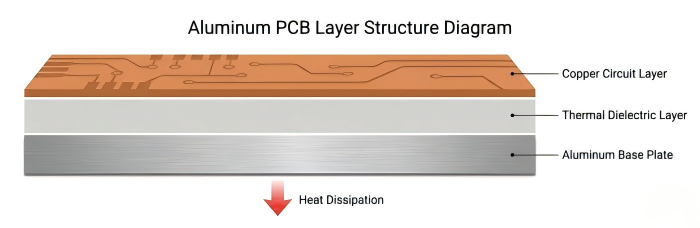
An average aluminum PCB framework comprises:
Copper Circuit Layer - Transfers electrical signals and current.
Thermal Dielectric Layer - Insulates, conducts heat.
Aluminum Base Plate - Provides as a heat sink and mechanical support system.
This layered design facilitates a healthy circulation of heat to both the elements and the surrounding, and it minimises chances of overheating.
Why Aluminum PCBs Matter
Efficient Heat Management
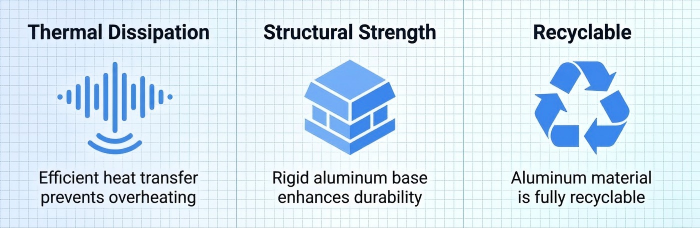
Aluminum has a good thermal conductivity that enables it to dissipate heat fast, and hence it should be used in high power circuits.
Structural Reliability
The base is made out of metal to enhance resistance to vibration, mechanical stress and thermal cycling.
Dimensional Stability
In response to changes in temperature, aluminum retains its shape, which minimizes the risks of failure compared to the traditional materials.
Sustainability
Aluminum is environment friendly as it can be recycled and promotes environmentally friendly manufacturing.
Limitations
Aluminum PCBs are not universal solutions despite these benefits. They have increased complexity of production and are normally used in applications that are heat-intensive.
Basic Materials and Their Functions
Aluminum Alloys (e.g., 5052, 6061): Strong, corrosion-resistant and thermally efficient.
Dielectric Materials: Designed to be insulating and thermal conductive.
Copper Foil: Decodes the current-carrying capacity and accuracy of the circuit.
The choice of materials has a direct impact on the performance and manufacturability.
Step-by-Step Aluminum PCB Manufaturing Process
Design and Thermal Planning
It starts with a circuit design in which the engineers should not only look at the electrical functionality of the circuit but also heat flow paths. High-power components need to be laid out in the right place, and trace widths should be optimized.
Substrate Preparation
Treatment of aluminum sheets involves cutting and pre-treatment of aluminum sheets by cleaning and treating surfaces. This is done to provide good adhesion between the metal base and the layers applied on top of it. Automated handling systems are often used to prevent scratches or contamination during transport.
Circuit Pattern Transfer
Photoresist is deposited on the copper surface. The circuit layout of interest is transferred to the board using UV exposure using a patterned film. Areas to be etched are uncovered and the board is ready.
Chemical Etching
The board is then placed in an ethering solution which erases all the undesirable traces of copper, leaving the desired circuit traces. Control is very important, particularly when the copper layers are thicker to be used in high-current applications.
Lamination and Layer Bonding
Heat and pressure bond the dielectric layer and copper foil to the aluminum base. This forms a durable composite framework that has an effective thermal conductor.
In the case of multilayer, further layers of dielectric and conductive layers are piled up and laminated respectively.
Drilling and Hole Processing
Mounting holes and vias are created by mechanical or CNC drilling. In more sophisticated designs, special methods have been employed of electrically isolating plated through-holes of the conductive aluminum base.
Metallization and Plating
Circuit paths are reinforced with copper plating and it allows electrical connection between layers when necessary. This process is more difficult than in the normal PCB because of the metal core.
Solder Mask Application
To stop oxidation and bridging solder, a protective solder mask is used. White solder mask is used in lighting applications where it is preferred due to its reflective characteristics.
Silkscreen Printing
The labels of components, polarity and identification information are printed on the board surface to help assemble and maintain the unit.
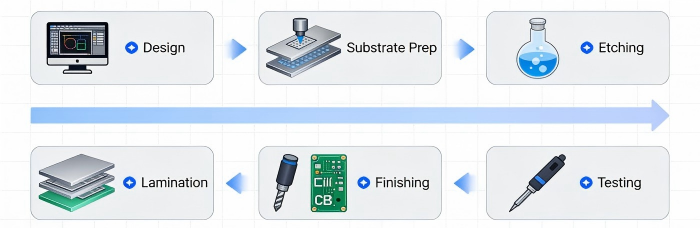
Surface Finishing
Surface finishes increase the solderability and shield exposed copper. Common options include:
ENIG
OSP
Lead-free HASL
Immersion silver or tin
The decision will be based on the performance demands and the environmental factors.
Routing and Depanelization
Routing, punching or V-cut are used to isolate boards off production panels. Edge finishing is done to remove burrs in order to make them safe to handle.
Testing and Quality Assurance
Final inspection includes:
Testing electrical continuity and insulation.
Automated optical inspection (AOI)
Check of functional and thermal performance.
Other stress or thermal cycle tests can be performed in high-reliability applications.
Manufacturing Types: Simple to complex
Single-Layer Aluminum PCBs
One conductive layer
Cost-effective and common in LED modules
Streamlined manufacturing process
Double-Sided Aluminum PCBs
Circuits on both sides
Greater design flexibility
Needs to be more accurately aligned and processed
Multilayer Aluminum PCBs
Several conductive and insulating layers
Multifaceted fabrication with lamination
Frequently used together with other materials to create advanced designs
Comparison to Traditional PCBs
Aluminum PCBs have:
Improved thermal conductivity
Increased mechanical stability
Increased dependability under high temperature
They also, however, include increased cost of manufacture and less applicable to low power consumer electronics.
Design Best Practices
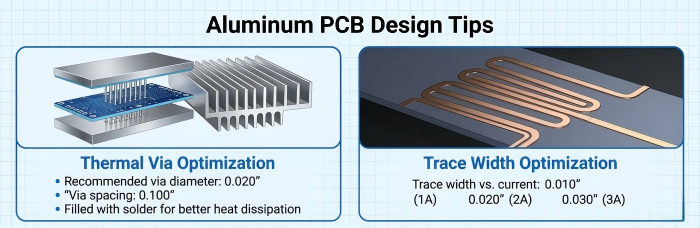
Provide direct thermal vias between components and aluminum base.
Choose high thermal material dielectrics.
Adjust trace size to high current load.
Reduce thermal stress due to the difference in material expansion.
A balanced performance against the cost of production.
Typical Applications
Applications of aluminum PCBs include:
LED lighting systems
Power modules and automotive electronics
Power supply and converters of industry
Aerospace and high-quality equipment
The ability of the board to control heat and work in severe conditions is most advantageous to these applications.
Aluminum PCB manufacturing is a specialized but crucial area of contemporary electronics manufacturing. These PCBs provide a combination of thermal efficiency and mechanical strength, which allows them to be used in high-power and high-temperature applications.
Starting with the preparation of materials and testing to its final stage, all the steps are to be thoroughly regulated to meet the requirements of quality and consistency. Aluminum PCBs are keeping an important role in the development of electronic designs, whether in the form of simple LED boards, or other multilayer systems.
In the case of companies that require optimization of production and wanted to be reliable, it is essential to collaborate with a reputable supplier. With its experience in EMS, PCB assembly, and PCB fabrication, PCBCart provides end-to-end solutions that facilitate the process of converting high-performance aluminum PCB projects between the idea and reality.
Partner with PCBCart for Reliable Aluminum PCB Assembly


