



Surface Mount Technology (SMT) has changed the world of PCB assembly by making it possible to place small components very precisely. The core of this process is the SMT stencil, which is a fine sheet of metal, through which solder paste is deposited on the pads of a printed circuit board (PCB). The selection of the appropriate stencil will be essential in determining the precision of soldering, fewer defects, and efficient production. In this guide, you will find all the information about the choice of the right SMT stencil according to your PCB assembly requirements.
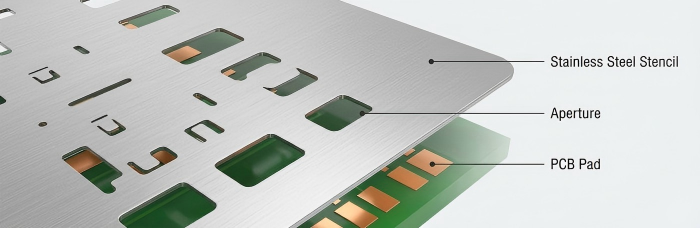
What is an SMT Stencil?
The SMT stencil is usually a metal sheet, usually stainless steel that has been laser-cut with holes that fit the pads on a PCB. These openings enable solder paste to flow into the PCB in accurate amounts so that surface-mount components are placed correctly in the reflow soldering. With stencils, there is reduced solder bridging, insufficient solder, and other assembly errors that this is particularly crucial with fine-pitch components.
Besides being made of stainless steel, there are also nickel stencils and copper stencils. The most used material is stainless steel because it is durable and resistant to corrosion and long life. Copper is not as widely used, but it has superior thermal and electrical conductivity, and these features may be applied in specialized applications.
Types of SMT Stencils
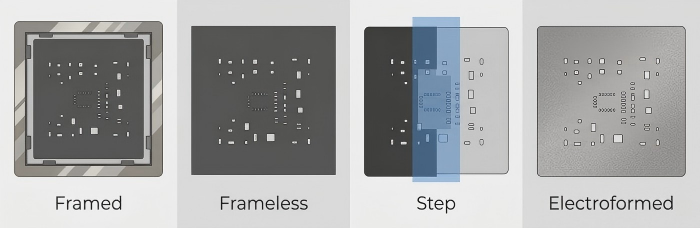
The types of stencils are important to understand, as each has its benefits based on the volume of production, PCB complexity as well as the size of components:
Framed SMT Stencils
Framed stencils are mounted on a metal frame, so they are stable during printing and can align with the PCB well. They can be used in high production volumes as the frame prevents stretching errors and can be used repeatedly. Framed stencils are however heavier, take up more storage space and can be more expensive to ship.
Frameless SMT Stencils
Frameless stencils lack the surrounding frame, and thus are lighter and more cost-effective and can be used on small-batches or prototyping work. They are mounted by hand to a temporary frame when in use, which gives it flexibility to a wide variety of PCB size and also lowers storage and shipping requirements.
Step Stencils
Step stencils are made on boards whose components need different quantities of solder paste. Step stencils, unlike standard stencils, can be used with a wide variety of stencil thicknesses (in particular regions), allowing the stencil volume of solder paste to be controlled precisely to a specific component size or pitch.
Electroformed Stencils
Electroformed stencils are a common type of nickel made stencil, being very durable and precise making them a good choice with very fine-pitch components or very high component quantity. They offer high solder paste release, and they can serve through several production cycles with no loss of accuracy.
Factors to Consider When Choosing an SMT Stencil
Selecting the right stencil involves evaluating multiple factors related to your PCB design, production requirements, and component characteristics.
Stencil Thickness
The solder paste deposited on the PCB depends on the thickness of the stencil. The typical thickness is 0.10 mm to 0.30 mm in accordance with the sizes of components and the distance between pins:
Thin stencils (0.10-0.12 mm): Suitable for fine-pitch components (<0.5 mm).
Medium stencils (0.15-0.18 mm): For general-purpose components having a standard distance between components.
Thick stencil (0.20-0.30 mm): Ideally used with large pads or components which demand heavier solder.
An intermediate thickness along with aperture adjustments or step stencil can be used to supply the best solution to boards having a combination of fine and coarse-pitch components.
Aperture Design
The volume of solder paste and quality of the placement is influenced by the stencil aperture design. Common practices include:
1:1 pad ratio: May be common to most components.
Apertures: Add more paste (10-20% larger with larger components).
Smaller apertures: Cut down paste by 10% of ultra-fine-pitch parts.
Paste release can also be enhanced by trapezoidal or tapered apertures to minimize chances of bridging or lumpy solder joints.
Stencil Size and Alignment
PCB size and pad layout should be equal to the stencil size, in order to be deposed carefully with the paste. The PCB pads are placed in a valid area, in the middle of the stencil, whereas the margin around is not to be printed. Proper alignment is paramount; the defects of the soldering process can occur in case of misalignment.
Material Considerations
Stainless Steel: This one is the most common; it is resistant to corrosion, strong and can be used in most applications.
Nickel: Ideal in producing fine pitch and high volume; has longer life period.
Copper: Improves electrical and thermal conductivity, and is applicable to special processes.
Production Volume
Framed or electroformed stencils are often used to benefit high-volume production since they are stable and long-lasting. Frameless or step stencils may be used on small-volume boards (small-scale or prototype) to allow flexibility and reduced cost.
Solder Paste Compatibility
The relative solder paste (lead-free or leaded) can need changes in the stencil thickness or aperture design. By working with your PCB manufacturer, it will be guaranteed that every project will receive the best solder paste deposition.
Benefits of SMT Stencils
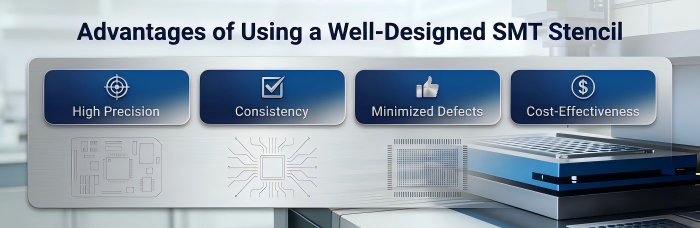
There are several advantages to it using a well-designed SMT stencil:
High Precision: Accurately picks small and fine-pitch components as solder paste placement.
Consistency: Ensures that the solder application on several boards is consistent and minimizes rework.
Minimized Defects: Less short circuits, cold solder joints, and solder coverage gaps.
Cost-Effectiveness: Saves time, cuts labor and lowers material wastage with time.
When a high-quality stencil is invested in, it will result in better yield, high reliability, and simplified assembly.
The process of selecting an appropriate SMT stencil is a matter of material, material thickness, shape of aperture, size, and manufacturing needs. The needs of your PCB and components are unique and thus by knowing the requirements you would be able to pick a stencil that would optimize precision, consistency and efficiency. The stencil is an important part of the system whether you are making small prototypes or even large quantity boards as it contributes to high quality of soldering.
PCBCart provides EMS, PCB assembly, PCB fabrication and professional services. Having the latest laser-cutting technology and the skills to design custom stencils, PCBCart makes sure that the stencils produced will be durable and precise and that they will be of the absolute precision required by your project. PCBCart ensures high-precision, durable stencils that meet the exact requirements of your project. Partnering with PCBCart guarantees smooth production, reduced defects, and superior PCB quality.
Get High-Precision SMT Stencils for Flawless PCB Assembly
Helpful Resources
• Stencil Design for QFN Components
• Free DFM Check
• SMT Assembly Capability — Supported Package Types & Sizes
• How to Identify SMD Components from Appearance and Marking
• BGA Assembly: From Design to Perfect Soldering


