



A populated PCB assembly (PCBA) is an intermediate product. For clinical laboratory instruments — blood chemistry analyzers, diagnostic readers, sample handlers, point-of-care devices — the deliverable that actually matters to the end user is a complete, enclosed, powered-on unit that performs to specification the moment it's unboxed.
When the manufacturing relationship stops at the PCBA stage, every subsequent step — mechanical integration, wiring, enclosure assembly, firmware loading, functional validation, burn-in — becomes the customer's responsibility, executed across a fragmented set of vendors. Each handoff between PCBA supplier, enclosure fabricator, harness shop, and final assembler introduces a quality boundary where defects can be introduced and traceability can break down.
Turnkey box-build integration consolidates these steps under one manufacturing and quality system. The scope expands from "assembled board" to "finished, tested instrument" — with a single serialization and traceability record spanning component receipt through final functional release.
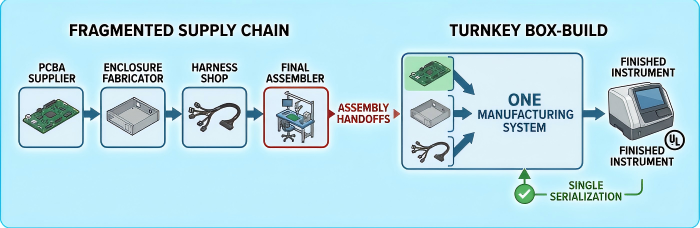
What Box-Build Integration Actually Covers
Box-build assembly (sometimes called system integration or electromechanical assembly) is the process of combining the PCBA with mechanical enclosures, cabling, power systems, and peripheral subassemblies into a complete, functional product. The scope typically spans several categories of work.
Mechanical Integration
Enclosure assembly: Installing the PCBA into its housing using standoffs, mounting bosses, or card-guide rails, with attention to clearances around tall components and connector access points.
Torque-controlled fastening: Enclosure screws and board standoffs are torqued to specification — commonly in the 0.3-0.8 N·m range for compact instrument housings — to prevent board flexure that can crack solder joints on large-format components such as BGAs.
Thermal management hardware: Heatsinks, thermal interface materials, and fan assemblies are fitted according to the thermal design, ensuring heat-generating regulators and processors transfer load to the chassis rather than radiating toward temperature-sensitive optical or chemical sensing elements nearby.
EMI and grounding continuity: Conductive gaskets and grounding straps are installed and continuity-checked, since clinical instruments frequently house sensitive analog front-ends (photodetectors, precision ADCs) alongside digital control electronics where stray EMI can elevate the measurement noise floor.
Cable Harnessing and System Interconnection
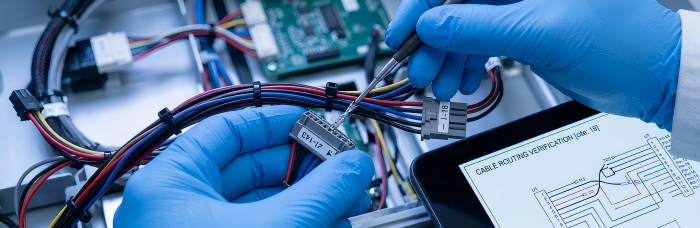
Cable harnesses are a disproportionately common source of field failures — not because of component defects, but because of workmanship variance in crimping, routing, and termination.
Crimp and termination quality: Wire crimps are verified against IPC/WHMA-A-620 workmanship criteria, checking conductor capture, insulation positioning, and pull-test force appropriate to wire gauge.
Connector keying and polarity verification: Each connector mate point is checked against the wiring schematic prior to final closure — a single reversed sensor polarity in a harness can produce systematically wrong readings that are difficult to trace once the unit is sealed.
Strain relief and routing discipline: Harnesses are dressed and secured at defined intervals to prevent vibration-induced fatigue at connector junctions, a known failure mode for benchtop instruments subject to repeated transport or access-panel cycling.
Signal/power separation: High-density digital buses (USB, Ethernet, I2C/SPI sensor lines) are routed separately from power and analog sensor lines within the same harness bundle, since cross-routing errors translate directly into signal integrity or noise-floor problems at the system level.
Power Systems and Final Assembly
Box-build also covers installation of power supplies, batteries (where the instrument includes backup power), power distribution wiring, and external interface connectors (power input, USB, Ethernet, RS-232/RS-485). Final assembly operations include installing bezels, covers, and access panels, applying serialized labels and regulatory markings, and fitting protective elements such as mounting brackets or rubber feet.
Functional Testing (FCT): Validating the Assembled Instrument
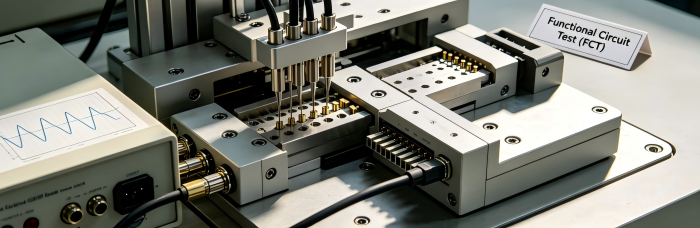
Functional testing (FCT) is the step that distinguishes a "tested board" from a "verified instrument." FCT powers up the fully assembled unit, applies realistic operating stimulus, and measures whether the system's outputs match the design intent — answering the question that matters most for shipped product: does the instrument work as a system?
How FCT Differs From Board-Level Testing
Structural test methods verify that individual components and nets are present and correctly valued. FCT verifies system behavior — and for firmware-driven clinical instruments, that distinction is decisive. A board can pass component-level inspection and still fail functionally if a firmware routine doesn't initialize correctly, a communication driver mishandles a sensor response, or a calibration table fails to load.
A typical FCT sequence on an assembled instrument follows four stages:
Power-up and current verification — confirming inrush behavior and steady-state current draw fall within expected bounds, and that voltage rails sequence correctly (often validated to within ±3-5% of nominal).
Firmware and stimulus application — loading the production firmware (via JTAG/SWD or a production bootloader) and exercising the unit with digital patterns, communication bus traffic, or simulated sensor inputs.
Response measurement — reading back voltages, digital I/O states, display output, and communication responses through the unit's actual connectors and interfaces.
Pass/fail determination against the customer's specification — every measured value is compared to limits defined in the test specification, not generic acceptance criteria.
Why Custom Firmware Matters for Clinical Hardware
For clinical lab instruments, firmware often contains calibration coefficients, sensor compensation tables, and safety interlocks that must be present and correctly executing before any functional claim about the unit can be made. A turnkey FCT process loads the actual production firmware binary onto each unit — not a generic test image — so the validation reflects the exact configuration the unit will run in the field.
Fixture-Based Production Testing
For volumes beyond prototype quantities, FCT moves from manual bench probing to a bed-of-nails or custom interface fixture that contacts test points and connectors simultaneously, cutting cycle times from many minutes of manual probing to under two minutes of automated testing per unit. Every test result — pass/fail status, measured values, firmware version — is logged against the unit's unique serial number.
Burn-In Testing: Screening Early-Life Failures
Electronic assemblies follow a well-documented failure-rate pattern in which a disproportionate share of failures occur early in operating life, driven by latent defects — marginal solder joints, component infant failures, or connector seating issues — that pass FCT at time-zero but manifest under sustained thermal or electrical stress.
Burn-in testing addresses this gap by operating the fully assembled unit under powered conditions for an extended duration — commonly 24 to 72 hours, depending on instrument criticality — sometimes with power-cycling or elevated ambient temperature to accelerate latent defect exposure.
During burn-in, monitored parameters typically include:
Voltage rail stability over time (detecting marginal regulator performance or thermally dependent drift)
Communication link stability (detecting intermittent connector or solder-joint issues)
Subsystem temperature behavior under sustained load
Units that fail during burn-in are pulled for failure analysis. Off-line X-ray inspection is used to examine BGA and QFN solder joints for voiding or cracking that may not have been visible at initial inspection but became apparent under thermal cycling — a particularly valuable diagnostic for the high-density processor and memory packages common in diagnostic instrument main boards.
For clinical lab equipment, this screening step has outsized value: a field failure in a deployed analyzer translates directly into laboratory downtime and, in regulated environments, generates documentation and investigation overhead that far exceeds the cost of catching the defect on the production floor.
The Closed-Loop Traceability Advantage
The combined effect of mechanical integration discipline, harnessing workmanship standards, customer-firmware FCT, and burn-in screening is a unit that ships in a genuinely plug-and-play state: powered on, functionally verified against specification, and screened for early-life failure modes before leaving the factory.
This matters differently to each stakeholder in the buying process:
For Quality Audit Managers, board-level 3D SPI and 3D AOI inspection with closed-loop feedback combines with system-level FCT and burn-i n data to produce one continuous traceability chain — from incoming component lot and date-code data through final functional release — tied to a single serial number under a Smart MES record, rather than fragmented records across multiple vendors.
For Hardware R&D Engineers, design intent — calibration tables, sensor compensation logic, firmware safety interlocks — survives intact from prototype to production volume, because it is validated at the system level rather than inferred from board-level testing alone.
For Procurement Directors, consolidating PCBA, mechanical integration, harnessing, and final test under one supplier eliminates the coordination overhead of managing separate vendors for enclosures, cable assemblies, and test fixtures — and removes the quality-boundary risk that exists at every vendor handoff.
Partner With PCBCart for End-to-End Instrument Delivery
PCBCart (General Circuits) supports the full transition from PCBA to finished box-build for life sciences manufacturers — combining automated SMT and selective wave soldering processes, 3D SPI/AOI inspection with closed-loop feedback, off-line X-ray analysis, and mechanical integration, cable harnessing, FCT, and burn-in protocols built around your test specification and production firmware, all tracked through a unified Smart MES traceability record. If your clinical instrumentation program requires a manufacturing partner capable of delivering tested, calibrated, ready-to-deploy units rather than boards alone, we welcome the opportunity to discuss your integration and test requirements.
Helpful Resources
• A Guide to Medical PCB Fabrication and Assembly
• What is Turnkey Box Build Assembly in EMS?
• Box Build Assembly Services: Process, Components, and Key Considerations
• Box Build Assembly Process
• What Are the Difference Between PCB and PCBA?
• Advanced PCB Assembly Service from PCBCart


