



In PCB manufacturing and electronics assembly, the terms SMT and SMD are often used together, which leads many engineers, buyers, and newcomers to believe they mean the same thing. In reality, they describe two different but closely connected concepts. Understanding their distinction is important for clear communication during PCB design, component selection, and assembly production.
Surface Mount Technology (SMT) is the manufacturing technique, and Surface Mount Device (SMD) is the electronic component used in the technique. One explains how parts are placed on to a printed circuit board and the other explains what is being placed. This difference, though it has a simple definition, plays a key role in the contemporary electronics production.
SMT: The Assembly Technology
Surface Mount Technology Surface mount Technologies (SMT) is the PCB assembly technique where an electronic part is mounted on the surface of a printed circuit board rather than being inserted in a drilled hole.
SMT, which was introduced in the 1980s, revolutionized electronics manufacturing by giving way to automated high-density and high-speed production.
Key Characteristics of SMT
Parts are solder padded onto PCB.
Most components do not need any through-holes.
Can be placed on both sides of PCB.
Superiorly amenable to automated production devices.
It is intended to be used in high-volume high-precision production.
Today's SMT technology is utilized in consumer electronics, automotive electronics, medical devices, telecommunications, and industrial systems.
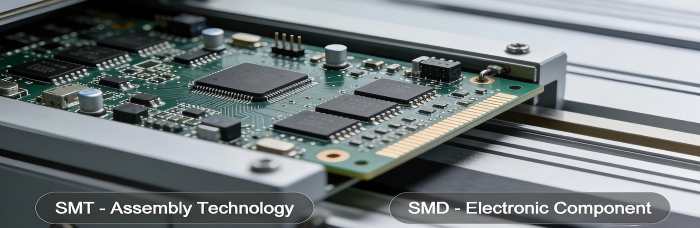
SMD: The Components in SMT
A Surface Mount Device is an electronic component or object that is specifically designed to be mounted on to the surface of a PCB by SMT processes. SMD components are available with small metal pads, short terminals or flat contacts rather than long wire leads and can be soldered straight onto the board.
SMDs come in very numerous types and applications of components. Passive elements like resistors, capacitors, and inductors control current, store energy and filter signals in circuits. Switches and signal control are carried out by discrete devices such as diodes, transistors and LEDs. More complicated SMD packaging consists of integrated circuits, sensors, connectors and switches that allow complex electronic functionality in the small footprint of a design.
SMT vs. SMD
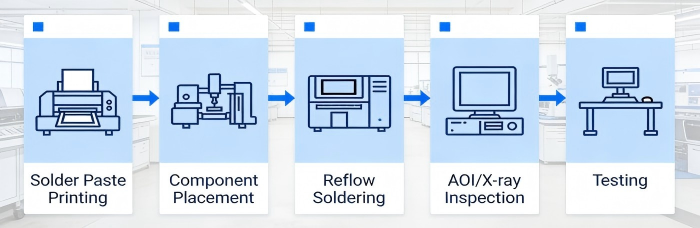
The simplest way in knowing the difference is to understand that SMT and SMD fall under different categories. SMT is a technology or a process whereas SMD is a physical device. SMT explains the process that is followed in the assembly of PCBs, such as the solder paste printing, automated placement, and reflow soldiering. SMD refers to the elements that are designed to be in line with that approach.
In practical manufacturing debate, there is a misunderstanding in that the two terms cannot be used without the other. SMT production line operates mostly with SMD components hence the reason why people use it interchangeably. Nevertheless, they cannot be considered as substitutes. SMT components cannot be efficiently assembled without SMD components and SMD components would have no components to be placed by SMT equipment.
SMT Assembly Process (How SMDs are Mounted)
In professional PCB assembly facilities such as PCBCart, SMT is a highly regulated workflow that is optimized towards precision and repeatability.
Step 1: Solder Paste Printing
A solder paste can be positioned on PCB pads onto which components will be placed using a stainless-steel stencil.
Step 2: Component Placement
SMDs are placed by automated pick-and-place machines with micron accuracy that can place thousands of components in one hour.
Step 3: Reflow Soldering
The PCB is put through a temperature-controlled oven. The solder paste melts and produces dependable electrical and mechanical connections.
Step 4: Inspection (AOI/X-ray)
Alignment of Automated Optical Inspection checks, solder joints, polarity and defects.
Step 5: Testing
Functional and electrical testing is used to check that the assembled board is functioning as per the performance requirements.
This is among the primary reasons why SMT massively lowers manufacturing cost and enhances consistency.
Features and Advantages of SMT
Manufacturing SMT has a number of significant advantages:
High Component Density
Elements may be brought nearer together and on both sides of the PCB making compact designs possible.
Automation and Speed
SMT is a modern technology that puts together thousands of components in a minute to save labor expenses and human errors.
Better Electricity Performance
Regardless of the length of the interconnections, shorter interconnections minimize parasitic capacitance and inductive and enhance signal integrity, particularly in high-frequency applications.
Reduced PCB Size and Weight
Most components are drilled with no drilling permitting smaller and lighter products.
Manufacturing Efficiency
Increasing yield rates and repeatable process enhance general reliability.
Features and Advantages of SMD Components
SMDs too play an important role in the contemporary electronic performance.
Miniaturization
Small package sizes favor smartphones, wearables, internet of things (IoT), and small industrial electronics.
Better Thermal Performance
Flat mounted surfaces enable better heat conduction via PCB copper layers.
High-Frequency Capability
Short leads reduce electrical losses and SMDs are the best suited to RF and high speed circuits.
Broad Component Availability
How SMT and SMD Work Together in Modern Manufacturing
Almost all of the electronic components in modern times are in surface-mount packaging.
The Cooperation of SMT and SMD in the Contemporary Production.
In real-world PCB manufacturing, SMT and SMD are not mutually exclusive ideas.
Engineers make circuits with SMD package to obtain small layouts.
The providers of PCB assembly use SMT processes to install such components effectively.
High volume production is made possible by automation of production with high quality at low cost.
The rise of smaller, faster electronics — from smartphones to medical equipment — became possible only because SMT processes and SMD components evolved together.
When It Matters to Know the Difference
It is important to know the difference between SMT and SMD, especially when:
Requesting PCB assembly quotations
Choosing component packages at PCB design
Negotiating with contract manufacturers
Assessing their manufacturing capacity
Cost and scale optimization of production
Instructions are to be formulated using clear terminologies to prevent misunderstandings between manufacturing and design teams.

SMT and SMD are two distinct yet inseparable aspects of modern electronics manufacturing, though mixed up with each other:
SMT (Surface Mount Technology) is automated to place components on PCBs.
SMD (Surface Mount Device) is the components that were specifically developed in that process.
They make it possible in combination to allow smaller, faster, more reliable and more cost-effective electronic products. With the development of PCB technology into the domain of higher density and higher performance, the integration of SMT processes and SMD components is still the basis of today electronic manufacturing.
At PCBCart, we focus on offering high quality PCB assembly services with the latest SMT technologies and an extensive variety of SMD components. Our processes are efficient, with precision and high reliability, and whether you are producing prototypes or more extensive quantities, your projects will be of the utmost quality. Contact us, and get a free quote to learn how our experience in SMT and SMD can make your next project come to life, with accuracy, speed, and affordably.
Request for High-Precision SMT Assembly Quote Now
Helpful Resources
• The Most Essential Facts about Surface Mount Technology (SMT)
• Elements Influencing SMT Soldering Quality and Improvement Measures
• Components Sourcing Services


