



A mid-build engineering change order in PCB assembly goes smoothly when your contract manufacturer has three things before anyone touches the line: a redlined BOM or revised data package, a clear effectivity point, and your decision on what happens to boards and parts already in process. Miss one and the job stops while emails go back and forth. In high-mix, low-volume work, that pause usually costs more than the change itself.
Below is how we sort ECOs at our Hangzhou and Thailand factories, what we need from you for each type, and how we handle work in process (WIP) and stock. At the end there is an ECO information template you can drop into your own change process.
Why do ECOs hit HMLV builds harder?
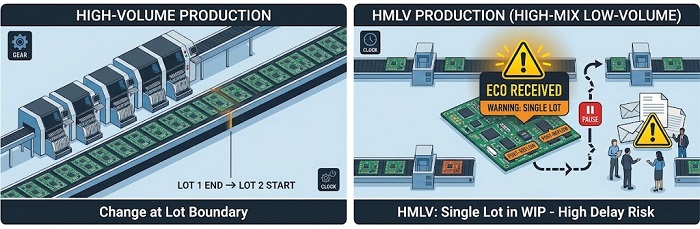
Because in HMLV the whole order is often a single lot, so there is no "next lot" to cut the change into. On a high-volume product, an ECO normally takes effect at a planned lot boundary and the current run finishes on the old revision. On a short-run industrial controller or a test-equipment interface board, the lot on our floor may be the entire order, and part of it is already past reflow when the change arrives.
Setup is the second pressure point. Each revision carries its own stencil, placement program, 3D SPI and AOI programs, feeder list, and sometimes dedicated fixtures. In a high-volume program those costs are spread over a long run. In HMLV they are a large share of the job, and a layout change resets most of them.
Parts are the third. Short-run BOMs are normally bought close to build quantity, so there is rarely a spare reel of the new part sitting on a shelf. An alternate part usually means a new purchase, and a deleted part usually means leftover inventory that somebody has to own.
Then there is overlap. Programs that revise often can easily have Rev B boards in WIP, Rev C bare boards in stock, and a Rev D ECO arriving by email in the same week. Splitting a lot cleanly depends on knowing exactly which boards were built to which revision, and we can only split along the lines the ECO draws. That is why the paperwork has to be specific.
Which kind of change are you making?
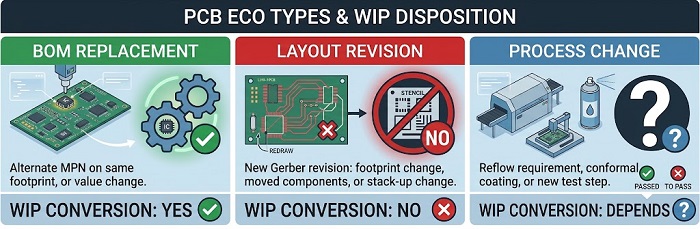
Classify the ECO by what physically changes on the board, because that decides which files we need and whether WIP can be converted. The reason for the change matters for your records, but it doesn't change how we execute it. We put every incoming change into one of three types.
A BOM replacement leaves the bare board alone. You are swapping a part for an alternate on the same land pattern, changing a value, or changing a fit/DNP status. It is the cheapest change to absorb, and boards that haven't reached placement can usually take it with no rework at all.
A layout revision means new Gerber data: a moved component, a new footprint, a trace change, a different stack-up. Old bare boards cannot become the new revision. Stencil, placement program and inspection programs all need to be redone, and anything already assembled stays on the old revision unless you choose to scrap it.
A process change leaves the design data untouched and changes how we build it. Typical examples are a new reflow requirement, an added cleaning step, a revised conformal coating area or keep-out, an extra IC programming or functional test step, or new labeling and packaging. Nothing is redesigned, but work instructions and the build routing change, and we generally re-verify the first boards built under the new process.
Watch for mixed changes that arrive labeled as BOM changes. The usual one is an "equivalent" part in a slightly different package. Our rule is simple: if the new part's terminations don't match the existing land pattern exactly, and somebody has to say "it should fit," we treat it as a layout change and ask for your engineering sign-off before we place it.
| Change type | Typical examples | What changes at our end | What we need from you | Can WIP convert? |
|---|---|---|---|---|
| BOM replacement | Alternate MPN on the same footprint; value change; DNP added or removed | Kitting, feeder setup, part data in placement program, AOI library | Redlined BOM with reference designators; datasheet for the new MPN; approval of the source | Yes before placement; after placement only by rework |
| Layout revision | New Gerber revision; footprint change; moved parts; stack-up change | Bare boards, stencil, placement program, 3D SPI and AOI programs, any fixtures | Complete Gerber set, drill file, centroid, assembly drawing, revised BOM, list of what changed | No. Old-revision boards finish as the old revision or are scrapped |
| Process change | Reflow requirement, cleaning, conformal coating area, IC programming or functional test step, labeling | Work instructions, build routing, inspection or test steps | Revised spec or drawing note, acceptance criteria, which boards it applies to | Usually, depending on which stations the boards have already passed |
What does the CM need to act on an ECO?
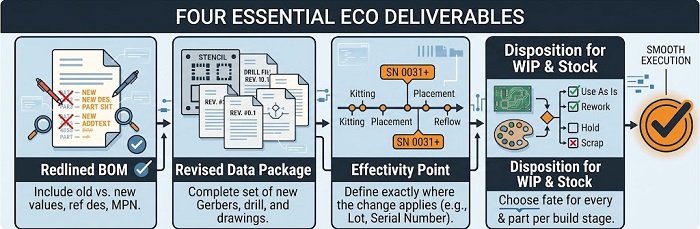
We need a redlined BOM or revised data package, an effectivity point, and a WIP disposition, plus one named approver on your side. With those four, an ECO is a planning task. Without them, it is a hold.
A redlined BOM, not just a new BOM
Put old and new values on the same line, with reference designators, MPN, manufacturer and quantity per board. A clean new BOM with nothing marked forces us to compare it by hand, and a comparison done by the factory is one you then have to check yourself. If the new part comes from a source you nominate rather than an authorized distributor, say so in the ECO. Our components sourcing team does not substitute parts without customer approval, and that applies to ECO parts just as it does to the original order.
A complete data package for layout changes
For a layout revision we need the full released set again: Gerber, drill, centroid, assembly drawing and the matching BOM, all carrying the new revision. We build from your released files and don't edit design data, so even a small fix should reach us as a new revision from your design owner. Please update the revision marking in silkscreen or copper too. When two revisions are on the floor at once, reading the rev straight off the bare board is the fastest check we have.
An effectivity point
Effectivity tells us exactly which boards get the change. "Effective immediately" doesn't qualify, because a board halfway through the line is neither clearly before nor after "immediately." Workable effectivity points are a serial number ("SN 0031 onward"), a lot, a build stage ("all boards not yet through placement"), or a date code for parts. If different items in the same ECO take effect at different points, list them separately.
A disposition decision for WIP and stock
This is the field most often left blank, and it is the one we can't decide for you, because whoever makes the call also owns the cost. The options are below.
What happens to WIP and stock?
Every affected board and part gets one disposition, and we ask you to choose it per build stage. The right answer depends mostly on how far the boards have traveled.
Boards still in kitting are the easy case. We pull the old part, kit the new one when it arrives, and the board never sees the old revision. Boards that are printed but not yet placed can often be cleaned and reprinted, or held until new parts arrive. Whether a cleaned and reprinted board is acceptable for your product is a quality decision on your side, and the cleaning method itself should be confirmed with our engineering team.
Boards past reflow can only reach the new revision by rework. For passives and leaded parts this is usually straightforward. For BGAs, QFNs and other bottom-terminated parts, rework adds heat cycles, and we check the reworked joints with X-ray inspection. Some customers accept reworked boards for any use and some only for internal or engineering use, so tell us which before we start. Finished and tested boards are often best completed and shipped on the old revision, clearly labeled, provided the old revision is still functionally acceptable to you.
For boards, the dispositions we work with are these:
• Use as is: complete to the old revision and ship labeled with that revision.
• Rework to the new revision: quoted separately, with reworked boards identified so you can tell them apart.
• Hold: quarantine until you decide, with an agreed review date so boards don't sit indefinitely.
• Scrap: we scrap the boards and document the quantity, recovering parts where that is practical.
• Return: ship the unfinished boards back to you as they are.
For stock, components can be consumed in a later build, returned, kept as buffer stock, or scrapped. Old-revision bare boards have fewer options: use them on a later build that still runs that revision, or scrap them. On a consigned job those parts are yours and come back to you or wait for your instruction. On a turnkey job they were bought against your order, so we list them on the ECO cost summary and you see exactly what is left before anything is thrown away.
Once the change is in, the first boards built to the new revision go through first article inspection before the rest of the lot continues. We can email images for a quick review, or ship the first article to you if you would rather verify it on your own bench. For a BOM-only change on a few non-critical passives, some customers waive re-FAI. For any layout revision we advise against waiving it.
ECO template: what should every change order include?
Send this sheet with every ECO, small ones included. A completed sheet usually turns a long email thread into one review call. The example column is illustrative only.
| Field | What to enter | Example |
|---|---|---|
| ECO number | Your internal change reference | ECO-114 |
| Assembly P/N and revision | Part number, from-revision and to-revision | CTRL-200, Rev C to Rev D |
| Change type | BOM replacement, layout revision, process change, or mixed | BOM replacement |
| Description | What changes, in one or two sentences | Replace U7 regulator with pin-compatible alternate |
| Reason | Obsolescence, design fix, test finding, cost, supply | Original part on allocation |
| Affected reference designators | Every RefDes touched by the change | U7, C21 |
| Attached files | Redlined BOM, Gerber set, centroid, assembly drawing, spec | Redlined BOM, Rev D |
| Effectivity point | Serial number, lot, build stage or date code | All boards not yet through placement |
| WIP disposition | One choice per build stage | Reflowed boards: use as is, label Rev C |
| Stock disposition | What happens to old-revision parts and bare boards | Return remaining U7 stock |
| Re-FAI | Required or waived, and approval method | Required, images by email |
| Revision marking | How boards of each revision are identified | Rev D in silkscreen; Rev C boards labeled |
| Approver | One name, role and email with authority to sign off | Hardware lead |
| Cost acknowledgment | Confirm that rework, scrap and new parts are quoted separately | Acknowledged |
FAQ
Should this be an ECO or a deviation?
If the change applies to a fixed quantity or a single lot and the design then returns to the released revision, it is a deviation. We handle it the same way, with the quantity or lot limit written into the document. If the change is permanent, issue an ECO and update the released files. A deviation that repeats on every order usually means the documentation should have been changed.
Who pays for scrapped bare boards and leftover parts?
Whoever owns the material at the time of the change, which depends on whether the job is turnkey or consigned and when the material was bought. We list the affected material and quote rework and scrap before acting, so the cost decision is made before anything is scrapped.
Can you make a small layout fix for us to save time?
No. We build to your released Gerber data and don't modify design files. Even a one-pad change should come from your design owner as a new revision, so the files in your system match the boards you receive.
What if old-revision boards have already shipped?
Shipped boards sit outside the WIP the ECO covers, so the ECO should state whether they are acceptable in service. If you want them upgraded, discuss return-for-rework with our engineering team; the scope depends on the boards' condition once they are back with us.
Can an ECO change the acceptance class or inspection plan?
Yes, and when it does, treat it as a process change. Our standard boards are built to IPC Class 2. If an ECO adds tighter acceptance criteria or extra inspection points, confirm the requirement with our engineering team before release so the inspection plan and the quote line up.
Helpful Resources
• Low-Volume PCB Assembly (HMLV)
• Full Turnkey PCB Assembly


