



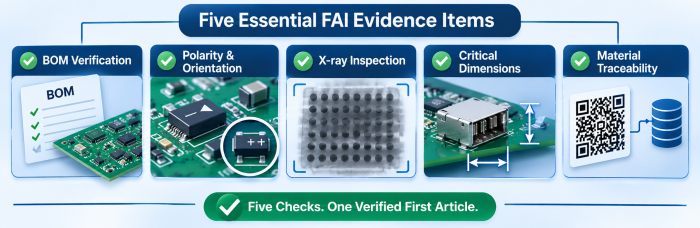
A first article inspection (FAI) shows that the assembly line, as set up for your job, can build the board to your released documents. It does not show that the lot will be good. For a PCBA first article we ask the buyer to request five things before the rest of the lot is released: a BOM-to-board check against the released revision, polarity and orientation evidence, X-ray images of BGAs and other hidden joints, measurements of the dimensions that matter to your enclosure or mating parts, and a record that ties the board to its material lots.
The rest of this article covers what each of those should look like, when the first article has to be done again, and how to tell a real FAI package from a stack of photos.
What does a first article actually prove?
It proves that setup is correct. The stencil and print parameters produce acceptable paste deposits, the placement program puts the right part at the right location and rotation, and the reflow profile produces acceptable joints on this specific board. It also proves that the people building the board read your BOM, Gerber and assembly drawing the same way you do, which is where a surprising number of NPI problems start.
It does not prove reliability, lot-to-lot consistency or functional performance. One board cannot tell you that the paste lot will behave next week, or that a capacitor reel is not mixed. Treat FAI as a gate on the build setup, and keep functional test and in-process inspection as separate controls.
Two conditions make a first article worth reviewing. The board should come off the production line using the production program, stencil, profile and materials, not from an engineering build or a hand-assembled sample. And the first article should be built before the full quantity is committed to the line, with an agreed decision on whether the line waits for your sign-off. Waiting costs schedule and not waiting costs risk; that trade-off belongs in the NPI plan, not in a Friday afternoon email. For the scope of the process on our side, see our first article inspection process.
What should you ask to see?
Ask for evidence, not a statement that the board passed. The table below is what we would put in a first article request if we were the buyer.
| Item | Evidence to request | What you are checking |
|---|---|---|
| BOM-to-board | Marked-up BOM or photos with reference designators, manufacturer part number, manufacturer name, date code where marked | Every line matches the released BOM revision; approved alternates are identified as alternates |
| Polarity and orientation | Close-up photos of diodes, LEDs, electrolytic and tantalum capacitors, pin-1 of ICs, connectors | Orientation matches the assembly drawing and silkscreen, and the silkscreen matches the drawing |
| BGA and bottom-terminated parts | X-ray images of each BGA and other hidden-joint package, with the acceptance criteria stated | No bridging or missing joints; voiding assessed against criteria agreed before the build |
| Solder paste print | SPI data or print inspection record for the first board | Deposit volume and position on fine-pitch and thermally heavy pads |
| Critical dimensions | Measured values for items you name: connector position, mounting hole to connector datum, component height under a cover or heatsink, board outline | Fit in your enclosure or mating part |
| Reflow | The profile used and the board or fixture it was run on | Same profile that will run the lot |
| Surface inspection | AOI result for the first board, both sides | Presence, offset, polarity and solder defects that automated inspection covers |
| Traceability | Serial or UID of the first article linked to material lots | You can trace this board back to specific reels and process records |
A few notes on the rows that get skipped.
BOM-to-board. The check has to be against the revision you released, and it needs the assembly drawing revision too. If the BOM allows alternates, the first article is the cheapest moment to learn which one the line actually used. We would also ask for the photo of the as-built board next to the BOM line, because a marked-up spreadsheet with no board photo only proves someone read the spreadsheet.
Polarity. Photos should be taken at an angle where the marking on the part and the marking on the board are visible together. Overall board shots tell you nothing about pin-1.
BGA and hidden joints. Specify which parts need X-ray before the build starts. Our offline X-ray inspection is run as a separate step, so the images exist only if someone asked for them. Void and joint acceptance criteria depend on the package and your application; for the numeric limits we apply, confirm with our engineering team, and agree them in writing before the first article instead of debating them after.
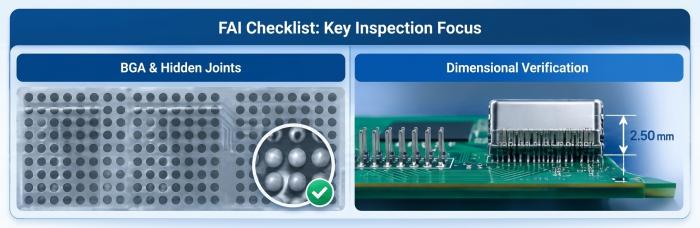
Critical dimensions. The assembler cannot guess which dimensions matter to your mechanical design. Name them. A connector that sits slightly off its datum passes every electrical test and still fails to mate.
If the board has a lot of fine-pitch parts, ask that the first article also be built with the same paste inspection and AOI programs that will run the lot. A first article inspected in a looser setup tells you less about the lot than it appears to.
When should FAI be repeated?
Whenever something changes that the first article was supposed to prove. Our rule of thumb is that a change to the product definition or to the process on the line that builds it triggers a new first article, at least for the affected area.
The usual triggers:
A new or alternate component with a different package, footprint or manufacturer, especially an IC, BGA or connector
A PCB revision, or a change in laminate, finish or stack-up that affects the assembly process
A new stencil or a change in aperture design
A change in reflow profile, oven or fixture
A change to the placement program beyond a documented minor edit
Moving the build to a different line or site
A long gap since the last build, with the interval defined in the NPI plan
A process escape or customer-reported failure that points back to build setup
It is rarely worth repeating the whole package for a resistor value change in the same package from the same manufacturer. It is worth repeating the affected portion for a new BGA vendor, even if the part number matches, because the ball alloy, package warpage and moisture handling can differ. If you are unsure, put the change in a short list in the NPI agreement: changes that need a full FAI, changes that need a partial FAI, and changes that only need an engineering notice. That list is more useful than any generic rule, including ours.
Also decide who classifies a change. If the assembler decides alone, you will find out about the change from the report. If you decide alone, you will ask for full repeats on trivial changes and slow your own program.
How to read an FAI report
AS9102 is an aerospace standard for first article reports, and we do not claim aerospace qualification by mentioning it. Its report structure is still a useful format to borrow, because it forces the right questions. It has three parts: one that identifies the part number and revision, one that lists materials, special processes and functional tests, and one that lists each characteristic with its requirement, measured result and disposition.
Read a PCBA first article report in this order.
Identification. Part number, revision, drawing revision, quantity built, date, and the serial of the board inspected. If any of these is blank, stop.
Characteristic list. Every characteristic you care about should appear: the items from your table above. If your critical dimension is missing from the list, the report is incomplete no matter how good the rest looks.
Measured values. A pass or fail with no value is a weak record. For dimensions, the value should be there. For visual checks, there should be a photo or image.
Deviations. Anything outside the requirement should have a disposition: accepted with a reason, corrected, or rejected. A complex board with zero observations is possible but unusual; ask how the inspection was done.
Sign-off. Who inspected, who reviewed, when. This matters later if a dispute arises about what was agreed.
If your organization already uses AS9102 forms, ask whether the assembler can fill them out. If it does not, a clear PCBA-specific template with the same three parts works fine.
Red flags in a first article package
Most of these we have seen in reports from other suppliers, and a few we have had to push back on ourselves.
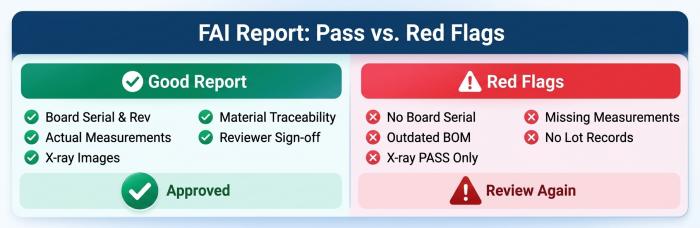
Photos with no reference to the board serial or date. They could belong to any board, and often do.
A BOM check against an old revision. The package looks complete and everything on it passes against the wrong document.
"X-ray: pass" with no images. The statement is only as good as the image behind it, and you need the criteria too.
Measurements rounded or absent. "Within tolerance" is not a measurement.
A first article built on a different line, a prototype line or by hand. It tells you what that setup can do, not what production will do.
No link to material lot records. If the supplier uses a traceability system, the first article should be linked in it like any other board. With our Smart MES, for example, the board carries a UID that connects to material and process records.
No deviations on a board with hidden joints and fine-pitch parts. Ask how the inspection was done.
A request to approve the first article the same day the lot is already running. Review time that does not exist is not a gate.
Changes since the first article not logged. If the profile or program was edited after sign-off, the first article no longer describes what is on the line.
If you see more than one or two of these, ask for a corrected package before approving, and decide whether production should pause until you have it.
FAQ
Is a first article the same as a prototype build?
No. A prototype tells you whether the design works. A first article tells you whether the production setup can reproduce the design as documented. A prototype can be assembled any way that gets it working; a first article should come from the line, program and materials that will build the lot.
Who should sign off on the first article?
The buyer's quality or supplier quality engineer for the document match, and the design engineer for anything that affects fit or function. In small teams one person does both. What matters is that sign-off is a named decision with a date, not silence after the report is sent.
Does FAI replace functional test?
No. FAI checks build against documents. Functional test checks that the board works. A board can pass FAI with a wrong-value resistor that happens to fall within circuit tolerance, and a board can fail function with a perfect FAI if the design has a problem. Use both.
How many boards should be in a first article?
It depends on the board and the program. One board proves setup; more boards show some variation. Agree the number in the NPI plan and confirm with our engineering team if the build includes multiple variants or panels.
What happens if the first article fails?
The assembler should identify the cause, correct the setup, and build and inspect a new first article rather than reworking the failed board and declaring it acceptable. The failure and correction belong in the record, because they become part of the history of that job.
Helpful Resources
• Elements Ensuring Your First-Time Success in New Product Introduction (NPI) during Electronic Manufacturing
• Comparison of AOI, ICT and AXI and When to Use Them during PCB SMT Assembly
• Printed Circuit Board Assembly Inspection Methods
• PCB Pre-order Checklist


