



An exclusivity or non-compete clause asks a supplier to give up other business — often specifically a competitor's business — in exchange for guaranteed volume, a pricing concession, or priority capacity from you. It's genuinely useful in a narrow set of situations, but it's also expensive leverage that buyers often reach for reflexively, without weighing it against what it actually costs to ask for.
What You're Actually Asking a Supplier to Give Up
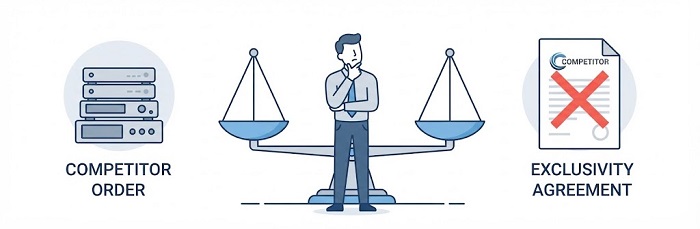
An exclusivity clause typically asks a supplier to agree not to manufacture for a named competitor, or not to manufacture a directly competing product, for the term of the agreement. That's a real constraint on their business — it means turning away revenue they might otherwise have won, based purely on a commitment to you. A rational supplier prices that risk into what they'll ask for in return: a higher minimum volume commitment, a longer contract term, a pricing floor that protects their margin even if your own order volume comes in lower than projected, or some combination of all three. Buyers who ask for exclusivity without expecting to pay for it in one of these forms are usually asking for something a supplier can't reasonably grant for free.
It's worth being specific about scope, too, since "exclusivity" can mean very different things depending on how it's worded. A clause restricted to a single named competitor is a much smaller ask than one restricted to an entire product category or industry vertical, and a supplier will price the two very differently. Vague exclusivity language — "the supplier agrees not to work with our competitors" — is also harder to enforce and easier to dispute later than a clause naming specific companies or a narrowly defined product category.
When Exclusivity Is Actually Worth Requesting
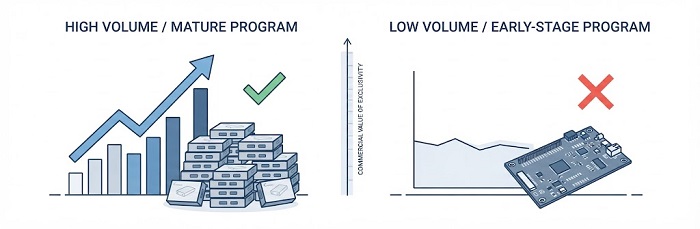
Exclusivity justifies its cost in a fairly narrow set of situations: a design that's genuinely differentiated enough that a direct competitor building an equivalent product at the same supplier represents a real, specific threat, not just a general discomfort with the idea. It also tends to make more sense at higher volumes, where the supplier has a real commercial incentive to accept the tradeoff, than on a small or early-stage program where the exclusivity is more symbolic than commercially meaningful to either side. A buyer requesting exclusivity on a low-volume prototype program, before the design has proven itself commercially, is often asking a supplier to price in a real cost against a hypothetical, unproven benefit.
It's also worth asking, honestly, what the exclusivity clause is actually protecting against. If the underlying concern is that proprietary design information might leak to a competitor, that's a confidentiality and NDA question, not an exclusivity question — and it's usually cheaper to solve directly with stronger confidentiality terms than to solve indirectly by restricting who else the supplier can work with. Exclusivity is the right tool specifically when the concern is competitive capacity or priority, not when the concern is information security, since a non-compete clause does nothing to prevent a genuine confidentiality breach.
Alternatives Short of Full Exclusivity
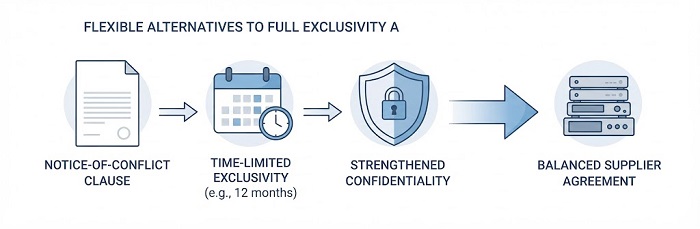
Several lighter-weight alternatives are worth considering before committing to full exclusivity. A notice-of-conflict clause requires the supplier to disclose, rather than avoid, taking on a directly competing program — giving a buyer visibility and a chance to react, without restricting the supplier's business. A time-limited exclusivity window (exclusive for the first 12-18 months of a new product's life, for instance, rather than for the full contract term) can address the specific period when competitive risk is highest without asking for an open-ended commitment. And in some cases, simply expanding the scope of an existing confidentiality agreement to explicitly cover competitive use of shared design information addresses the real underlying concern more directly than exclusivity does.
These alternatives also tend to be easier to actually negotiate to a resolution. A supplier facing a full exclusivity request has to weigh a genuinely open-ended commercial constraint, which invites a longer, more cautious negotiation and a higher price for agreeing. A notice-of-conflict or time-limited window is a smaller, more bounded ask, and suppliers are correspondingly more willing to agree to it quickly and without demanding as much in return. For a buyer trying to move a negotiation forward without stalling on a single high-stakes clause, starting with the lighter option and reserving full exclusivity for the cases that genuinely warrant it is often the more practical path.
A Note on the Legal Side of This
None of the above is legal advice. Whether a specific exclusivity or non-compete clause is enforceable varies significantly by jurisdiction, and how narrowly or broadly such clauses can be drafted and still hold up is a question for a buyer's own legal counsel, not a general commercial framework. What's worth taking from this article is the negotiating logic — what exclusivity actually costs a supplier, and what it's genuinely protecting against — rather than any specific clause language to copy directly into a contract.
FAQs
1. Can exclusivity be requested only for certain products, not a supplier's entire relationship with a competitor?
Yes — narrowing scope to one competing product is both fairer to the supplier and easier to negotiate.
2. Does an exclusivity clause need to be mutual to be reasonable?
Not necessarily, but expect the supplier to ask what they get in return — a volume commitment is the common ask.
3. What happens if a supplier breaches an exclusivity clause?
Depends entirely on the contract's specified remedy — liquidated damages or general breach recourse — worth having counsel review upfront.
4. Is it reasonable to ask for exclusivity without offering a longer contract term in return?
It's a harder sell — less offsetting benefit makes the tradeoff less worthwhile for the supplier to accept.
5. Should a startup or early-stage program pursue exclusivity at all?
Usually not yet — the cost rarely matches an unproven design's actual risk; revisit once volume and differentiation are clearer.
Helpful Resources
• Top HMLV EMS Providers: What to Consider When Choosing
None of this needs to be settled before you've even seen a quote. Raising contract-structure questions early — while pricing is still being discussed, not after — is the point where they're cheapest to negotiate. PCBCart's assembly quote process is one place to start that conversation if you're weighing these terms for an upcoming order.


