



With the spread of electronic systems into the automotive, marine, medical, outdoor and industrial markets, there has been a need to adopt waterproofing as a critical standard to ensure long-term reliability. Exposure to moisture, condensation, salt spray, and liquid can severely affect the electronic performance unless it is managed well.
This paper is a formal and effective introduction to the waterproof PCB, its design principles, material selection, and the key protection technologies in the modern world of electronics manufacturing.
What Is a Waterproof PCB?
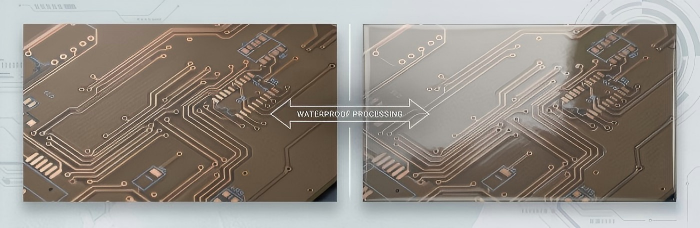
A waterproof PCB does not inherently mean to be water-resistant. Rather, it is a printed circuit board that has been designed and coated to withstand moisture, humidity, splashing water or even immersion.
Waterproofing is attained by using a combination of:
Waterproof substrate materials.
Anti-corrosive surface finishes.
Conformal or nano protective layers.
Potting or encapsulation
Mechanical enclosures that are sealed.
The aim is to ensure that moisture does not find its way to the conductive traces, solder joints, and components to cause electrical failure and degradation of the material.
The importance of Moisture Protection
Some of the main reliability problems that may arise due to water exposure include:
Short Circuits
Water minimizes insulation resistance and can cause unwanted conductive paths between traces.
Corrosion
Water and contaminants cause electrochemical reactions, which damage copper, vias, and component leads.
Electrochemical Migration
In humid conditions, metal ions in the PCB can move on the surface due to electrical bias, resulting in leakage currents or breakdown.
Mechanical Deformation
The absorption of moisture in the substrate can lead to swelling, stress, or delamination.
In case of electronics that are used in a humid environment or outdoors, waterproofing is necessary to maintain stable operation and a long service life.
Selection of Substrate and Surface Finish
Waterproofing reliability commences with the choice of materials.
Moisture-Resistant Substrates
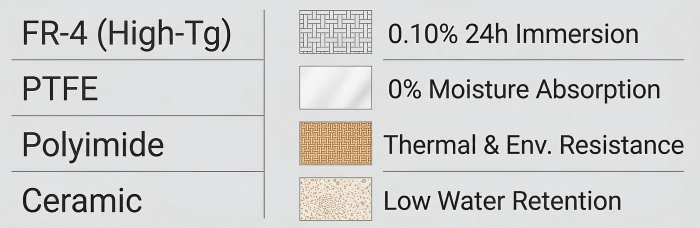
FR-4 (High-Tg): Water absorption is usually approximately 0.10% following 24 h immersion. When used with protective coating, it is appropriate in most industrial applications.
Laminates using PTFE: No moisture absorption at all, widely used in high frequency or RF circuits.
Polyimide: provides good thermal and environmental resistance.
Ceramic substrates: Low water retention and high resistance to harsh conditions.
Corrosion-Resistant Surface Finishes
ENIG (Electroless Nickel Immersion Gold)
Immersion Silver
OSP (controlled environments)
ENIG is also commonly used in severe environments because it can resist corrosion and remain stable.
Major Waterproofing Technologies
Three major protection approaches are employed in waterproof PCB applications. They both present various trade-offs of price, lifecycle, and serviceability.
Conformal Coating
Conformal coating is a process in which a thin layer (usually 25-75 mm) of polymer is coated on top of the assembled PCB. The most common materials are acrylic, silicone, urethane, epoxy and parylene.
This technique offers good resistance to humidity, dust and exposure to light splash and has minimum effect on board dimensions and heat dissipation. It is relatively inexpensive and can be repaired in most cases and is therefore applicable in automotive electronics, industrial controls, and outdoor equipment that is subjected to moderate stress of the environment.
Nevertheless, conformal coating is not supposed to be immersed in water or subjected to high pressure. The preparation of the surface and control of thickness are essential to adherence and performance consistency.
Nano-Coating
Nano-coating creates a hydrophobic coating on the molecular level. It avoids water at present, yet does not affect the look or physical size of parts.
The technology is especially applicable in smaller, densely packed electronics whereby the coating depth needs to be minimal. It provides a good deal of moisture protection with little or no effect on thermal performance.
Its drawbacks are increased cost and reduced mechanical abrasion resistance. It is not usually advisable in long term submersion applications.
Potting and Encapsulation
Potting offers maximum protection to the environment. Under this technique, a PCB assembly is enclosed by a casing and fully filled with a resin substance like epoxy, polyurethane, or silicone. Once it has cured, the compound creates a solid protective mass over the electronics.
Potting offers:
Waterproof (can reach IP67/IP68) performance.
High vibration and mechanical shock resistance.
Improved electrical insulation.
Better resistance to corrosive conditions.
Nonetheless, potting adds a lot of mass and volume, design complexity to heat dissipation, and removes serviceability. It is commonly applied in marine electronics, submarine systems, industrial heavy machinery, and automotive modules that are subjected to severe environments.
Thermal and Design Concerns
Thermal management needs to be balanced with waterproofing. Uncontrolled coating depth or incorrect encapsulation may limit the amount of heat loss, which may impact electrical performance and life expectancy.
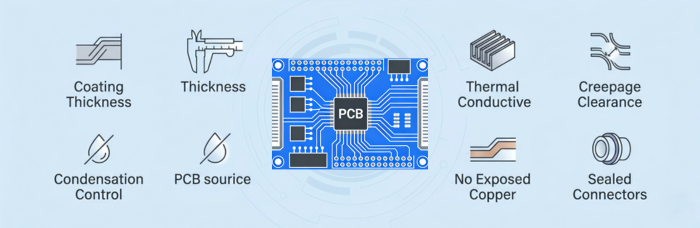
The main design factors are:
Managing the coating thickness.
Application of potting compounds that are thermally conductive where necessary.
Ensuring sufficient creepage and clearance spacing.
Avoiding exposed copper
Choosing sealed connectors.
Adopting condensation management strategies.
Instead of being included as an after-production feature, waterproof performance should be considered as an element of the entire system design.
Waterproof Cases and System-Level Protection
Coating is not enough in most applications. Mechanical enclosures are used to ensure water is not entered.
Ordinary protection levels are:
IP65 - Water jet protection.
IP67 - Temporary immersion protection.
IP68 - Continuous immersion protection.
In harsh conditions, conformal coating and sealed enclosure is the best protection.
Testing and Validation
Environmental testing of waterproof PCBs should include:
Measurement of insulation resistance.
Thermal cycling
High-humidity exposure
Salt spray testing
Post-coating or encapsulation functional testing.
Validation Good validation makes sure the protection strategy chosen works as intended in actual operating environments.
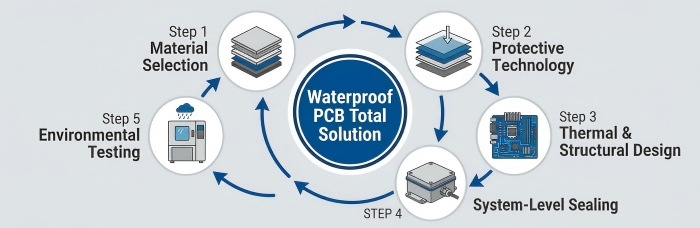
Electronic systems that require waterproof PCBs include those that are in humid, corrosive or submerged environments. A combined strategy requires:
Proper choice of substrate and surface finish.
Proper protective technology (coating, nano-coating, or potting)
Close thermal and structural planning.
Sealing at the system level.
Environmental validation testing.
Durability, safety, and product lifespan can be achieved by considering waterproofing early in the design process.
Pcbcart offers a full range of PCB fabrication and PCB assembly services with reliable waterproofing solutions to projects that need professional PCB fabrication and PCB assembly to meet the requirements of the demanding environment.


