



The Core Problem: One Board, Two Incompatible Paste Demands
Power converter boards for industrial applications—motor drives, DC-DC modules, isolated gate driver platforms—routinely combine 3–6 oz copper pours with fine-pitch logic. A single board may carry a 0.5 mm-pitch BGA device alongside 8 mm² power pads for a TO-263 or D²PAK component. Those two geometries have directly conflicting paste volume requirements, and a single-thickness stencil cannot satisfy both.
With a standard 150 µm stencil, the physics are unforgiving:
Fine-pitch BGA pads receive correct paste height—but only if aperture area ratio is held above 0.66. At 0.5 mm pitch, that often means apertures are already at the margin.
Power pads on the same stencil are starved. A 150 µm deposit on a 6 mm² thermal pad produces insufficient solder volume to survive the cyclic thermal stress of a converter running at 85°C case temperature.
Excess paste on power pads (by opening the stencil to accommodate power geometry) causes bridging across the BGA field during reflow.
The result is a process that is tunable for either the logic or the power domain—but never reliably for both simultaneously.
Step-Stencil Engineering: Matching Aperture to Geometry
A step-stencil resolves this conflict by machining localized thickness changes into a single foil. The design logic follows two rules:
Fine-pitch zones: Apertures are typically reduced to 80–90% of pad area, depending on package pitch, pad design, and stencil thickness. In stepped-down regions (typically 100–120 µm), aperture reductions are optimized to maintain acceptable area ratios and control solder paste deposit height.
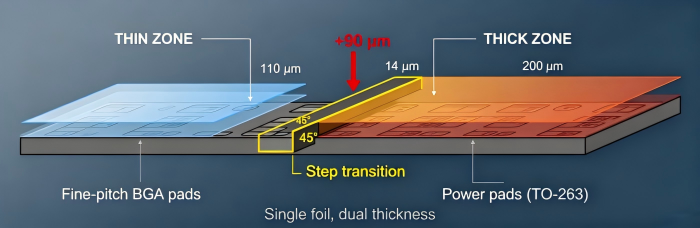
Power pad zones: Apertures are held at 100% opening over the full 150–200 µm foil thickness, allowing full-volume paste transfer onto large thermal pads without aperture restriction.
In fine-pitch BGA zones, the stencil may step down to approximately 110 µm with reduced apertures to achieve controlled paste volumes suitable for fine-pitch assembly. Power pad zones retain full 180–200 µm foil thickness with larger aperture openings to maximize solder volume for thermal and mechanical reliability. The 70 µm height differential between the two zones is what a standard single-level stencil cannot accommodate.
Verifying this dual-height deposit requires a closed-loop measurement system. Our high-speed 3D SPI captures volumetric paste data at each pad type post-print, before any component placement occurs. When measured paste height or volume falls outside established process control limits for either power pads or fine-pitch components, the SPI system can trigger an automatic stencil cleaning cycle before the board proceeds to placement. This prevents the single largest source of solder joint failure in heavy copper assemblies: under-filled thermal pads reaching reflow.
Thermal Via Array Design: Quantifying Junction Temperature Reduction
Thermal via arrays serve a different function than electrical vias. Their role is to create a low-resistance thermal path from a component's exposed pad through the board stack to a heatsink or copper plane on the opposite side. For power converter boards operating at elevated ambient temperatures, inadequate via density is a direct contributor to premature MOSFET or diode failure.
Design rules that govern thermal via arrays in IPC-2152-compliant layouts:
Drill diameter: 0.25–0.35 mm is the effective range. Below 0.25 mm, capillary forces during via-fill processing are insufficient to achieve consistent fill. Above 0.35 mm, the via acts as a solder thief during reflow, draining paste from the thermal pad.
Via fill strategy: Conductive or non-conductive epoxy fill followed by copper cap-plating produces a planar surface suitable for via-in-pad component mounting. Non-filled vias are acceptable only when the via field lies outside the component pad boundary.
Via density and thermal impact: IPC-2152-based thermal modeling shows that increasing thermal via count generally reduces thermal resistance, although the exact improvement depends on board thickness, copper weight, via geometry, and cooling conditions. The benefit gradually diminishes as via density increases. At lower via densities, thermal via arrays primarily provide a basic heat-transfer path. As via density increases, measurable reductions in junction temperature become more likely, depending on power dissipation and board construction. Increasing via density to approximately 8–10 vias/cm² can provide noticeable thermal improvement in many 3–4 oz copper designs, although the actual temperature reduction depends on component power dissipation, airflow, and board structure. For high-power 5–6 oz copper designs, via densities in the range of 12–16 vias/cm² may provide substantial thermal benefits. In some applications, double-digit reductions in junction temperature have been observed before diminishing returns become significant. Beyond 16 vias/cm², additional vias produce diminishing thermal returns while beginning to compromise mechanical integrity of the pad area.
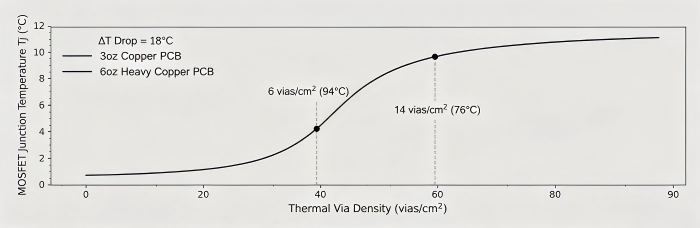
In a documented power module assembly at PCBCart—a three-phase gate driver for an industrial servo drive—increasing thermal via density from 6 vias/cm² to 14 vias/cm² within a 120 mm² exposed pad reduced measured junction temperature rise by 18°C at rated load, from 94°C Tj to 76°C Tj, under a 70°C ambient condition.
Nitrogen-Atmosphere Selective Soldering for THT Power Passives
Industrial power converters use through-hole inductors and transformers precisely because the geometry and wire gauges required for high-current, high-inductance components are not achievable in SMT form. These components sit on large copper pours—often tied to power planes on multiple layers—and that thermal mass creates a soldering challenge that reflow cannot address.
The primary failure mode in THT power passive soldering is incomplete hole fill driven by copper oxidation. On a 6 oz board, the copper barrel surface area within a PTH is substantial. Oxidized copper dramatically increases wetting resistance: oxidized copper surfaces exhibit significantly higher contact angles and poorer wetting behavior than properly protected copper surfaces soldered in a low-oxygen nitrogen atmosphere, resulting in reduced solder flow and hole-fill performance. That 27° difference in contact angle corresponds to a measurable reduction in solder climb height within the barrel—directly producing insufficient hole fill.
Our ZSWHPS-11-2 selective wave soldering machine addresses this with a closed nitrogen curtain around the solder nozzle. Operating parameters for heavy copper THT assemblies:
N₂ flow rate: 80–120 L/min at the nozzle shroud, maintaining O₂ concentration below 500 ppm in the active soldering zone
Solder temperature: 265°C ±3°C for Sn-Ag-Cu on 5–6 oz Cu boards (elevated from standard 255°C to compensate for thermal absorption)
Dwell time per joint: 4.5–6.0 seconds for multi-layer boards with internal copper planes
Selective wave, rather than full-panel wave, avoids thermal shock to adjacent SMT components that have already been reflowed and are not designed for wave solder temperatures.
X-Ray Verification: Via Fill Rate and BGA Void Acceptance
Two defect categories in heavy copper power converter assemblies are invisible to optical inspection and require X-ray analysis as the primary detection method.
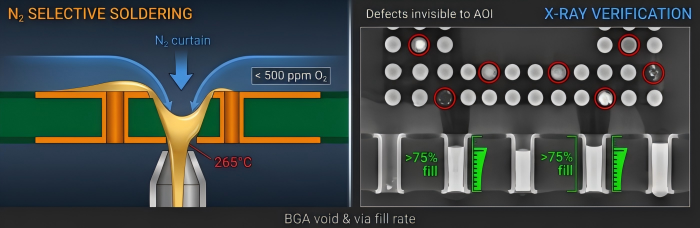
Thermal via fill rate: Inadequate epoxy fill within a via leaves an internal void that dramatically reduces its thermal conductivity—a hollow via contributes negligible heat transfer regardless of its location within the pad. Many manufacturers specify minimum via-fill requirements of approximately 75% or greater by cross-sectional area for thermally critical via structures, depending on reliability objectives and customer requirements. Our automated X-ray system performs statistical sampling of via arrays per board, flagging any via field where more than 5% of sampled vias fall below the 75% threshold.
BGA void detection: For high-reliability power-module assemblies, manufacturers often adopt conservative internal voiding criteria for BGA solder joints, frequently targeting lower void levels than the maximum limits permitted by customer specifications or industry guidance. In comparative process data from a 256-ball BGA on a 4 oz power converter board, X-ray analysis revealed the detection gap between optical and X-ray methods with particular clarity. X-ray inspection demonstrated substantially higher detection capability than AOI for hidden defects such as BGA voiding and thermal-via under-fill, identifying defect conditions that are typically difficult or impossible to detect optically—neither defect type was visible to AOI at all. Solder bridging under QFN components showed a 94% X-ray detection rate against 31% for AOI, while cold joints on power pads registered 87% under X-ray versus 22% optically. The pattern is consistent: the defects with the highest field-failure consequence in power converter assemblies are precisely those that optical inspection cannot see.
Engineering Your Heavy Copper Assembly to First-Pass Success
Heavy copper PCBA is not a standard SMT process with thicker copper—it is a distinct manufacturing discipline requiring coordinated decisions across stencil design, via architecture, selective soldering atmosphere, and inspection methodology. Errors in any one domain propagate into the others.
Our IATF 16949-certified process controls, step-stencil capability, 3D SPI closed-loop paste verification, N₂ selective wave soldering, and 100% X-ray inspection for power modules are engineered as a system, not as independent stations.
Ready to validate your power converter design before first article?
Request a Reflow Profile Review — submit your board stackup and component thermal specs for a complimentary thermal simulation and paste volume assessment from our process engineering team.


