



When a Solder Joint Becomes a Safety Obligation
A machine stops. A robot arm fails to halt. A conveyor does not detect the obstruction. In each scenario, the upstream failure is often not the safety relay itself — it's an intermittent open joint on the safety controller PCBA that the relay trusts.
IEC 62061 and ISO 13849 do not merely define reliability targets for safety functions. They create a legally enforceable chain of evidence from system-level Safety Integrity Level (SIL) or Performance Level (PL) rating down to the hardware components and — critically — the manufacturing processes that produce them. For SIL 2 and SIL 3 controllers, a solder void under a power-rail QFN or a cold joint on a safety relay coil driver is not a yield issue. It is a systematic failure mode that can invalidate the SIL claim.
This imposes three non-negotiable demands on the EMS supplier:
Process control with statistical evidence, not just end-of-line pass/fail
Component-level traceability that survives a post-incident audit
Thermal process discipline across heterogeneous boards carrying both SMD logic and THT safety-critical passives
The sections that follow address each demand in sequence, beginning with how process FMEA translates safety risk reduction into measurable SMT controls, then examining the specific inspection and soldering disciplines that make those controls operational, and closing with three DFM rules that determine whether a safety controller design is manufacturable to SIL requirements at all.

PFMEA × SMT: Bridging IEC 62061 Risk Reduction and Process Failure Modes
IEC 62061 requires a systematic hazard analysis (HARA) and risk reduction architecture. What is less often discussed is that every risk reduction measure implemented in hardware depends on the integrity of the PCBA manufacturing process that realizes it. A dual-channel watchdog circuit designed for SIL 3 performs at SIL 0 if both channel enable lines share a solder bridge that went undetected.
Under an IATF 16949 quality system, the Process Failure Mode and Effects Analysis (PFMEA) and Control Plan are living documents. For functional safety boards, these tools are explicitly extended to link SMT failure modes to safety function degradation. Table 1 illustrates how five representative failure modes are evaluated within this framework and connected to both process controls and detection methods:
| SMT Process Failure Mode | Potential Safety Function Impact | Control Method | Detection |
| Insufficient solder paste (QFN/BGA) | Intermittent open → SIL channel loss | SPI closed-loop ±15% volume gate | 3D SPI 100% |
| Solder bridging on isolation barrier | Degraded voltage withstand → hazard | IPC-A-610 Class 3 spacing audit | 3D AOI 100% |
| Component misplacement (safety relay driver) | Wrong switching threshold | Vision + MES placement verification | AOI + X-ray |
| Thermal damage (reflow Δ overshoot) | Latent dielectric failure | Profiled N₂ reflow, thermocouple witness | Process SPC |
| Void ratio >25% in power pad (QFN) | Thermal runaway under fault current | Automated X-ray void quantification | AXI 100% |
The PFMEA Severity ratings for safety function–linked failure modes are forced to the maximum tier (S = 9–10), which mandates both detection controls and process controls — not detection alone. This directly mirrors IEC 62061's requirement that systematic failures be addressed at the process level, not compensated by diagnostic coverage alone.
Statistical Process Control (SPC) is applied to paste volume, reflow peak temperature, and conveyor speed as key process characteristics (KPCs). Control charts with Cpk targets ≥ 1.67 provide the quantitative process evidence that safety auditors require. The most consequential of these KPCs — paste volume — is where the next control layer begins.
3D SPI Closed-Loop Control: The First Line of Defense Against Cold Joints
Cold joints and insufficient solder are consistently among the top field failure root causes in safety controller assemblies — particularly on QFN power pads and fine-pitch IC lead frames where visual inspection after reflow is architecturally impossible. By the time a cold joint manifests as an intermittent open in the field, the manufacturing window to catch it has long closed.

The process response begins before the component is placed. High-Speed 3D Solder Paste Inspection measures paste volume on every deposit of every board, comparing against nominal targets with a tolerance gate of ±15%. Any deposit outside this window triggers an immediate closed-loop feedback signal to the solder paste printer, which automatically adjusts squeegee pressure or separation parameters before the next board enters.
This is not statistical sampling. It is 100% board, 100% deposit inspection with real-time process correction. The practical effect on a safety controller build:
Paste volume Cpk is maintained above 1.67 on critical pads (safety relay drivers, power management ICs, isolated gate drivers)
Boards with out-of-tolerance deposits are quarantined before placement — not after reflow, where rework risk and thermal re-exposure escalate
The SPI data record becomes part of the board's traceability package, providing process evidence for SIL validation files
Note for SIL 3 dual-channel designs: both channels on the same board must independently satisfy the paste volume KPC gate. A single-channel paste defect on a redundant safety function is a partial systematic failure — 3D SPI isolates it before placement, before the defect is locked in under a component body.
The SPI data record does not stand alone. It feeds directly into the component-level traceability chain that functional safety audits require.
MES Component-Level Traceability: Building the Audit Trail IEC 62061 Demands
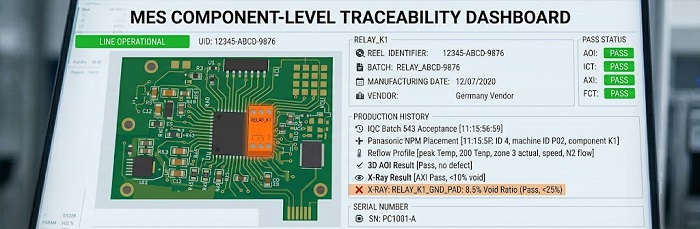
Functional safety standards require that the "proven in use" argument or systematic capability claim be supported by traceable production records. After a field incident, the ability to identify which lot of safety relay, which batch of isolation capacitors, and which reflow profile produced a given serial number is not optional — it is the difference between a targeted containment action and a full market recall.
PCBCart's Smart MES captures and locks the following data chain for every board, from incoming material to laser-marked serial number:
IQC Lot Acceptance
    ↓
Component Reel Scan (UID linked to MPN + lot + date code)
    ↓
Panasonic NPM-W2 Placement (machine ID + nozzle ID + timestamp per component)
    ↓
Reflow Oven Profile (actual zone temperatures, conveyor speed, atmosphere)
    ↓
3D AOI Result (per-board pass/fail + defect coordinates)
    ↓
X-Ray Result (BGA/QFN void % per package)
    ↓
Laser-Marked Serial Number (board UID linked to all upstream records)
This data chain is not documentary overhead — it is operational containment capability. Every critical component — isolation amplifiers, safety relay drivers, Hall-effect sensors, power stage gate drivers — is linked to its physical reel lot number. If a supplier issues a field alert on a specific component date code, PCBCart can identify affected boards, their shipment status, and their end-customer within minutes, without manually cross-referencing paper records.
That speed of response is only possible because the traceability is component-level, not batch-level. This architecture generates the production records that your IEC 62061 Clause 8 and ISO 13849-1 Clause 10 documentation requires — without the overhead of a separate quality system overlay.
Traceability, however, only captures what the process produces. The thermal integrity of the solder joints themselves — particularly where through-hole safety-critical components share a board with fine-pitch SMD — depends on a separate process discipline entirely.
Selective Wave Soldering: Protecting SMD Neighbors When Safety Relays Go THT
Many industrial safety controllers combine surface-mount logic and power management ICs with through-hole safety relays, terminal blocks, and high-current connectors. The through-hole components carry mechanical and electrical loads that preclude replacement with SMD equivalents — this is a design constraint, not a legacy choice.

The conventional wave soldering response to this mix exposes the entire board to a solder wave at 255–265°C — a second full thermal excursion that SMD components were not designed to survive repeatedly. For 0402 ceramic capacitors adjacent to safety relay footprints, and for Hall-effect sensors and precision resistor networks in safety measurement circuits, this second thermal shock introduces:
Capacitor cracking (mechanical stress from differential thermal expansion)
Resistor drift beyond initial tolerance (latent accuracy failure in safety measurement paths)
Flux entrapment under tight component spacing (ion contamination, elevated leakage risk across isolation barriers)
The ZSWHPS-11-2 Selective Wave Soldering Machine eliminates this exposure by delivering solder only to the defined THT pads — a programmable nozzle traces the exact footprint of each through-hole connector and relay, never contacting the surrounding SMD population. Key process parameters:
Localized solder contact time: 3–5 seconds per joint, vs. 6–8 seconds for full wave
Board temperature rise at adjacent SMD components: < 40°C above ambient
Flux application is equally selective — no overspray onto nearby isolation gaps or sensor pads
Together, these parameters ensure the THT joint receives sufficient thermal energy and dwell time for full intermetallic formation, while the surrounding SMD population never exceeds its second-reflow thermal budget. The result is a board where the safety relay achieves full solder fillet integrity to IPC-A-610 Class 3, and the 0402 bypass capacitors 2 mm away have experienced one — and only one — reflow thermal excursion.
Process discipline on the manufacturing floor, however, can only compensate so far for design decisions made upstream. Three layout choices determine whether a safety controller PCBA is manufacturable to SIL requirements at all.
DFM Rules Specific to Functional Safety Controllers
Before a functional safety PCBA enters the SMT line, three design-level decisions have outsized process impact. PCBCart's DFM review for safety controllers specifically flags the following — each one addresses a distinct failure mechanism that process controls alone cannot fully mitigate after the board is laid out.
1. Test Point Accessibility for SIL Verification Testing
IEC 62061 validation requires functional safety testing of every safety function at the circuit level. Test points must be accessible to bed-of-nails or flying probe fixtures without depopulating connectors or shielding cans. Minimum pad diameter: 1.0 mm for automated probe; minimum clearance from adjacent components: 2.5 mm. Safety-critical nets — watchdog signals, enable lines, feedback channels — must each have a dedicated, individually addressable test point.
Test point access ensures the safety function can be verified after manufacturing. The next concern is ensuring that verification — and the safety function itself — cannot be defeated by a single physical fault on the board.
2. Redundant Channel Routing Separation
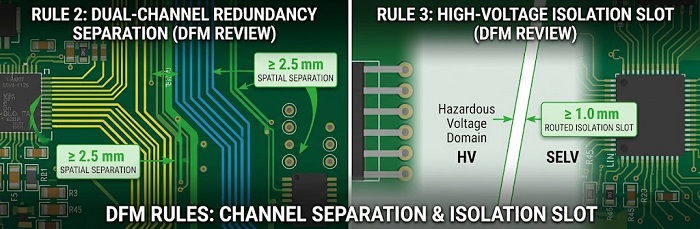
Dual-channel SIL 2/3 architectures require that Channel A and Channel B signal paths maintain ≥ 2.5 mm spatial separation (or a routed ground guard trace) to prevent common-cause failure from a single solder bridge, ESD strike, or board-level crack simultaneously defeating both channels. This separation must be maintained through via transitions and on inner copper layers — not just on the outer layer where it is visually apparent during DFM review.
Spatial separation addresses in-plane failure coupling between channels. The third rule addresses the out-of-plane isolation boundary that separates hazardous voltage domains from the safety logic that monitors them.
3. High-Voltage Isolation Slot Design
For safety controllers with reinforced insulation requirements (IEC 60664-1 Pollution Degree 2, Overvoltage Category III), the PCB isolation slot between hazardous and safety extra-low voltage (SELV) domains must be ≥ 1.0 mm wide, routed continuously without solder mask bridging the gap, and flagged in the Gerber data as a controlled feature. Surface contamination in this slot — from misapplied flux or incomplete board cleaning — is a direct creepage failure. The slot geometry must accommodate wash chemistry penetrating the full slot depth; boards cleaned in the KED600 Batch Cleaner are specifically validated for slot-interior cleanliness to IPC-610 ionic contamination limits.
Ready to Validate Your Safety Controller PCBA Process?
The process controls described here — PFMEA-linked SPC, 3D SPI closed-loop feedback, MES component traceability, and selective wave soldering — are active production disciplines at PCBCart, not quality system claims. Each one generates the process evidence that a functional safety validation file requires: quantitative, traceable, and audit-ready.
If you are designing a SIL 2 or SIL 3 safety controller and need a manufacturing partner whose process record can stand behind your IEC 62061 validation file, two resources are immediately available:
→ Request a FREE DFM Review for your safety controller Gerber package. Our engineering team will return a structured report covering test point accessibility, channel separation, and isolation slot compliance within 48 hours.
Contact PCBCart Engineering: [Request DFM Review]
PCBCart operates under an IATF 16949-certified quality management system. Our automotive-grade process control protocols — PFMEA, SPC, Control Plans, and component-level MES traceability — meet or exceed the systematic capability requirements for non-implantable industrial and life science safety electronics.
Helpful Resources
• Hybrid Assembly Strategies for THT and SMT Components
• Comparison of AOI, ICT and AXI and When to Use Them during PCB SMT Assembly
• Some Handy Methods in Evaluating SMT Assembler's Capabilities
• Stencil Design Requirement on QFN Components for Optimal Performance of PCBA
• Advanced PCB Assembly


