



Industry: Medical & Life Science Instrumentation
Company: Confidential
Services: Medical PCB Assembly, Process Optimization, HMLV EMS
Background
A leading developer of medical and life science instrumentation required a reliable partner for medical PCB assembly during the prototype and validation stage of a new detection system.
At this stage, the project involved high-mix, low-volume (HMLV) production, multiple design iterations, and strict reliability requirements typical of medical electronics manufacturing.
The client needed an EMS partner capable of delivering flexible low volume PCB assembly while also providing strong engineering support to quickly resolve manufacturing challenges during development.
As a specialized HMLV EMS provider, PCBCart was selected to support the project through engineering-driven process optimization and rapid production response.
Challenges
During early-stage prototype builds, several critical manufacturing issues were identified that directly affected product reliability and assembly consistency.
One major issue involved solder voiding in power components after reflow. Excessive voiding reduced thermal performance and created long-term reliability concerns for the medical device.
At the same time, elevated components with standoff structures experienced insufficient solder filling, leading to inconsistent solder joints and potential electrical instability.
The project also faced connector alignment issues during assembly. Variations in positioning and height affected coplanarity and reduced assembly consistency across different builds.
In addition, the combination of multiple component types and ongoing design revisions created tight process windows, requiring rapid engineering adjustments throughout production.
These challenges are common in prototype PCB assembly for medical devices, where product designs continue to evolve during validation stages.
PCBCart’s HMLV EMS Solutions
To improve manufacturing reliability, PCBCart implemented several targeted process optimizations tailored for HMLV production environments.
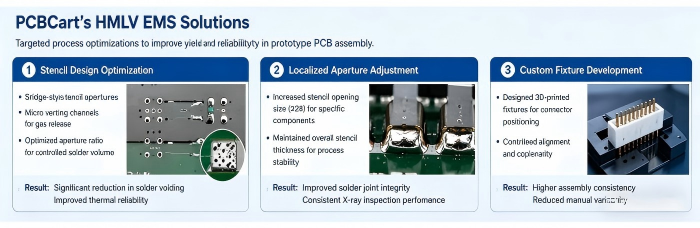
Advanced Stencil Design Optimization
To reduce solder voiding in critical power devices, PCBCart redesigned the stencil aperture structure by introducing bridge-style openings and micro venting channels for gas release during reflow.
The engineering team also optimized aperture ratios to better control solder volume distribution without affecting adjacent components.
As a result, solder voiding was significantly reduced, improving thermal reliability and overall assembly quality for the medical PCBA.
Localized Aperture Adjustment for Improved Solder Filling
For elevated components requiring additional solder volume, PCBCart applied localized stencil aperture enlargement while maintaining the original stencil thickness for process stability.
This optimization improved solder joint formation and ensured more consistent electrical and mechanical performance.
X-ray inspection confirmed improved solder integrity and stable assembly quality across repeated prototype builds.
Custom Fixture Development for Precision Assembly
To address connector alignment challenges, PCBCart designed customized 3D-printed assembly fixtures to precisely control component positioning and height during assembly.
The fixtures improved coplanarity, reduced manual variation, and enhanced consistency across multiple low-volume production runs.
This rapid tooling capability is one of the key advantages of PCBCart’s HMLV EMS model, allowing fast adaptation during product development stages.
Technical Capabilities Demonstrated
This project demonstrated PCBCart’s ability to deliver high-reliability medical PCB assembly through a combination of engineering expertise and flexible HMLV manufacturing.
Key capabilities applied throughout the project included:
High-reliability assembly for medical electronics
High-mix, low-volume production management
Iterative process optimization during prototype builds
X-ray inspection for solder joint validation
Custom fixture engineering for precision assembly
Rapid engineering response to ongoing design changes
Results
Through continuous process refinement and close engineering collaboration, PCBCart successfully improved manufacturing stability during prototype production.
The project achieved:
Improved yield in low volume PCB assembly
Reduced defect rates in critical components
Faster iteration cycles during development
Enhanced reliability and consistency of medical PCBA
Better production readiness for future scaling
Why HMLV EMS Matters for Medical Devices
In medical electronics manufacturing, many critical quality and reliability issues emerge during the prototype stage rather than during mass production.
PCBCart’s HMLV EMS model enables rapid process adjustments, engineering-driven problem solving, and flexible low-volume manufacturing support that align closely with medical device development cycles.
By resolving manufacturability and reliability challenges early, customers can reduce risk, accelerate validation, and transition more smoothly toward mass production.
By combining deep expertise in medical PCB assembly with flexible HMLV manufacturing capabilities, PCBCart helped the customer overcome critical early-stage production challenges and improve product reliability during development.
This case highlights how engineering-focused HMLV EMS support can play a key role in accelerating medical device innovation while maintaining the high quality standards required for medical electronics.


