



Yes — per-unit cost in HMLV work typically runs 15-40% higher than a single high-volume run of the same board, because fixed setup costs are spread across far fewer units, and this is a mathematical reality of small batches, not a hidden markup.
Why Small Batches Cost More Per Unit
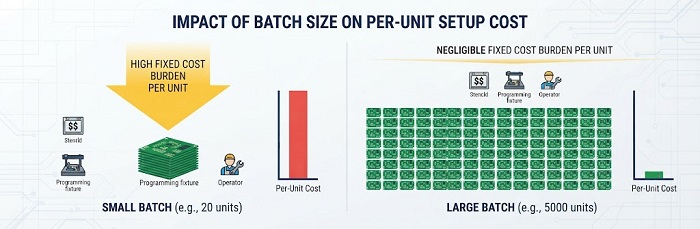
A stencil costing $30-80 is negligible across a 5,000-unit run (a few cents per board) but adds real, visible cost per unit across a 20-unit run. The same is true of first-article inspection time, line changeover, and programming setup for any parts requiring firmware upload — all of these are fixed costs regardless of batch size, so the smaller the batch, the higher the per-unit burden.
The Fee Categories Worth Asking About Explicitly
Because disclosure practices vary across suppliers, these are the fees most often missing from a headline quote:
NRE/engineering fee — commonly $0-150 for a new design; many suppliers waive it above a minimum order value.
Programming fee — applies to any part (MCU, EEPROM) requiring firmware/data upload during assembly.
Line-changeover fee — charged when a production run switches between multiple distinct board designs in the same batch, common in true high-mix orders.
Testing fees — AOI is usually bundled; ICT and functional test are typically itemized separately.
Panel/setup fees per unique design — relevant if you're shipping several different boards together; ask whether setup is charged once per unique Gerber/BOM pair.
Fee Transparency Comparison
| Fee Type | Usually Included in Base Quote? | Typical Range |
|---|---|---|
| Stencil | Sometimes | $30-80 one-time |
| NRE/Engineering | Sometimes waived above minimum order | $0-150 |
| Programming | Rarely | $10-50 per unique part |
| AOI Inspection | Usually yes | Included |
| X-ray/ICT/Functional Test | Rarely | Quoted separately |
| Line changeover (multi-design batch) | Rarely | Varies by supplier |
How to Compare Quotes Fairly Across Suppliers
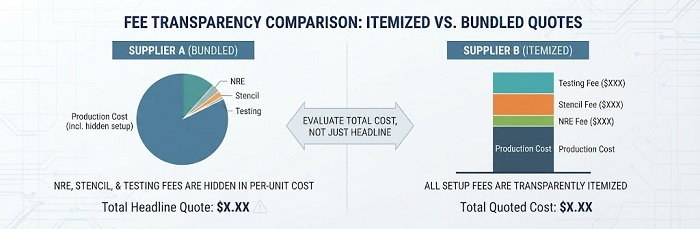
The single biggest mistake HMLV buyers make is comparing two suppliers' headline numbers without normalizing for what's excluded. Ask each supplier for "cost per unit excluding one-time fees" as a separate line, then compare that number directly — this strips out the batch-size distortion and lets you see who actually has better component pricing and labor rates.
A Real-World Scenario
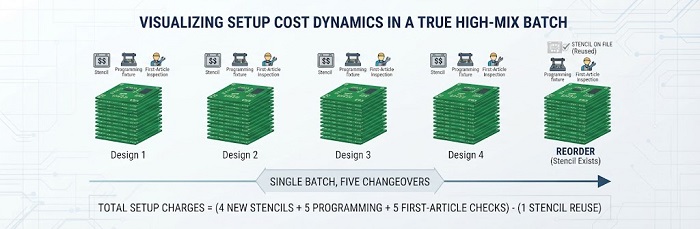
A buyer ordering 5 different board designs, 15 units each (75 boards total, true high-mix), receives a quote that looks 25% more expensive per board than a single-design 500-unit run quoted by the same supplier. The difference is almost entirely five separate stencil/setup charges instead of one — not a punitive high-mix surcharge, but the direct mathematical consequence of five fixed costs spread across small quantities. When the buyer asks for the itemized breakdown, the supplier confirms that four of the five designs are new (each requiring its own stencil and first-article check), while the fifth is a reorder of a previous design whose stencil was already on file — reducing that one design's line item noticeably and confirming that the price gap is fully explained by legitimate one-time setup costs rather than any high-mix penalty being applied across the board.
Common Mistakes Buyers Make on Small-Batch Orders
Splitting one design into multiple tiny orders instead of one consolidated order. Every split order re-triggers setup costs; consolidating a year's expected demand into fewer, larger releases (even if shipped in batches) can meaningfully cut total fixed-cost exposure.
Not asking whether a stencil from a prior order still exists. Buyers frequently pay for a new stencil on every reorder simply because they didn't ask the supplier to retain and reuse the one from last time.
Assuming HMLV pricing is uniform across suppliers. Fixed-cost amortization models differ meaningfully between suppliers — one may absorb NRE into a minimum order value while another itemizes every fee — so a supplier that looks expensive on a single order can be cheaper across a full year of small reorders.
Ignoring line-changeover fees on multi-design batches. True high-mix orders (several different boards in one shipment) commonly carry a changeover fee per design switch that's easy to miss when only reviewing the headline total.
Negotiation Tips for High-Mix, Low-Volume Buyers
If you have predictable recurring demand across several small designs, ask about a blanket order or scheduled-release agreement — committing to an annual quantity across multiple release dates often unlocks better per-unit component pricing than treating each release as an independent one-off order, even though the batch sizes themselves stay small. It's also worth asking directly whether your specific supplier waives NRE above a stated minimum order value, since this threshold varies significantly and isn't always advertised — sometimes a small quantity increase is enough to cross into waived-fee territory.
The most overlooked lever for HMLV buyers specifically is tooling reuse. Because a framed stencil and any programming fixtures are physical assets the supplier holds on your behalf, explicitly asking "will you store this and reuse it on my next order" converts a recurring fixed cost into a true one-time cost. Suppliers vary in how long they retain tooling by default — some discard it after a fixed window (commonly 6-12 months) if there's no reorder, so if your reorder cadence is longer than that, it's worth asking whether they'll extend retention for a known, named recurring customer rather than assuming indefinite storage.
How Batch Size Changes Your Per-Unit Cost Structure
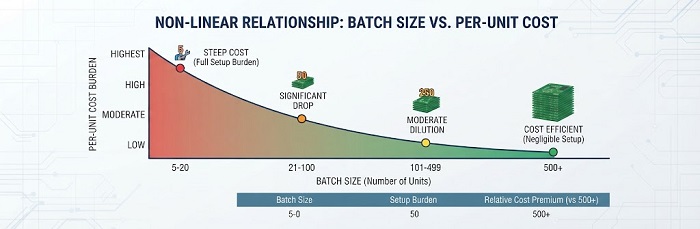
The relationship between batch size and per-unit cost isn't linear — it's steepest at the smallest quantities and flattens out as fixed costs get diluted across more units.
| Batch Size | Fixed-Cost Burden Per Unit | Typical Premium vs. 500+ Unit Run |
|---|---|---|
| 5-20 units | Highest — full NRE/stencil cost on very few boards | 30-40% |
| 21-100 units | High — still meaningful dilution gap | 15-25% |
| 101-499 units | Moderate — most setup cost already diluted | 5-15% |
| 500+ units | Low — setup cost is nearly negligible per unit | Baseline |
This is exactly why buyers who reorder the same small-batch design repeatedly should think in terms of cumulative annual spend rather than judging each individual order in isolation. A $60 stencil paid once and reused across four quarterly 25-unit reorders costs the same $0.60/unit as paying it fresh on a single 100-unit order — but a buyer who unknowingly triggers a new stencil charge on every reorder is effectively paying that fixed cost four times over the year for no additional benefit.
Why Fee Structures Vary So Much Between Suppliers
Two suppliers quoting the identical BOM and quantity can structure their fees in completely different ways while landing on a similar total — one may fold NRE into a slightly higher per-unit labor rate, while another itemizes every fixed cost separately and charges a lower headline labor rate. Neither approach is inherently better, but they're not directly comparable at a glance, which is exactly why itemization matters more than the bottom-line total when evaluating competing quotes. A supplier with an itemized, higher-looking total that excludes testing may end up cheaper than a lower, bundled quote once you add the testing cost you'd need anyway — so always ask what's excluded before assuming a lower number represents genuine savings.
Checklist Before Committing
· Request a fully itemized quote broken into fixed (one-time) vs. variable (per-unit) costs.
· Ask specifically whether testing beyond AOI is included.
· If reordering the same design, ask whether the stencil can be reused to avoid repeat NRE charges.
· For multi-design batches, confirm whether setup is charged per design or per shipment.
· Normalize competing quotes to "cost per unit excluding one-time fees" before comparing.
· Ask about blanket/scheduled-release agreements if you have predictable recurring small-batch demand.
FAQs
1. What's a normal NRE fee range for a new design?
Commonly $0-150 depending on complexity, and many suppliers waive it entirely above a stated minimum order value — ask what that threshold is, since it's rarely advertised upfront.
2. Does testing always cost extra?
Basic AOI is usually bundled into the base quote at no extra charge, but ICT and functional test are almost always itemized separately, so confirm test scope before assuming it's included.
3. Can I share a stencil across multiple small orders?
Yes, as long as the design is unchanged — explicitly ask the supplier to store and reuse it rather than assuming they will by default, since some suppliers discard tooling after a set retention period.
4. Is per-unit price negotiable at low volume?
Rarely on the component-cost line itself, but sometimes on labor or setup fees if you commit to a recurring order cadence or a blanket annual agreement.
5. How do I compare quotes fairly across suppliers?
Normalize every competing quote to "cost per unit excluding one-time fees," then compare that number directly — this strips out batch-size distortion and reveals who genuinely has better component and labor pricing.


