



Procurement teams evaluating EMS partners frequently request "industry benchmarks" without a defined source for what those benchmarks represent. This reference compiles publicly documented material from two organizations that track the electronics assembly industry — IPC and iNEMI — and translates it into questions buyers can raise during supplier due diligence.
This is a compilation of publicly available survey methodology and roadmap content, not proprietary production data, organized for buyers running high-mix, low-volume (HMLV) programs.
Why Public Benchmarks Matter More for HMLV Buyers
High-volume OEMs can draw on an extended production history with a single contract manufacturer to establish what constitutes normal process behavior. HMLV buyers — frequent design revisions, smaller lot sizes, more first-article builds — operate with less accumulated reference data. Each new build behaves closer to a first-pass yield event than a mature, steady-state process. Public benchmark data provides a reference point when a supplier's self-reported figures are the only figures available for comparison.
What IPC's Benchmark Study Actually Covers
IPC publishes a biennial Study of Quality Benchmarks for the Electronics Assembly Industry, compiling survey results from more than 50 assembly companies, predominantly contract electronics manufacturing service (EMS) providers and original equipment manufacturers (OEMs) — roughly two-thirds EMS, about one-fourth OEM. The panel has expanded across editions; the 2022 study represented 59 electronics assembly companies of varying scale worldwide.
The measurements tracked include:
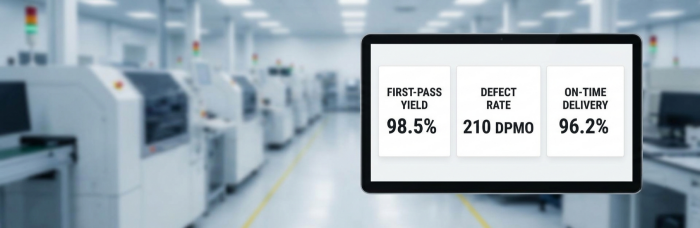
Yield — first-pass and final inspection yield, plus internal yield by process step
Defect rate, expressed in DPMO (defects per million opportunities)
On-time delivery and customer return rate
Cost of poor quality — rework and scrap as a percentage of sales
Certification adoption — for example, 44% of respondents held AS9100 certification, with an additional 5% in the process of obtaining it
Inventory accuracy — a metric directly linked to delivery reliability. One recent survey cycle reported average SMT component inventory accuracy of 88.7%, against 74.8% for PTH components — both a measurable decline from the prior cycle
All figures are reported as averages, medians, and percentile distributions, segmented by company size tier, region, and production type. The numeric ranges for yield and DPMO by segment reside within the paid report; what's publicly available is the methodology and select summary figures, not the full percentile tables. When a supplier cites an "industry benchmark," the reasonable follow-up question is which report edition and which segment the comparison draws from.
What iNEMI's Roadmap Contributes
iNEMI (International Electronics Manufacturing Initiative) does not publish a KPI benchmark survey; its function is distinct from IPC's. iNEMI's roadmaps chart, over a ten-year horizon, the trajectory of electronics manufacturing — application and market drivers, technical requirements, maturity of available solutions, and anticipated technology gaps. Recent roadmap expansions added board assembly and complex integrated systems as dedicated topics, addressing the rising integration complexity spanning chips, packages, and boards.
For HMLV buyers, this functions less as a numeric benchmark and more as a maturity indicator: iNEMI's roadmap identifies which process capabilities — finer-pitch placement, advanced inspection, mixed-technology integration — are considered industry-mainstream versus still-emerging. A supplier's equipment list carries more meaning when evaluated against that maturity trajectory.

Applying These Benchmarks to an HMLV Program
A few considerations when translating industry-wide figures to a small-lot, high-mix context:
Aggregate benchmarks skew toward steady-state production. Industry-level DPMO and yield figures are typically driven by high-volume, repeat-build data. A first-article run or a low-volume specialized batch behaves differently under statistical analysis — smaller sample sizes inflate the apparent weight of individual defects.
On-time delivery benchmarks assume stable component supply. The industry-wide decline in inventory accuracy that IPC's own data documents reflects a supply-chain condition as much as a process-control one — worth raising directly with a prospective CM regarding their specific BOM.
Certification adoption is not a proxy for process capability. Certification rates indicate the prevalence of specific quality management frameworks across the industry, not whether a given supplier's SPI/AOI closed-loop process is tuned to a specific component mix.
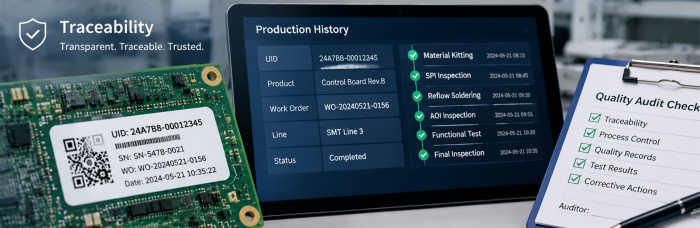
This connects to points raised in earlier coverage of MES-based UID traceability and 3D SPI/AOI closed-loop inspection: process control systems generate the internal data that makes a supplier's benchmark claims verifiable in the first place. A supplier who can produce only a plant-wide average, rather than process-level yield data by work order, is offering an industry statistic rather than an answer specific to a given board.
A Framework for Auditing an EMS Supplier Against Public Benchmarks
Rather than requesting a single figure, structure the inquiry:
Identify which benchmark, which edition, which segment. "What's your DPMO" invites a rounded, unverifiable response. "How does your DPMO compare to IPC's most recent benchmark study for EMS companies in your revenue tier" invites a sourced one.
Request data at the process level, not the plant level. Plant-wide yield obscures process-step variation. Request first-pass yield broken out by SPI, reflow, and post-AOI/X-ray inspection stages, specific to the product class in question — for example, fine-pitch BGA or high-copper power boards.
Ask how statistical noise is handled at low volume. A CM quoting a single plant-wide DPMO figure for both 50,000-unit and 50-unit programs has not addressed how HMLV builds behave statistically. Ask how first-article and pilot-run data is tracked separately from steady-state production data.
Ask what drives on-time delivery variance. Given the industry-wide pressure on inventory accuracy, ask specifically how component kitting and MOQ handling affect delivery commitments on mixed, frequently-changing BOMs — not only the headline on-time percentage.
Treat certification as a baseline, not a differentiator. Different certifications signal different things, and none of them alone confirms fitness for an HMLV program. IATF 16949 speaks to automotive-derived process discipline and defect-prevention methodology; AS9100 layers in aerospace-grade traceability and configuration control; ISO 13485 addresses medical device quality management specifically; ISO 9001 establishes a general quality management system baseline. A supplier holding one or several of these has a documented management system — it doesn't by itself indicate whether that system was built around HMLV variability (frequent changeovers, small lots, first-article risk) or high-volume repeatability. For buyers in regulated end markets, the more useful question in a supplier conversation is not which certifications a CM holds in the abstract, but which ones are actually relevant to the specific product category and how the quality system handles the failure modes that come with mixed, low-volume production runs.
Where This Fits
Public benchmark data serves as a starting point for a supplier conversation, not a substitute for one. The figures indicate what is typical across a large, predominantly high-volume panel; the actual risk in a given program sits in the specifics — component mix, pitch, thermal profile, lot size — that no industry survey captures.
PCBCart works across industrial automation, telecommunications, data infrastructure, and life sciences HMLV programs. To compare a project's lead time, yield, or defect-rate expectations against what's realistic for a specific build, submit your project parameters and we'll walk through a preliminary comparison assessment.
Helpful Resources
• Help For PCB Fabrication & Assembly Orders
• ISO 13485 Principles with an IATF 16949 Certified PCBA Partner
• Free DFM Pre-Review
• DFM Audit Checklist for HMLV/Industrial PCBA


