



Industry: Telecommunications
Key Capabilities: Critical Component Engineering · Pad Optimization · IPC Class 3 Standards · Dual Soldering Process · High-Reliability Assembly
Overview
Telecommunication infrastructure requires the highest level of reliability, often demanding IPC Class 3 compliance. For critical "PHD" and "C33" components, standard assembly methods are often insufficient to prevent shifting or soldering defects. PCBCart optimized the assembly of these critical communication components through advanced pad re-engineering and a specialized dual-soldering process, ensuring absolute alignment and electrical integrity.
Background
A telecom client was experiencing inconsistent alignment and frequent "short/open" defects on mission-critical components. These parts are vital for signal processing, and any defect could lead to network downtime. Previous attempts using traditional fixtures failed to meet the strict IPC Class 3 standards for alignment and solder volume.
The Challenges
Ultra-High Precision Requirements: Components required near-perfect alignment to maintain signal integrity at high frequencies.
Class 3 Quality Standards: Zero tolerance for solder voids, shorts, or component shifting.
Ineffective Fixture Solutions: Standard mechanical jigs were introducing more variability rather than reducing it.
Complex Component Geometry: The specific footprint of PHD components made traditional reflow profiles difficult to manage.
Engineering Insight
In high-precision telecom assembly, the "Surface Tension" of the molten solder can be your best friend or your worst enemy. If pad designs are unbalanced, surface tension will "pull" the component out of alignment during reflow. By optimizing the pad geometry and using a dual-soldering approach, we can harness these physical forces to "self-center" the component.
Optimization Strategy
Pad Geometry Optimization: Redesigned the component pads to ensure perfectly balanced thermal mass and solder wetting, facilitating automatic self-alignment during reflow.
Dual-Soldering Process Implementation: Combined precision SMT reflow with a secondary specialized soldering step to ensure maximum joint strength and electrical conductivity.
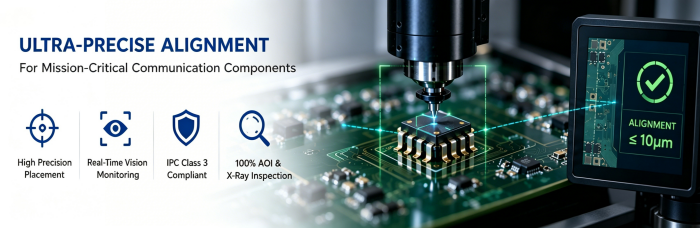
Real-Time Alignment Monitoring: Integrated high-resolution vision systems on the Pick-and-Place line to verify placement accuracy to within microns.
Rigorous Reliability Validation: Conducted 100% AOI and X-ray inspection on all critical nodes to verify compliance with Class 3 standards.
Results
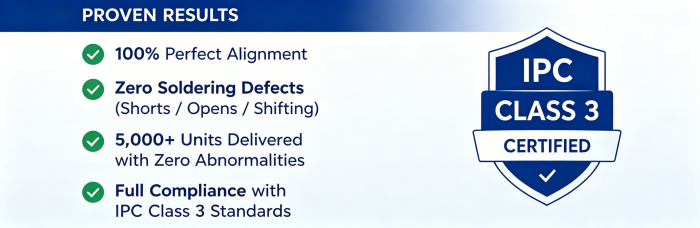
Perfect Alignment: Achieved 100% precise component alignment across the production run.
Zero Soldering Defects: Eliminated all occurrences of shorts, opens, and component shifting.
Validated Production: Successfully delivered 5,000+ units with zero reported abnormalities.
IPC Class 3 Certified: Fully met and exceeded the reliability requirements for high-performance communication systems.
Need Precision Assembly for Critical Telecom Components?
Achieve IPC Class 3 reliability and zero-defect performance with PCBCart’s advanced design and process optimization.


