



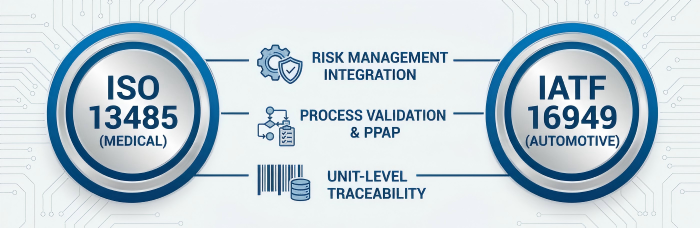
The first thing that comes to mind when procurement teams give an EMS partner a thumbs-up for non-implantable medical instrumentation — such as DNA sequencers, hematology analyzers, patient monitoring systems, and diagnostic imaging controllers — is to adopt a certification checklist approach. When it comes to that list, ISO 13485 more often than not is the top contender for good reason: It is the internationally recognised quality management system standard for medical device organisations that requires an ISO 9001-like approach, but with a twist, and that's risk management, unit-level traceability, process validation and rigorous documentation control.
However, a certification on a quality certificate is not a final answer, but rather a stepping stone. The real field reliability question, running the other way, is more basic: can the supplier demonstrate with data that their process architecture is designed to fail-proof the product before it is installed?
The International Automotive Task Force (IATF) quality management standard, IATF 16949:2016, was created to provide an answer to this question for the most challenging environment for high-volume, zero-defect manufacturing in the world. It is critical for procurement and engineering teams to understand the relationship between its core tools and medical PCBA risk control requirements when making a substantive supplier evaluation.
What Medical PCBA Compliance Actually Requires at the Process Level
Subcontractors working for Medical Device OEMs are required to perform under specific clauses in ISO 13485:2016, clauses 7.4 and 7.5. After removing the regulatory language, the engineering requirements are:
Process design with documented risk management, not attached afterwards
Traceability at the unit level to component lot, date code and process parameter.
True statistical evidence for process control—end-of-line inspection sampling is not enough!
Managed change management with documented impact assessment to product safety
Tested soldering and cleaning process and accepted it according to the objective criteria
There is clearly each one of these requirement that corresponds to a more mature counterpart in IATF 16949's Advanced Product Quality Planning (APQP) framework. The mapping is not just an approximation, it is structurally isomorphic. An IATF 16949 system with Tier-1 automotive discipline has the same risk control outcomes as ISO 13485, but by equivalent engineering mechanisms.
Five Core IATF 16949 Tools and Their Medical Risk Control Equivalents
FMEA — Process Failure Mode and Effects Analysis
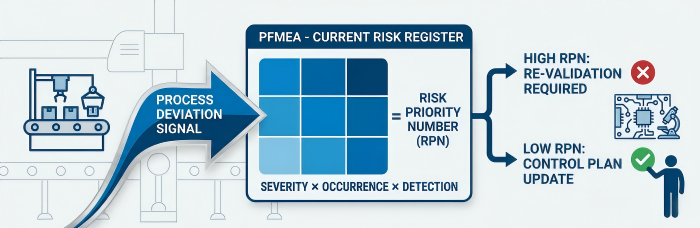
Process FMEA (PFMEA) in automotive production is not a document that is created only at the start of the programme. It is a current risk register and is updated at every engineering change, when a new supplier of components is qualified and whenever a process deviation occurs. Risk Priority Numbers (RPNs) are directly related to process changes and whether they need to be re-validated prior to production release (severity x occurrence x detection).
This aligns precisely with the requirements of ISO 13485, Clause 7.1 Risk Management Integration, and ISO 14971 Process Hazard Analysis, for medical instrumentation PCBA. Our PFMEA methodology is used to analyze potential failure modes when installing a new sequencer control board, including:
Solder bridging on 0.4 mm pitch BGA packages (Severity: 9 — undetected open circuit in signal acquisition path)
Violation of area of thermal pad joints (QFN) >25% (Severity: 8 — thermal runaway in analog front-end amplifiers)
When used in power rails, electrolytic decoupling capacitors can undergo polarity reversal when the power line fails.
Detection controls are pre-assigned in the PFMEA before the first production unit is built; our offline X-Ray inspection system measures the void percentages per IPC-7095D, and 3D AOI with sub-pixel optical resolution is measurement control.
PPAP — Production Part Approval Process
For the new assembly to be approved for serial production, it must provide objective evidence for 18 elements, a standard that is met by PPAP Level 3 submission, routinely performed by automotive Tier-1 suppliers. The most relevant elements to life sciences procurement are:
Design Records/Engineering Change Documentation — complete revision controlled BOM and assembly drawings.
Documented Routing from incoming inspection to final functional test is the Process Flow Diagram.
Inspection Equipment (SPI, AOI, X-Ray) is an example of measurement system analysis (MSA) which assures that the inspection equipment is capable of distinguishing conforming from non-conforming parts of the product.
Initial Process Capability Studies (Cpk ≥ 1.67) prior to production approval for critical-to-quality (CTQ) parameters
Control Plan — the document that ties all the process steps together with the control method, the reaction plan, and the responsible technician.
The PPAP submission package for a medical OEM is essentially the same as the Design Validation and Process Validation (V&V) documentation required by ISO 13485 Clauses 7.3.7 and 7.5.6. In engineering practice, it can be much harder to generate, maintain, and defend this package in the face of automotive customer audits than is a standard medical device supplier qualification cycle.
SPC — Statistical Process Control
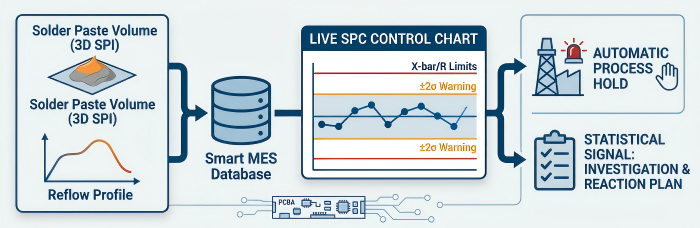
Process capability is something that is not a one-time demonstration. Our Smart MES (Manufacturing Execution System) collects real time process data for each production order and can monitor control chart behaviour for CTQ parameters such as:
Solder paste volume (3D SPI): Target Cpk ≥ 1.67 for the volume of solder paste deposited into the stencil aperture for each stencil aperture — critical with 0201 and smaller passive components in which ±15µm change in solder paste deposit is directly related to the possibility of cold joints due to the paste deposit
Thermocouple data is recorded and associated with each production lot and monitored for each reflow profile for peak temperatures of 240°C-250°C for lead-free SAC305 alloy reflow, time-above-liquidus of 40-60 seconds, and ramp rates of ≤ 3°C/second.
The following parameters of the selective wave solder process are recorded per pallet: Solder pot temperature (usually 255°C - 265°C for lead-free wave), flux deposit volume and Dwell time under N2 atmosphere (O₂ < 500 ppm) to minimize the oxidation of through-holes joints.
Our MES workflow calls for a process hold at any two consecutive process points outside of the X-bar/R chart limits of ±2σ. This is in response to statistical signals, not to get rid of — just like ISO 14971 requires for process risk monitoring.
Control Plans and Reaction Plans
Each assembly has a tiered Control Plan that outlines the control method, sample size, measurement frequency and reaction plan for each process step. In the case of through-hole parts on medical instrument motherboards, the control plan will include:
IPC-A-610 CLASS 3 – Acceptance criteria: Through-hole solder joints meet minimum 75% barrel fill and is verified by cross-section sampling of through-hole at defined intervals.
Zero-defect escape targets for open circuits and solder bridges achieved by 3D AOI immediately after reflow.
The 100% X-Ray inspection is required for all BGA packages and the voiding acceptance limit is ≤ 15% aggregate void area according to IPC-7095D.
Reaction plans are pre-defined and include what the line operator does, who is notified and what disposition authority exists. It is not up to the machine operator's interpretation whether to continue or not when an alarm is activated.
MSA — Measurement System Analysis
If a quality system is not supported by a quality policy or strategy that proves that the inspection equipment is capable of consistently identifying the defects that it is intended to identify, then it is not a quality system, it is a documentation system. Our Gauge R&R studies of 3D SPI equipment are showing that the measurement variation due to the inspection system itself is less than 10% of total tolerance range for the paste volume measurement (which is the automotive Tier-1 requirement for an acceptable measurement system).
X-Ray void detection and AOI lighting and algorithm qualification are also under the same discipline. Medical OEM customers can obtain performance data from the measurement system during supplier qualification audits.
Automotive-Grade Assembly Under Vibration and Thermal Stress
The environment in which non-implantable life sciences instruments operate is as demanding as that of automotive electronics, with exposure to mechanical vibration during transport and field use, thermal cycling over the entire life cycle, and exposure to the humid environment that increases the chances for electrochemical migration on PCBAs with closely spaced components.
To meet AEC-Q component standards and OEM environmental test program requirements, such as exposure to condensing humidity and -40°C to +125°C thermal shock, combined with random vibration up to MIL-STD-810G profiles, the integrity of the solder joints must be designed in — not inspected out — at the process level. The process disciplines developed for obtaining reliable joints on an engine control unit at elevated temperature and for extended periods are directly applicable to the thermal management issues of a sequencer flow cell controller or a mass spectrometer RF drive board.
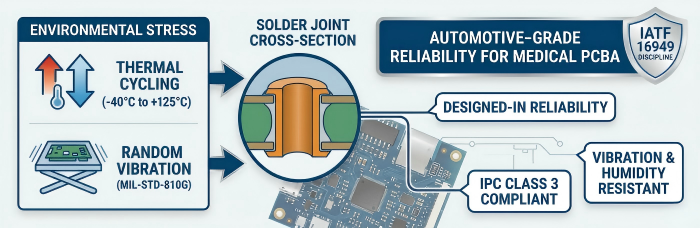
Our selective wave soldering system is fully automatic and has been designed to achieve Nitrogen protected THT soldering on Mixed Technology Boards, where adjacent SMD components should not be damaged when forming the through-hole solder joint. Selective soldering uses nitrogen-blanketed solder nozzles with dwell times and temps programmed down to the individual joint with a 0402 ceramic cap 1.2 mm from a 2-pin connector that needs a full IPC Class 3 barrel fill.
Traceability: MES Architecture and Laser Serialization
It is a Tier-1 automotive requirement to have unit-level traceability, and similar to the requirements for Device History Record (DHR) outlined in FDA 21 CFR Part 820 and ISO 13485 Clause 7.5.9.
Our Smart MES monitors component lot and date code at a feeder level and assigns each placement event to a production order and board serial number. Each finished PCBA is given a laser-marked unique serial number that is permanent, non-alterable and tied into the MES database to the complete manufacturing history. The following can be recreated in hours in the event of a field return or regulatory investigation:
Which component reel (lot/date code) was used for all the critical active devices
A reflow profile thermocouple log for that production order.
All raw measurement data, SPI, AOI and X-ray inspection results
Details for any manual assembly or inspection step, such as operator ID and workstation ID
This infrastructure was designed to meet OEM traceability audits for the auto industry. It is not a retrofitting of life sciences DHR requirements, but rather a logical outcome of life sciences requirements.
The engineering requirements for reliable PCBA in non-implantable life sciences instrumentation (rigorous risk management, validated processes, unit level traceability, and statistically controlled production) are not specific to the medical field. They're the 'floor rules' used by Tier-1 automotive producers and they're held in check by a quality system architecture called IATF 16949.
The productive dialogue with a PCBA partner is one of process data, inspection architecture, and traceability infrastructure, for hardware engineering teams creating diagnostic, sequencing, and analytical instrumentation. One input to that evaluation is scope of certification, and process evidence is the substance. PCBCart is an IATF 16949:2016 certified Electronic Manufacturing Services (EMS) provider with focus on High Mix Low Volume (HMLV) PCBA manufacturing for high reliability applications. Contact our engineering team about your program needs.


