



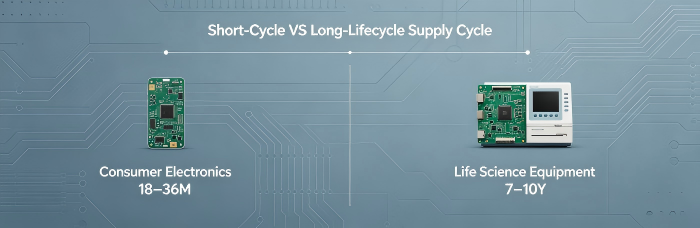
Life sciences instrumentation operates under a constraint that is practically foreign to consumer electronics: a device validated and cleared today may remain in production—largely unchanged—for a decade or longer. Diagnostic analyzers, patient monitoring platforms, and laboratory automation controllers routinely carry 7–10 year product lifecycles, and field-installed bases can extend support obligations even further. For the hardware R&D engineers and procurement directors responsible for sustaining these programs, the bill of materials is not a static document—it is a living risk register.
Why Standard EMS Practice Fails Medical Electronics
Most electronics contract manufacturing is optimized for programs with 18–36 month product cycles. Supplier qualification, component inventory strategy, and process documentation are all calibrated to that cadence. Life sciences programs break these assumptions immediately.
Consider a single microcontroller that anchors a signal-acquisition front-end. Over a 10-year horizon, the original part may be discontinued, re-spun to a new silicon revision, transferred to a different fab node, or absorbed into a vendor portfolio following an acquisition—each event carrying real engineering risk: changed timing characteristics, revised errata, shifted pin-compatible but not register-compatible behavior. The EMS partner that treats component selection as a procurement detail, rather than a systems engineering decision, will consistently deliver surprises at the worst possible moment.
At PCBCart, we structure our HMLV programs around a Supply Chain Risk Architecture built specifically for extended lifecycle commitments. The key pillars are described below.
Obsolescence Management: A Structured Engineering Discipline
Lifecycle Intelligence and PCN Monitoring
Every qualified component in our customer programs is enrolled in active Product Change Notice (PCN) and Product Discontinuation Notice (PDN) monitoring via direct manufacturer data feeds and third-party lifecycle intelligence platforms. Notifications are triaged by our component engineering team within 48 hours of receipt and classified against a standardized risk matrix:
Class A – Immediate Action: Last-time-buy (LTB) window open; direct customer notification with recommended LTB quantities calculated from remaining program forecast.
Class B – Controlled Substitution: Pin, package, and function equivalent identified; formal Alternate Part Engineering Evaluation (APEE) initiated.
Class C – Monitored: Lead time extension or allocation risk; buffer stock recommendation issued.
This cadence means customers are never discovering a discontinuation during a production build. The conversation happens at the engineering desk, not on the factory floor.
Alternate Part Engineering Evaluation (APEE)
If no direct replacement, a structured APEE is performed on candidate components which is assessed on the following parameters:
Electrical equivalence: DC operating characteristics, AC parametric limits, input/output thresholds and timing specifications are reviewed against original device datasheet, and delta analysis is documented in a formal comparison table.
Package and land pattern compatibility: Physical dimensions checked to IPC-7351 footprint requirements; co-planarity tolerance and lead pitch checked against our 3D Solder Paste Inspection (3D SPI) capability which is a high resolution measurement of solder paste height, area and volume for process verification.
Thermal profile compatibility: Best fit parts to reflow temperature rating. Our lead-free reflow profiles are designed to operate at peak temperatures of 245C-250C and usually have a time-above-liquidus of 45-60 seconds, depending on the qualification requirements of the component, for solder systems using SAC. If the candidate's MSL rating is lower or has a lower peak temperature tolerance, a qualification build is automatically generated.
Silicon revision delta analysis: In silicon revision delta analysis, a structured impact statement is generated and sent to the customer's software validation team to highlight Errata, functional changes and firmware dependency.
There is not an alternate part that is brought into production without an APEE package, the functional validation build and customer sign-off. This is required for all life sciences programs.
Strategic Buffer Stocks and Bonded Inventories
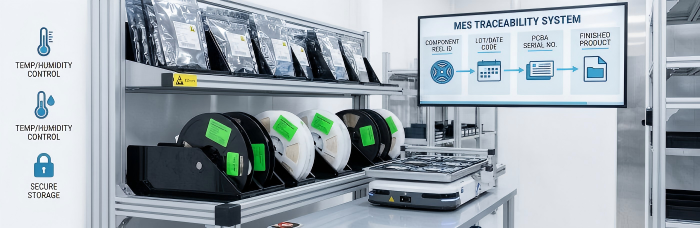
Components that are deemed to be single source, long lead-time, and/or exhibit early lifecycle maturity signals are coordinated with customers under bonded inventory agreements. All the components are purchased from authorised sources and individually lot coded, date coded and documented in our Smart MES (Manufacturing Execution System) for complete traceability. Controllable temperature and humidity are used for storage that meets component sensitivity and manufacturer handling requirements.
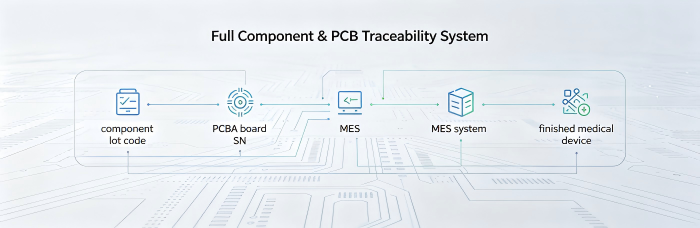
A finished PCBA can be traced back to a specific component reel, lot number and date code (down to the individual board serial number via Laser Marking SN) with each inventory lot having a unique identifier in the MES and a link to the customer program code.
Counterfeit Component Mitigation: The IQC Red Line
From consumer electronics to medical and aerospace applications, counterfeit electronic components are a global supply-chain risk in a huge variety of applications. Refurbished components from end-of-life electronics, re-marked with bogus date codes, and outright functional counterfeit products enter into supply chains via unauthorized distributors, spot-market brokers, and opportunists. In situations where a patient or operator's health and safety consequences are directly affected by a failing PCBA, a finished product with one counterfeit part is not acceptable.
There are two aspects to our counterfeit mitigation strategy: procurement channel discipline and physical, incoming inspection.
Authorized Channel Procurement Policy
PCBCart maintains a strict Approved Vendor List (AVL) that limits component sourcing to:
Direct from Manufacturer: Best choice for high risk, single source, or high volume.
Authorized Distributor: A franchised distributor with direct traceability to its manufacturer (e.g., Arrow, Avnet, TTI, Mouser, Digi-Key and regional distributors).
Qualified Independent Distributor: If the component is allocated or discontinued, a small list of vetted independent distributors that have completed an audit of their supplier and have documented the process of document tracking and ensured compliance with tests.
The components not coming from these three tiers are not accepted at the purchasing process. Whatever the price or delivery advantage, the spot market quotations are not accepted if they fail to show the unbroken chain of custody to an authorized channel.
Physical Incoming Inspection (IQC) Protocol
Tiered IQC is performed on all component lots as they are received. The level of rigor for each tier increases based on the component's risk level (new source, independent channel, high counterfeit risk device family and critical function):
Tier 1 – Documentation and Label Verification
Reconciling manufacturer country of origin, date code, lot number and quantity with purchase order.
Label font, ink consistency and reels/tubes/trays marking cross referenced to manufacturer packaging standards. Any font issues, fuzzy markings or different country codes will be reasons for rejection.
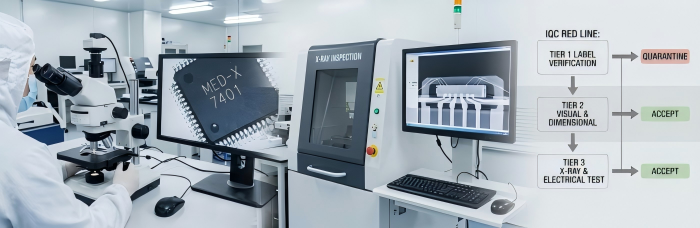
Tier 2 – Visual and Dimensional Inspection
Under calibrated optical systems, Package body dimensions, Lead pitch and Coplanarity are measured.
Solvent-wipe test to check for marked-out epoxy surfaces; laser re-marking ghost images when illuminated under an oblique angle; finish evaluation for irregular bead morphologies in solder bead, oxidation staining in finish – for re-tinning evidence.
SAE AS6081 Component Marking Permanence tested.
Tier 3 – X-Ray & Electrical Functional Verification
In addition to being used for void measurement during production, offline X-ray inspection is employed during IQC to check the die geometry of the devices. In certain instances, counterfeit or re-packaged devices can have atypical die geometry, missing bond wires or other internal structural anomalies that are detectable under X-Ray inspection.
High risk ICs: key DC parameters measured against datasheet limits (Parametric Electrical Testing on sampled units)
The supplier will be immediately notified, and the non-conformance tag will be added to the lot when it fails any of the Tier 1, Tier 2, or Tier 3.If a lot fails Tier 1, Tier 2, or Tier 3, the lot will be quarantined immediately in the MES system and the non-conformance tag added to the lot and supplier notified. The lot disposition is completely documented whether returned to supplier, destroyed, or escalated to independent test laboratory, for customer review.
Traceability as a Quality Multiplier
The disciplines described above only deliver their full value when integrated into a coherent traceability system. Each component lot and date code is linked to the corresponding boards that it is sold into, the reflow oven profile run it was soldered with, the 3D AOI inspection result, and the final serialized unit. Rapid identification of the potentially affected population can be achieved via traceability records, on a field return or reliability event should it ever be pointed to a suspect component lot, thereby minimizing investigation time.
This isn't just for convenience for life sciences companies with post market surveillance requirements. It is one of the basic aspects of corrective action capability.
For devices that will be manufactured, serviced, and relied upon for a decade, the bill of materials strategy deserves the same engineering rigor as the schematic. Obsolescence management and counterfeit prevention are not procurement activities, they are engineering disciplines that need to be approached with structured methodologies, documented decision criteria and an EMS partner that has the process infrastructure to repeat these solutions at low volume and high mix.
PCBCart's HMLV manufacturing model is built around exactly this premise. We bring automotive-derived rigor—systematic risk identification, structured change management, and closed-loop inspection feedback—to the specific demands of life sciences PCBA, where the consequence of a supply chain failure is measured not in a warranty return, but in a device that must not fail.
Helpful Resources
• Components Sourcing
• How to Create A Qualified BOM for Quick PCB Assembly Quotation and Production
• Advanced PCB Assembly Capabilities
• Pre-order File Checklist


