



Industry: Industrial / Telecommunications (Global Instrumentation)
Key Capabilities: PTH Soldering · Selective Soldering · Mechanical Strength Analysis · Process Hardening · IPC-A-610 Compliance
Overview
In high-reliability connectivity systems, the mechanical strength of Plated Through-Hole (PTH) connectors is vital for long-term operational stability. In a project for a global leader in instrumentation, a design mismatch between connector terminals and PCB holes initially led to insufficient solder fill (below the 75% IPC threshold). This weakness resulted in connector detachment under physical stress. By optimizing the pad geometry, refining the soldering process, and implementing X-ray inspection, the engineering team eliminated the failure risk and achieved zero recurrence over three years of production.
Background
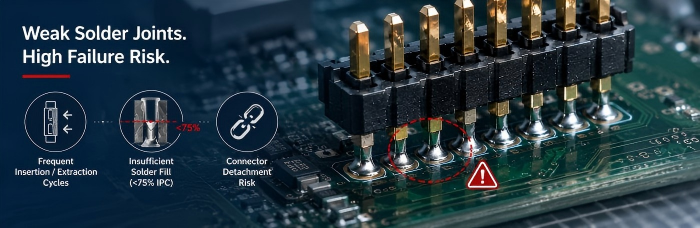
The product serves as a core communication module in industrial environments where cables are frequently plugged and unplugged. The mechanical stress of these "insertion/extraction" cycles is concentrated on the solder joints of the main connector. When the solder fill is insufficient, the joint lacks the necessary leverage to resist these forces, leading to pad lifting or complete connector separation.
The Challenges
Insufficient Solder Fill: The ratio of terminal diameter to hole diameter was suboptimal, making it difficult for solder to rise vertically through the hole.
Mechanical Failure Risks: Connectors were detaching under standard operational handling due to brittle or starved joints.
IPC Non-Compliance: The fill rate was inconsistent, frequently falling below the required 75% vertical fill for Class 2 and 3 electronics.
Engineering Insight
The "wicking" effect of solder in a PTH joint is governed by thermal mass and capillary action. If the thermal balance between the connector pin and the PCB barrel is uneven, the solder will not flow properly. By optimizing the pad's "thermal relief" design and increasing the soldering temperature profile locally through selective soldering, we can ensure that the molten solder overcomes the surface tension and achieves a full-depth fill.
Optimization Strategy
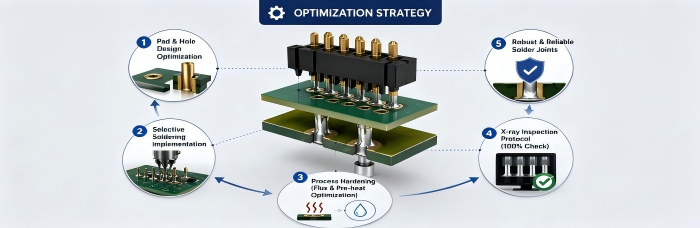
Pad & Hole Design Optimization: Modified the PCB layout to adjust the clearance between the pin and the hole, facilitating better capillary flow.
Selective Soldering Implementation: Transitioned from manual soldering to a programmed selective soldering process to provide consistent heat and precise solder volume.
Process Hardening: Optimized the flux application and pre-heat temperatures to ensure the PCB barrel was fully activated for wetting.
X-ray Inspection Protocol: Implemented mandatory 100% X-ray checking for critical connectors to verify fill depth and joint density.
Results
Full IPC Compliance: Consistently achieved >90% solder fill, far exceeding the 75% minimum requirement.
Eliminated Field Failures: Successfully resolved the connector detachment issue, with zero reported failures in the field over the last 36 months.
Improved Mechanical Life: The robust solder joints significantly increased the "mating cycle" durability of the device, ensuring a longer service life in industrial settings.
Facing Challenges with Connector Reliability?
Ensure your high-stress joints meet the most demanding mechanical standards with our advanced soldering and inspection technologies.


