



Industry: Healthcare / Life Sciences
Key Capabilities: DFM Optimization · Selective Soldering · High-Reliability Assembly · X-ray Inspection · Plated Through-Hole (PTH) Analysis
Overview
In high-precision healthcare device assembly, the mechanical integrity of connectors is mission-critical. A manufacturability mismatch between connector terminals and plated through-holes (PTH) often results in insufficient solder fill, leading to latent field failures. PCBCart resolved a critical connector detachment risk for a life sciences client by leveraging DFM optimization and advanced selective soldering, ensuring 100% compliance with IPC-A-610 Class 3 standards.
Background
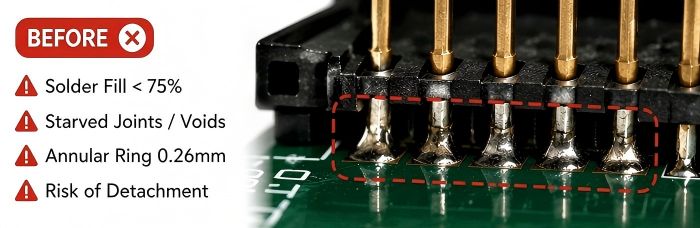
The client’s PCB design featured high-density connectors subject to frequent manual cable insertions and stress. During initial quality assessments, it was discovered that the solder vertical fill was consistently failing to meet the IPC minimum requirement of ≥75%. This compromise in joint volume created a significant risk of connector detachment under mechanical strain, which could lead to catastrophic failure in medical diagnostic environments.
The Challenges
Hole-to-Terminal Inconsistency: The ratio between the connector pin diameter and the PTH drill size was not optimized for capillary action.
Solder Fill Deficiencies: Inconsistent wetting led to "voiding" or "starved joints" within the barrel.
Mechanical Strength Risks: Insufficient annular ring width (measured at 0.26mm) reduced the pad's bond strength to the laminate.
Risk of Field Failure: Potential for intermittent connections or total detachment during cable insertion/extraction cycles.
Engineering Insight
Root cause analysis using X-ray imaging and cross-sectional data identified that the thermal mass of the heavy-duty connector pins was dissipating heat too rapidly for standard wave soldering. This prevented the solder from reaching the top-side destination. To solve this, the relationship between pad design, solder wetting behavior, and thermal delivery had to be fundamentally re-engineered.
Optimization Strategy
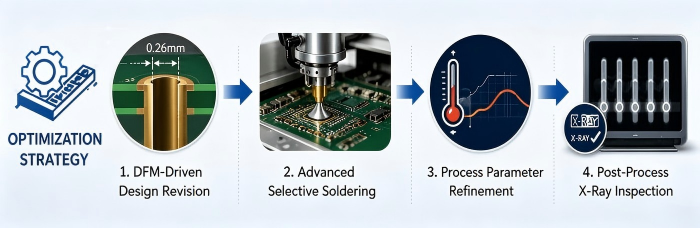
DFM-Driven Design Revision: Optimized the PTH diameter and annular ring geometry to facilitate better solder flow while maintaining structural bond strength.
Advanced Selective Soldering: Transitioned from traditional wave soldering to programmable selective soldering. This allowed for localized, prolonged dwell times and precise temperature control for each connector pin.
Process Parameter Refinement: Adjusted flux application and pre-heat profiles to ensure the PCB reached the ideal delta-T for maximum capillary vertical fill.
Post-Process X-Ray Inspection: Integrated 100% X-ray inspection to verify internal barrel fill and eliminate the risk of hidden voids.
Results
Total Reliability: Achieved consistent solder fill exceeding 75% across all production batches.
Zero Field Failures: Eliminated all connector detachment issues, ensuring mechanical stability under high-insertion-force scenarios.
Long-Term Stability: The optimized process has been running for 3 years with zero quality recurrences.
Compliance: Fully met Agilent and IPC Class 3 high-reliability standards.
Struggling with Through-Hole Soldering Reliability?
Ensure your life sciences hardware meets the most stringent mechanical and IPC requirements with PCBCart’s engineering-led assembly solutions.


