



Almost every dispute over a failed board comes down to one document — the confirmed BOM and files the supplier actually built against. If what shipped doesn't match what was confirmed, that's a manufacturing defect and the supplier should cover it. If the shipped boards match the confirmed files exactly, but the confirmed files themselves contained the error, responsibility typically shifts to whoever approved that confirmation — which is usually you.
The One Document That Decides Almost Every Case
Think of the BOM/file confirmation as the single piece of evidence that would settle a dispute in front of a neutral third party. Everything upstream of that confirmation — your original design, your component choices, any back-and-forth about substitutions — gets folded into "what was agreed." Everything downstream — what actually got built and shipped — either matches that agreement or it doesn't. Nearly every real dispute is, underneath the specific defect being argued about, actually an argument about whether the shipped boards match that one document. Once you start looking at disputes this way, the "who's responsible" question usually answers itself.
This reframing matters because it changes what you should actually be doing in the moment a defect surfaces. The instinct is to focus entirely on the defect itself — how bad is it, how did it happen, whose fault does it feel like. The more productive first move is almost always to pull up the confirmation record and check it against what shipped, before getting into any argument about intent or competence. Most disputes that drag on do so because neither side did this first, and instead spent time arguing from memory and impression rather than from the one document that actually settles it.
Three Cases, Three Verdicts
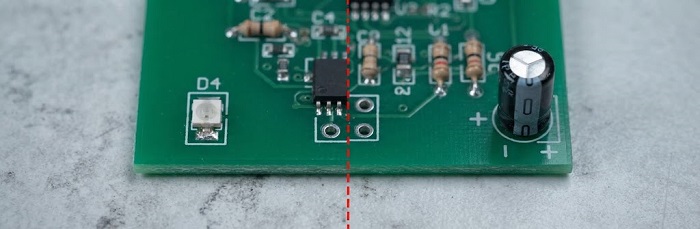
Case 1: The missing LED. A buyer receives boards and immediately flags a missing LED as a defect. The supplier pulls the confirmation trail and shows that the LED was explicitly removed from the BOM after the buyer's own team approved a revised version that excluded it. Verdict: buyer's responsibility. The boards match what was confirmed; the disagreement was really about whether the buyer remembered approving that change, and the email trail settles it.
Case 2: The reversed polarity. A buyer receives boards where an electrolytic capacitor is installed backward. The confirmed BOM and placement files both show the correct orientation. Verdict: supplier's responsibility. This is a straightforward manufacturing defect — nothing in the confirmed files authorized building it this way, so no evidence trail can shift blame back to the buyer.
Case 3: The intermittent failure. A buyer reports boards failing sporadically in the field, with no visible defect on inspection. Neither side can say with confidence what's wrong just by looking. Verdict: depends on test data, not on either party's word. This is the case that visual evidence can't settle — resolving it requires pulling functional or ICT test data from that specific production run, which is exactly why testing scope matters at the quoting stage, long before any dispute exists. A buyer who only purchased AOI inspection has no electrical data to fall back on here; a buyer who purchased functional test on the original run can often trace the failure to a specific component tolerance or a marginal design condition that visual inspection was never going to catch either way.
The pattern across all three: the cases with a clear paper trail resolve quickly and without much friction. The one case without a clean evidence path — the intermittent failure — is the one that actually requires investigation rather than just document-checking.
What a Credible Defect Policy Actually Commits To
A real defect policy states three things clearly, in writing, before you order: a specific claim window (commonly somewhere in the 7-30 day range after receipt, though the exact number varies by supplier and is worth confirming rather than assuming), a clear definition of what counts as a manufacturing defect versus a design/file issue, and what the supplier actually commits to doing about it. On that last point, ask exactly what the process looks like rather than accepting a vague "we'll make it right" — some suppliers require photographic evidence submitted for evaluation before accepting responsibility, which is a reasonable and standard ask, but you want to know that process exists and roughly how long evaluation takes before you're relying on it during an actual dispute rather than reading about it for the first time.
Different suppliers structure their remedy differently — some default to repair, others offer replacement or a partial credit depending on the scale of the issue — and none of these is universally "the" correct approach. What matters is that you know which one applies to your specific supplier before you need it, rather than assuming a remedy type that was never actually promised.
Using IPC-A-610 to Remove the Subjective Argument

IPC-A-610 defines acceptable solder joint workmanship objectively — fillet shape, void limits, and other measurable criteria — by class (2 or 3). Asking which class your boards were inspected against removes subjectivity from "is this joint acceptable" disputes, since it gives both parties an external, agreed-upon standard rather than two people arguing from personal judgment. Without this specified upfront, a "cold joint" dispute has no objective referee; with it, the joint either meets the class spec or it doesn't.
How to Report a Suspected Defect So the Evidence Actually Holds Up

The moment you notice a potential defect, photograph it clearly, note the date and unit/lot identifiers, and send it in writing rather than raising it by phone call alone — a phone call describing a problem is weaker evidence than a dated photo and written description sent the same day. Reference the specific confirmed BOM/files and the IPC class specified for the order when you raise the issue, since this frames the claim around an objective standard from the start rather than a subjective quality complaint that has to be argued into one. If the defect is intermittent or not visually confirmable, request the functional/ICT test data from that specific production run before assuming it's a workmanship issue — electrical test data settles the question far more conclusively than a visual re-inspection ever will.
Why Most Disputes Are Actually Confirmation Disputes
It's worth naming the pattern directly: the majority of "defect" disputes that get heated aren't really disagreements about solder quality or component placement — they're disagreements about what was actually confirmed before production. A buyer who doesn't keep their own copy of the BOM confirmation is relying entirely on the supplier's version of events if a disagreement ever arises, which is a weaker position regardless of who's actually right. Keeping your own confirmation trail isn't about distrust — it's about making sure a real dispute, when one does happen, gets resolved by evidence instead of by whoever's memory of the conversation is more confident.
FAQs
1. What if the supplier becomes unresponsive before a claim gets resolved?
This is exactly why payment method matters — a dispute-capable method like PayPal gives you an external party to escalate to when goodwill alone isn't enough.
2. If a defect is only found after the boards are integrated into your product, does it still fall within the claim window?
Usually no — most windows run from the receipt date, not from first use, so inspect and test promptly on arrival regardless of when integration happens.
3. Will a supplier accept a third-party lab's failure analysis, or do they need the boards back?
It varies — ask upfront, since some evaluate from photos and a report while others require the physical boards returned first.
4. If only some units in a batch fail, does the whole batch count as defective?
Often not — check whether the failure rate falls inside or outside the acceptance quality limit (AQL) disclosed for the run.
5. Does responsibility change if you bought through a broker instead of the assembler directly?
Yes — your claim runs through whoever you contracted with, which is one more reason high-stakes orders often go directly to the manufacturer.
Ready to make sure your own BOM confirmation is airtight before production? Request a PCB Assembly quote and confirm the defect policy in writing before you order.


