



First-order risk is real, but it's rarely the risk buyers imagine. Independent buyer review data on PCBA suppliers consistently shows the common failure mode isn't fraud — it's process gaps: a missed confirmation step, an undocumented substitution, ambiguity over who's responsible when something goes wrong. That's actually good news, because process quality is something you can screen for before you pay a cent, unlike honesty, which you can't verify in advance no matter how good the sales call feels. The practical fix isn't finding a way to trust a stranger faster — it's sizing your first order so that being wrong about them costs you very little.
Green Flags vs. Red Flags
| Green Flag | Red Flag |
|---|---|
| Quote is itemized line by line, within 24-48 hours | Single lump-sum number with no breakdown |
| A real DFM/BOM confirmation step exists, and can pause production | No confirmation step, or it's just an order-confirmation email |
| Payment structure includes a deposit + balance split | 100% upfront, wire transfer only, no exceptions |
| Reviews show a consistent pattern across many accounts | Only a handful of extreme five-star or one-star reviews, nothing in between |
| Sourcing/substitution policy is specific and named | Vague reassurance ("we only use trusted sources," "we never substitute") with no process behind it |
No single green flag guarantees a good experience, and no single red flag guarantees a bad one. What matters is the pattern — a supplier with four green flags and one ambiguous answer is a very different bet than one with a single green flag surrounded by vague reassurances. It's also worth noting that some of these signals are cheap for a supplier to fake in isolation (anyone can say "we never substitute without approval"), while others are expensive to fake convincingly (a genuinely itemized quote broken into real cost buckets, delivered within 24-48 hours, requires an actual costing process behind it). Weigh the harder-to-fake signals more heavily when the easier ones seem to conflict with your overall impression.
The Graduated-Trust Approach
You don't need to resolve all your uncertainty before the first order — you need a first order sized so that being wrong is cheap and being right tells you something useful. That's the entire logic behind starting small: a 5-25 unit pilot batch costs little enough that a process failure is a lesson, not a crisis, while still being large enough to reveal whether DFM, BOM confirmation, and communication actually work the way they're described.
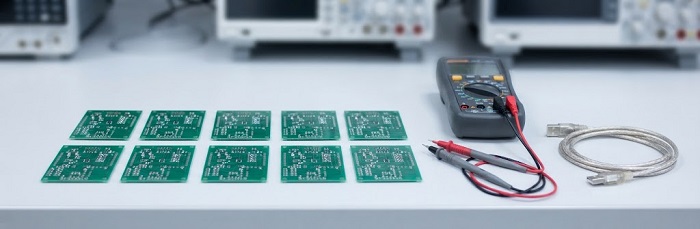
What you're testing for in that pilot isn't just "did the boards turn out fine" — plenty of suppliers can build a simple design correctly by accident. You're testing whether the process around the build was real: whether they proactively flagged anything ambiguous in your files, whether the inspection scope matched what was quoted, and whether a Certificate of Conformance showed up without you having to ask for it. A supplier that does these things on a small first order is very likely doing them as standard practice, not performing for a new customer — which is exactly the kind of evidence buying guides for PCB manufacturing consistently point to: track record and responsive technical support matter more than any single quoted price.
Most experienced HMLV buyers describe a similar pattern once they've worked with several suppliers: real trust gets extended gradually, after 2-3 clean pilot or small-batch runs, not granted upfront based on a sales conversation or a polished website.
This graduated approach also protects you against a specific failure mode that's easy to miss: a supplier who is genuinely excellent at winning new business but has never had to build the internal process discipline that comes from serving demanding, repeat customers. A strong sales process and a strong production process are different capabilities, built by different pressures, and a first order sized to actually stress-test the second one is the only reliable way to tell them apart from the outside.
A Real Comparison: Two First Orders
A buyer places a first order for a simple two-layer board with an unfamiliar supplier, sized deliberately small. The supplier's DFM process catches a file-conversion error from a proprietary CAD export before production begins — the kind of catch that's hard to fake and hard to explain away as luck. Based on that single signal, the buyer scales up confidently on the next order.
Compare that to a different first-time buyer who skips the pilot step entirely, places a full production order to save a few weeks of schedule, and pays the full amount by wire transfer because the supplier's website looked professional and the sales rep was responsive. When a BOM ambiguity later turns into a shipped defect, this buyer has no small-order track record to fall back on, no split-payment leverage, and no earlier signal that would have surfaced the process gap on a smaller, cheaper mistake.
Neither buyer necessarily picked a "bad" supplier — the second buyer may have picked exactly the same supplier as the first. The difference in outcome traces back almost entirely to order structure, not supplier selection. This is worth sitting with, because it means the most important first-order decision isn't really "which supplier do I choose" — plenty of qualified suppliers exist — it's "how do I structure my first engagement with whichever one I choose so that a process gap surfaces as a small, manageable lesson instead of a full-production disaster."
The One Signal That's Hardest to Fake
Of everything on the green-flags list, a DFM process that catches a real, specific error in your actual files — and pauses to confirm it with you rather than guessing — is the hardest thing for an unprepared supplier to fake. A polished quote system or a fast reply to a sales inquiry says something about the sales operation; catching a genuine file problem before production says something about the engineering and quality process underneath it. If you only have the bandwidth to verify one thing before your first order, ask what their DFM check actually covers and whether it happens before or after payment is finalized.
This one question also tends to reveal a lot about how a supplier will handle you as a customer more broadly. A supplier who answers specifically — describing what the DFM review checks, roughly how long it takes, and what happens if it flags something — is demonstrating the same kind of process transparency you'd want to see in every other part of the relationship: BOM confirmations, substitution approvals, shipping documentation. A supplier who answers vaguely on this one question, even if everything else about the sales interaction feels smooth, is telling you something worth taking seriously about how much visibility you can expect once you're an actual customer rather than a prospective one.
FAQs
1. Should I always start with a small pilot order?
Yes, especially for orders above roughly $2,000-3,000 in component value, since the cost of a process failure at that scale is manageable while the information gained is highly valuable for future, larger orders.
2. What payment structure is lowest-risk?
A split structure — deposit plus balance due on shipment confirmation — gives you real leverage without requiring you to pay the full order upfront on an unproven relationship.
3. Are third-party reviews reliable indicators?
They're most useful in aggregate; look for recurring patterns across many reviews rather than weighting a single glowing or scathing account too heavily.
4. What's a red flag during the quoting stage?
The absence of any DFM or BOM confirmation step, or a quote delivered as a single unexplained lump sum rather than an itemized breakdown, both suggest an immature or opaque process.
5. How long before I'd trust a supplier with a large order?
Most experienced buyers report scaling up meaningfully only after 2-3 successful pilot or small-batch runs have demonstrated consistent process quality, not just acceptable finished boards.
Ready to test a supplier's process on a low-stakes first order? Request a PCB Assembly quote and ask specifically what their DFM confirmation step looks like.


