



IC programming, the loading of firmware or data into programmable parts as part of the build, is one of the techniques we list with our assembly services. Whether it runs smoothly depends less on the programming step itself than on decisions made earlier: which parts are programmed, how the programmer reaches them, and which firmware version is released. Settling those points before you request a quote saves time later.
Three Ways Programming Can Fit Into a Build
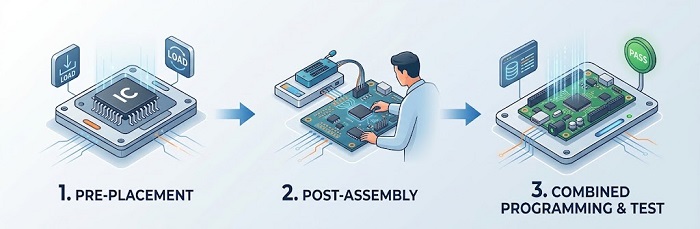
In general, programming can happen at different points in a build. The first option is before placement, when the device is programmed on its own and then mounted on the board. The second is after assembly, through a header or a set of test pads on the finished board. The third combines programming with function testing, so that the board is loaded and checked in one pass.
Which of these suits a given board depends on the device, the package, the layout, and the quantity. A part that cannot be reached once it is soldered down points toward programming before placement, while a board with a clean programming header points toward programming afterward. We do not assume one answer fits every design, so ask us which approach we can run for your parts.
Design Decisions That Make Programming Easy or Hard
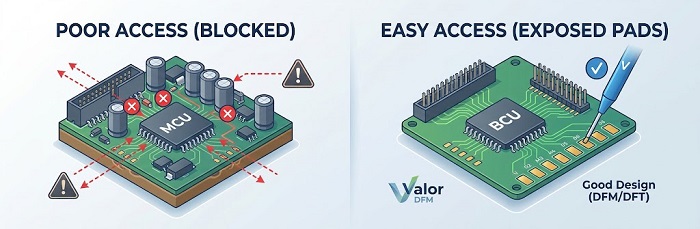
The most common problem is a board with no practical way to reach the device. If a part will be programmed after assembly, the board needs a header or test pads that are exposed and not blocked by other components. Pins should be clearly labeled, and the board needs to be powered correctly during programming. These details cost almost nothing to add while the design is open, and they can be costly to add afterward.
This is also why we look at designs from a test point of view as well as an assembly one. Our engineers review design files for testability so that custom function testing can run smoothly later. A free Valor DFM/DFA check is part of our assembly service, and you can mention programming access when you submit your files.
It is also worth thinking about the whole life of the board. Boards sometimes need to be reprogrammed later, for a firmware update or after rework. Keeping the programming access in the production design, rather than only on prototypes, keeps that option open. Removing it to save a little space is a change people often regret once the first update is due.
What to Send With Your Quote Request
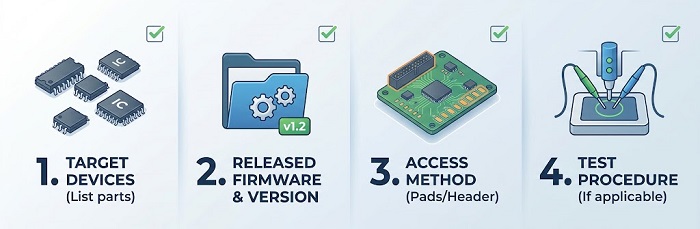
Tell us which devices on the board need programming, and how many boards you plan to build. Include the released firmware file together with its version, and say how the device is meant to be reached, whether through a header, test pads, or a fixture. If you have a test procedure, send it too, since programming and function testing are closely linked. Finally, tell us what format your files are in so we can confirm that they can be used.
Send only the released build. Source code is not normally needed for programming, and keeping it out of the package avoids both confusion over versions and unnecessary exposure of your intellectual property.
A simple example shows how these choices play out. Imagine a controller board with one microcontroller and one small serial memory. The microcontroller sits near a programming header that is clear of other parts, so it can be programmed after assembly. The memory chip has no access at all once it is soldered down, so it has to be loaded before placement or not at all. Same board, two parts, two different answers, and both are easy to decide while the layout is still open and hard to change once boards have been built.
What happens after programming deserves the same attention. A board that has just been loaded with firmware still needs a basic check that it starts up and behaves as expected, and that check needs clear pass and fail criteria. Custom function testing is among the techniques we list, so share your test procedure early. That lets us discuss how the programming step and the check should be planned, instead of treating them as unrelated.
Keeping Firmware Versions Under Control
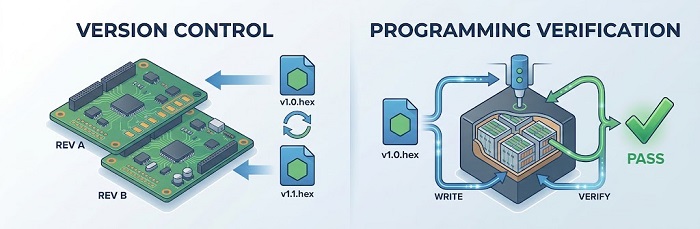
Most programming problems are version problems. A board can pass every assembly inspection and still fail in the customer's system because it carries the wrong firmware. The remedy is simple discipline. Give each firmware release a clear version, tie it to a specific board revision, and tell us right away if the version changes, ideally before the order is placed.
It also helps to ask how programming is verified for your device. Loading a file and confirming that it loaded correctly are different steps, and it is reasonable to ask how the second one is handled for your part.
A few mistakes come up repeatedly. Sending several firmware versions without saying which is current forces a guess that nobody should have to make. Leaving no access to the device turns a simple step into a redesign. Assuming programming replaces testing is a third, because loading code and checking that the board works are separate jobs. We list IC programming and function testing as separate techniques for that reason.
FAQs
1. Do you provide IC programming? Yes, it is one of the techniques we list with our assembly services. Tell us your device and quantity when you request a quote.
2. Who supplies the firmware? Programming loads firmware that you have released. Send the file and its version, and we can discuss the programming step for your device.
3. Can a device be programmed before it is placed? It depends on the device and its package. Ask us whether this suits your part.
4. What if the firmware changes after I send it? Tell us as early as possible, ideally before the order is placed, and send only the released version.
5. Does programming replace functional testing? No. Programming loads the code, while function testing checks that the board works. We list them separately.
A programmable board is easiest to build when its programming access, firmware version, and test plan are decided together, before the first quote request.
Get an Instant Quote for PCB Assembly
Helpful Resources


