



By default, no — most PCBA quotes state production lead time only, so a "5-day lead time" headline can turn into a multi-week door-to-door delivery once procurement and freight are added on top. The gap isn't concealment; it's just that "lead time" on a quote and "when my boards arrive" are two different measurements, and most first-time buyers don't find that out until the first one doesn't match the second.
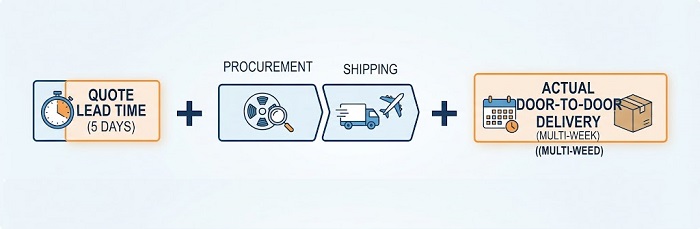
Decoding What a Quote Actually Says
| What the Quote Says | What It's Actually Measuring | What's Usually Missing |
|---|---|---|
| "5-day lead time" | Time on the assembly line only, starting from when the supplier has everything they need in hand | Procurement time for anything not already in the supplier's inventory, plus shipping |
| "In stock" (on a distributor listing) | True at the moment it was checked | Nothing — but "in stock" is a snapshot, not a promise, and can change between quoting and ordering |
| "Ships in 24 hours" | Time between production finishing and the box leaving the building | Transit time to reach you, which varies enormously by freight method |
None of this is dishonest labeling — it's just industry convention to headline the number the supplier controls most directly, which happens to be the smallest of the three numbers that actually determine your delivery date.
Why the Shipping Segment Deserves Its Own Decision
Procurement tends to get all the attention because it's the segment most likely to blow up a schedule, but shipping is the one segment you actually control directly, and buyers often default to air freight without running the comparison. For a small prototype order, the cost difference between air and sea is usually small enough that it's not worth the mental overhead of comparing — just take the faster option. For a larger production shipment, the math changes: air freight's cost premium over sea freight scales with weight and volume, so the absolute dollar gap on a bigger order can be substantial, while the time saved might not matter if your internal deadline has any real flexibility. The question worth asking yourself before defaulting to air isn't "which is faster" — it's "does the extra speed actually change anything on my end, or am I paying a premium for margin I don't need."
The Formula That Actually Predicts Your Delivery Date
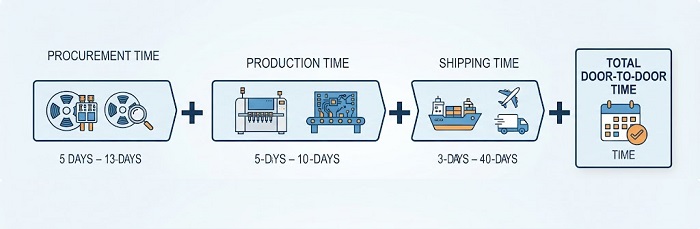
Door-to-door time is procurement time, plus production time, plus shipping time — and only one of those three is what a "lead time" headline usually describes.
Procurement ranges from a few days, if everything's already in the supplier's own inventory, to however long the current component market dictates for anything that has to be ordered fresh. As of 2026, that second case matters more than it used to: components in constrained categories are commonly running 10-40+ weeks depending on type, which dwarfs the production and shipping segments combined. Production is the segment the headline number usually describes — typically a matter of days for a straightforward board. Shipping runs 3-10 days by air or 20-40 days by sea, depending on the method and how urgently you actually need the boards.
Add the three together, and a board built entirely from in-stock parts might land in 10-20 business days total. The same board with one component that has to be freshly procured in a constrained category could stretch the timeline by months — not because anyone estimated badly, but because the procurement segment, which the "5-day" headline never claimed to cover, is now doing almost all the work. This is also why comparing two suppliers' "lead time" numbers head-to-head, without asking what each one actually measures, tells you very little — one supplier's 5-day figure and another's 7-day figure could represent nearly identical door-to-door outcomes, or wildly different ones, depending entirely on what's happening in the procurement segment neither number mentions.
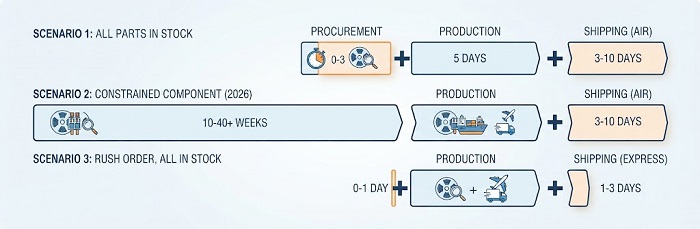
Three Timelines, Same Quoted "Lead Time"
| Scenario | Procurement | Production | Shipping (Air) | Realistic Door-to-Door |
|---|---|---|---|---|
| All parts already in stock | 0-3 days | 3-7 days | 3-10 days | ~10-20 business days |
| One component in a constrained category (2026 conditions) | 10-40+ weeks | 3-7 days | 3-10 days | Procurement time dominates entirely |
| Rush order, everything in stock | 0-1 day | 2-4 days | 1-3 days (express) | ~5-10 business days |
The headline "lead time" a supplier quotes could be identical across all three rows — it's describing the same production segment each time. What changes the actual delivery date has nothing to do with that number.
Where the Confusion Usually Starts
It's rarely the supplier misrepresenting anything. It's two smaller assumptions stacking on top of each other: buyers assume the clock starts when they place the order, when it usually starts once payment clears and the BOM/files are confirmed — sometimes several days later. And buyers assume "lead time" already accounts for getting the parts, when it's describing the segment that starts only after the parts are already in hand. Neither assumption is unreasonable on its own; together, they're the most common reason a "5-day" quote turns into a three-week wait with nobody having lied about anything.
For HMLV buyers specifically, there's a third assumption worth naming: that a supplier who's been reliable on past orders will automatically flag a procurement delay on this one, without you asking. A supplier who's genuinely on top of their process usually will. But "usually" isn't "always," and the cost of confirming the three-part breakdown on every order — even a reorder of a design you've built before — is a two-minute question, while the cost of assuming and being wrong is a missed launch date. The BOM that shipped in 10 days last quarter can ship in 10 weeks this quarter if a single component's availability changed in the interim, and nothing about your prior good experience with that supplier changes that.
The One Question That Fixes This
Ask for a single door-to-door date broken into its three segments — not a production-day number you have to interpret yourself. A supplier who can say "procurement is X, production is Y, shipping is Z, so you'll have boards on this date" is giving you a real answer. A supplier who repeats the production number when you ask "when will I actually receive these" is answering a different question than the one you asked, whether or not they realize it. If your BOM includes anything flagged as long-lead, explicitly ask the supplier to model the date assuming the current, real procurement time for that part — not a best-case guess — so your own downstream planning isn't built on a number nobody can actually promise.
It's worth writing this three-part date down somewhere you'll actually reference it, rather than trusting your memory of a verbal estimate from a sales call. Quotes and timelines both drift over the course of a negotiation, and having the specific procurement/production/shipping breakdown in writing — ideally in the same document as your order confirmation — gives you something concrete to point back to if the delivery date later shifts and you need to understand why.
FAQs
1. What typically starts the lead-time clock?
Usually full payment plus final BOM/file confirmation, not the initial order submission — so the practical clock often starts several days later than buyers assume when they place the order.
2. Is air freight always faster overall?
It's faster in transit, but the cost premium is substantial; for orders with any real deadline flexibility, comparing total landed time against sea freight is worth the extra few minutes of planning.
3. Can I get a lead-time guarantee in writing?
Some suppliers offer this with an explicit penalty or credit clause for missed dates — it's worth asking directly rather than assuming it's unavailable, especially for schedule-critical orders.
4. Does rush production actually save time if a component is on allocation?
No — procurement time will dominate the total schedule regardless of how fast the production line itself runs, so paying for rush production on a shortage-affected BOM often buys very little real benefit.
5. How do I plan buffer time for a first order with a new supplier?
Add meaningful buffer beyond the quoted production date until you've built a track record with that specific supplier; the buffer matters most on any BOM containing components that aren't already confirmed in stock.
Ready to see your own procurement/production/shipping breakdown instead of a single headline number? Request a PCB Assembly quote and ask for the three-part date directly.


