



As of 2026, a single out-of-stock component can add anywhere from 1-3 weeks for a minor substitution to 30-50+ weeks for a semiconductor caught in the current allocation cycle — and the range is wide because 2026 is running a genuinely tighter component market than the "post-shortage normal" many buyers still expect, not just lingering effects from 2021-2022. The size of the delay still depends heavily on which of three points in the order timeline the shortage is caught at, but the starting baseline itself has shifted upward industry-wide.
The Three Points Where This Gets Decided
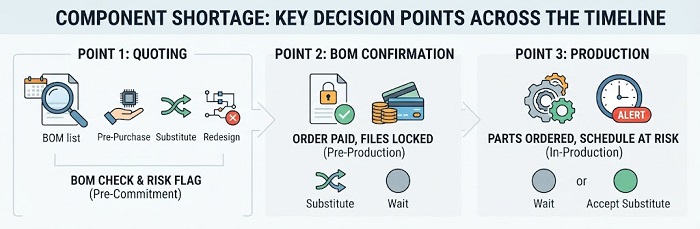
There are exactly three moments a shortage can surface, and your options narrow sharply at each one.
Point 1 — At quoting, before you've committed anything. This is the best-case timing. A supplier who runs a BOM availability check as part of quoting can flag a risk part within 24-48 hours of file submission — before you've paid, before anything's been ordered. At this point you genuinely have three options on the table: pre-purchase the part yourself and consign it, accept a supplier-proposed substitute after reviewing it on your own timeline, or redesign the circuit around a more available part. A buyer whose BOM gets flagged with one IC at an 18-week lead time, right at the quoting stage, still has all three of these available and can decide calmly, with no money committed yet.
Point 2 — At BOM confirmation, after you've paid but before production starts. Still manageable, but with less runway. You're choosing between accepting a proposed substitute or absorbing a wait — redesigning the circuit is no longer realistic once you've paid and files are locked. The supplier still hasn't ordered anything irreversible, so this is a fine outcome, just a narrower one than Point 1.
Point 3 — During production, after parts are already on order. This is the point nobody wants to discover a shortage at, because your options have collapsed to two: absorb whatever delay the substitute process takes, or accept a substitution you have less time to properly review because the schedule is already visibly at risk. Nothing about this stage is dishonest on the supplier's part — it's simply that the earlier decision points have already passed. The frustrating part for buyers is that a shortage discovered here often involves the exact same part, at the exact same lead time, that would have been a non-event if it had surfaced two weeks earlier at Point 1 — the part didn't get worse, your options did.
The practical takeaway isn't "shortages are bad." It's that the exact same shortage, on the exact same part, produces a completely different experience depending on which of these three points it's caught at — which is why the single most useful question to ask a prospective supplier isn't "do you have this part in stock," it's "when in your process do you actually check."
How Long the Delay Runs, By Part Type
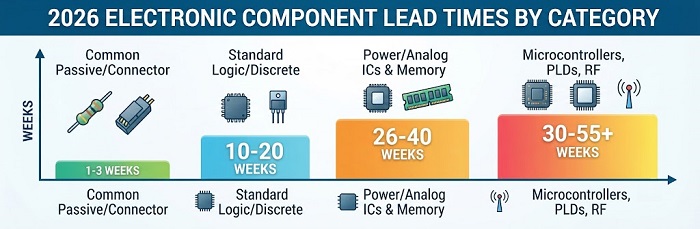
Once a shortage is identified, the realistic delay range still depends on what kind of part it is — this is the second variable, independent of which point it's caught at, and the two compound: catching a constrained IC shortage at Point 1 still means living with whatever the current market lead time actually is if you choose to wait it out, it just means you get to make that choice deliberately instead of having it forced on you.
As of 2026, the honest range by category looks meaningfully wider than it did even a year or two ago:
| Part Type | Typical Delay (2026 conditions) |
|---|---|
| Common passive or connector with a ready alternate | 1-3 weeks, often absorbed without buyer-visible delay |
| Standard logic and discrete semiconductors | Roughly 10-20 weeks — the closest category to "normal," though still above pre-2021 baselines |
| Power/analog ICs and memory (DRAM, NAND) on allocation | Roughly 26-40 weeks |
| Microcontrollers, programmable logic, and RF components in the most constrained categories | 30-55+ weeks, with some specific device quotes running past 60 weeks |
It's worth being direct about why these numbers are wider than a lot of buyers still expect: this isn't simply the tail end of the 2021-2022 shortage lingering on. Industry lead-time tracking has shown a distinct new tightening cycle building through late 2025 and into 2026, with a sharp jump in top-component lead times recorded in March 2026 alone. The drivers are different this time too — AI infrastructure buildout is pulling fab capacity away from other categories (including some mature nodes that supply ordinary industrial and automotive parts), automotive-grade semiconductor demand keeps growing structurally, and category-specific disruptions (export-control disputes affecting certain automotive logic parts, tariff-related order front-loading) have added further pressure on top of that. Some individual categories are now running lead times comparable to, or beyond, the widely-cited 2021-2022 shortage peak — this is an active market condition in 2026, not just an aftereffect.
There's a compounding effect worth watching for too: a BOM with five components each carrying a modest few weeks of lead-time risk can, in aggregate, produce a much longer realistic delay than any single line item suggests on its own, since the parts don't all clear at the same time.
When Redesigning Is Actually the Better Option
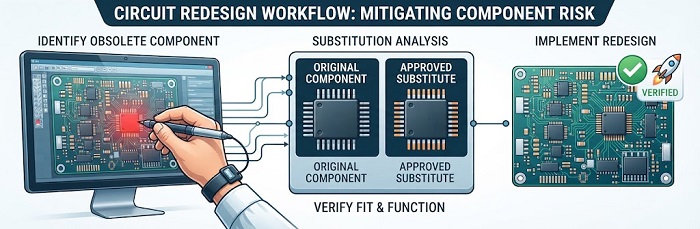
Of the three Point-1 options, redesigning around the part gets the least attention, mostly because it feels like the most disruptive choice. But it's worth genuine consideration in two specific situations: when the flagged part is on a category with a documented history of chronic allocation (meaning this won't be the last time it causes a delay), and when the part in question isn't load-bearing to your design's core function — a status LED driver or a generic op-amp is often easier to redesign around than a part central to your product's main circuit. Pre-purchasing and consigning tends to be the better choice when the part is genuinely unique to your design and a wait is tolerable; accepting a supplier-proposed substitute tends to be the better choice when the alternate is truly form-fit-function equivalent and you don't want to touch the design at all. None of these three is universally "correct" — the right choice depends on how replaceable the part is, how tolerant your schedule is, and how likely this specific shortage is to recur on your next order.
The One Habit That Actually Moves the Needle
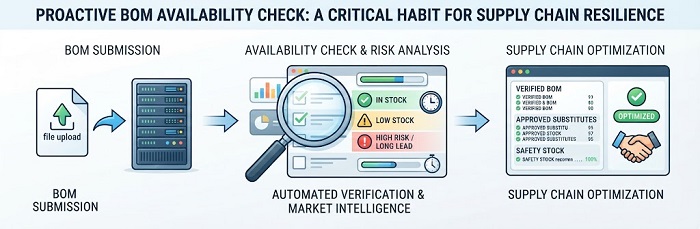
Of everything a buyer can do about shortage risk, one habit does more work than the rest combined: requesting a BOM availability check as a standard part of every quote request, not as a special ask reserved for complex designs. This is what pushes your shortage discovery back to Point 1 instead of leaving it to chance. Once a component is flagged as long-lead, decide upfront which of the three Point-1 options you'll take, rather than leaving the decision until the deadline is already at risk — indecision at that stage effectively defaults you into Point 3's narrower options even if the shortage was technically caught early.
For recurring designs, it's also worth asking your supplier directly whether they'll bank a small safety stock of your chronically scarce parts between orders. Not every supplier offers this, and it typically comes with a modest holding cost, but for a design you reorder regularly, it can convert a recurring shortage risk into a solved problem rather than a repeated fire drill.
A Question Worth Asking About Your Own First Order
If this is a new supplier relationship, it's worth asking directly how far in advance they typically catch shortages on new customer BOMs — not as a trust test, but because a first-order relationship hasn't yet demonstrated its own track record. Build extra schedule buffer into a first order specifically for this reason, and treat availability as something to re-check close to your actual order date rather than something you verified once and can rely on indefinitely — allocation status for a given part can shift meaningfully within a few weeks, especially in categories prone to it.
This matters more than it might seem, because the honest answer to "how far in advance do you catch shortages" tells you which of the three points above you should expect to operate at with this particular supplier, before you've committed to anything. A supplier who can describe their availability-check process specifically — what stage it happens at, how it's communicated, and what the typical turnaround is — is telling you they operate at Point 1 by design, not by luck. A supplier who answers vaguely, or seems unfamiliar with the question, is more likely to be the kind of supplier whose shortages tend to surface later in the process, closer to Point 3, simply because nothing in their workflow is built to catch them earlier.
FAQs
1. How far in advance should shortages be identified?
Ideally at the quoting stage, within 24-48 hours of file submission, since that's the point at which all three response options — substitute, pre-purchase, or redesign — are genuinely still available to you.
2. What's a realistic worst-case delay for one allocated IC?
As of 2026, 26-40 weeks is common for power/analog ICs and memory on allocation, and the most constrained categories — microcontrollers, programmable logic, RF parts — are frequently quoted at 30-55+ weeks, with some specific devices running past 60 weeks. This is a live 2026 market condition, not a leftover from the 2021-2022 shortage.
3. Can I pay to expedite a scarce component?
Sometimes, through paid expedite services offered by authorized distributors — ask your supplier to check this specifically for the part in question rather than assuming it's unavailable.
4. Should I hold safety stock on chronically scarce parts?
Yes, particularly for recurring designs where you've already identified specific components with a history of allocation problems.
5. Does a longer lead time always mean higher risk of counterfeit substitutes?
It correlates strongly — scarcity is exactly the market condition under which counterfeit and gray-market activity concentrates, so long-lead parts deserve extra sourcing scrutiny, not just schedule patience.
Further Reading
• Essential Principles of PCB Sourcing
Ready to see your own itemized breakdown? Request a PCB Assembly quote and get a line-by-line quote within 24-48 hours.


