



The decision to outsource PCB assembly is, in practice, two decisions made simultaneously. The first concerns cost, capacity, and delivery performance, and is the one most evaluation processes are built around. The second — how much of a product's intellectual property is being placed in another company's custody, and under what terms it can be recovered — receives far less structured scrutiny, despite carrying materially greater long-term risk. Getting IP protection right when working with an offshore EMS partner is, in effect, a core supply chain risk-management discipline in its own right, not an afterthought to the sourcing decision — see 10 questions to ask any EMS partner before signing for a starting list.
Procurement organizations routinely underinvest in this dimension of intellectual property protection in electronics manufacturing. Teams will spend weeks benchmarking quotations and lead times, execute a boilerplate NDA, transfer a complete design package, and proceed to production. This article sets out a more disciplined approach: a precise account of what is genuinely exposed in an offshore PCBA engagement, the PCBA NDA and contract manufacturing mechanisms that mitigate that exposure, and the diligence steps that constitute sound security practice before the first purchase order is issued.
Mapping the IP Exposure Surface: What Is at Risk, and What Is Not
Not every document in a design package carries equivalent exposure, and a disciplined buyer evaluates each category on its own merits rather than treating the full package as a single, undifferentiated risk.
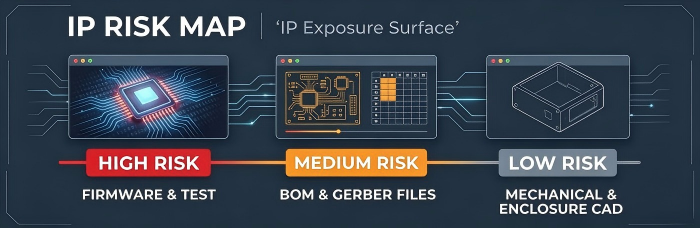
Gerber and fabrication files convey circuit topology, layer stack, and routing strategy. This represents moderate exposure, as it reveals structure without necessarily disclosing the underlying design rationale. The Bill of Materials carries substantially higher risk: critical component selection, sourcing strategy, and cost structure are frequently the clearest expression of a design's competitive differentiation — more so than the physical layout itself. Firmware, in engagements where the EMS partner performs flashing, represents the highest tier of exposure, since product behavior, algorithms, and calibration parameters often constitute the product's actual value, rather than a supporting asset to it. Test procedures carry comparable risk, as performance thresholds and tuning parameters define what constitutes an acceptable unit — information a competitor could use to reverse-engineer toward the same specification. Mechanical drawings and enclosure CAD, by contrast, typically present low-to-moderate risk, since industrial design and thermal or EMI strategy are rarely proprietary in isolation.
The more consequential exercise, however, is not risk cataloguing but scope discipline: determining what need not be disclosed at all. Many buyers default to transferring a complete design package because it is administratively simpler, but an EMS partner does not require a schematic to assemble a board — it requires manufacturing outputs. It does not require firmware source code to flash a device — it requires a compiled binary and a flashing procedure. Establishing this boundary prior to the RFQ stage is arguably the single highest-leverage decision available to a buyer managing IP exposure with any EMS partner, and one that is most often overlooked.
Contractual Safeguards: The Provisions a PCBA NDA Must Contain for Contract Manufacturing
An NDA executed as a procedural formality and one capable of withstanding an actual dispute are, in substance, different instruments. In the context of PCBA NDA and contract manufacturing agreements specifically, five provisions distinguish the latter.
The first is a precisely defined scope of confidential information. Language such as "all information shared" is difficult to enforce in practice; the agreement should instead define confidentiality by specific document type and marking convention. The second is a sub-supplier flow-down obligation. An EMS partner relies on component distributors and, in some cases, subcontracted processes, and the NDA must extend binding obligations to those parties rather than covering the primary contractor alone. The third is a departing-employee provision, specifying how design-file access is revoked and confirming that confidentiality obligations survive an employee's departure from the manufacturer. The fourth is a clearly defined remedy for breach. Generic damages clauses are difficult to enforce, whereas liquidated damages tied to specific breach scenarios — unauthorized disclosure or reproduction, for instance — are considerably more actionable. The fifth is a file destruction and return protocol: a documented, time-bound commitment to purge design files at project completion or contract termination, accompanied by written confirmation.

A candid point on enforceability: in a cross-border contract manufacturing relationship, NDAs governed by Chinese law are enforceable, but their practical effectiveness depends heavily on drafting precision and choice of venue. Agreements drafted exclusively in English, or that designate foreign courts with no nexus to China, are materially harder to enforce. Buyers seeking meaningful protection typically use a bilingual agreement with a China-based dispute resolution mechanism, since arbitration tends to be faster and more predictable than litigation in this context. This is a point worth confirming with independent legal counsel rather than assuming an EMS partner will raise it unprompted.
Technical Risk Mitigation: Limiting Exposure Beyond the Contract
A contract deters misconduct; it does not physically prevent it. More durable protection comes from limiting what is technically exposed at the outset. This begins with obscuring design intent within fabrication files — providing manufacturing Gerbers rather than schematics, since a capable EMS partner can execute a build from fabrication data alone, without requiring an understanding of the underlying circuit logic. It extends to the Bill of Materials, where the small subset of components representing genuine competitive differentiation can be specified using functionally equivalent, non-identifying part numbers wherever design tolerances permit. And it extends further still to firmware: where feasible, retaining flashing responsibilities in-house or with a trusted third party, and having the EMS deliver bare, unflashed boards, removes the single most sensitive layer of exposure from the manufacturing relationship altogether.
None of these measures require unusual arrangements. They require only that the question be raised before the Statement of Work is finalized, rather than after a complete design package has already changed hands.
MES Traceability: A Dual-Purpose Safeguard
Manufacturing Execution System (MES) traceability is typically presented to buyers as a quality-assurance capability. Within an IP protection framework, however, it serves two distinct functions simultaneously.
The first is production quantity discipline. A serialized, timestamped build record provides verifiable confirmation that units produced correspond exactly to units ordered, foreclosing the possibility of unauthorized overproduction or downstream gray-market diversion.
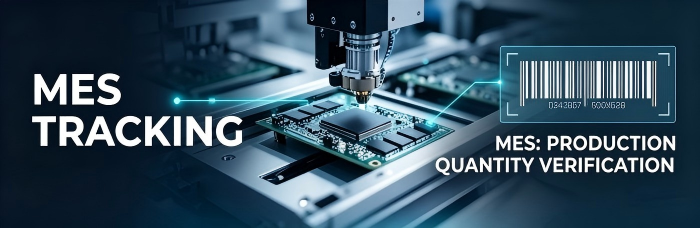
The second is evidentiary. A complete, auditable production record establishes a documented chain of custody for design files and build data, which becomes materially valuable should IP infringement ever need to be pursued — a substantive record, rather than one party's account against another's.
Facility Due Diligence: Verifying IP Security Controls On-Site
Prior to committing volume production to a new EMS partner, an on-site or video-based audit should confirm eight specific controls: a visitor log and escort policy governing access to the SMT floor; mobile phone and camera restrictions at production line entry points; tiered access permissions for design files, maintained separately from general production data; a documented account-deactivation process for departing employees; physical segregation of a given project's build data from other customers' files; a controlled printing and export policy for Gerber and BOM files; an NDA acknowledgment on record for every engineer or operator with project access; and a time-stamped, revision-controlled document version history.
A supplier capable of addressing these eight points with specificity — rather than offering general assurances about security posture — is demonstrating something substantive about how the facility actually operates.
Intellectual property protection in electronics manufacturing is not a single safeguard but the coordinated operation of contractual precision, technical exposure management, and facility-level discipline. Treated this way, IP protection in a cross-border EMS relationship becomes a governable part of the supply chain relationship rather than a residual risk absorbed on faith.
The practical test of any of this is how a manufacturing partner behaves at the very first point of contact — before a production contract exists, while a design is still under evaluation. PCBCart applies the same principles outlined above from that first exchange: a standard mutual NDA is put in place before any design file is transmitted, and the initial engagement is scoped to what is functionally necessary rather than a complete data handoff. Organizations that want to see this approach in practice, rather than take it on description, are welcome to submit a design for a complimentary DFM review under that framework.
Helpful Resources
• How to Evaluate A PCB Manufacturer
• How to Generate Gerber Files
• Printed Circuit Boards Assembly PCBA Process
• Design for Manufacture and Assembly of PCBs


