



Portable ultrasound systems compress a complete imaging signal chain — analog front-end, beamforming logic, power conditioning, and the interconnect to the transducer array — into a probe housing barely larger than the acoustic stack itself. Rigid-flex PCB assembly has become the standard architecture for this geometry, because the flex sections route signals around the piezoelectric or CMUT array and through the probe's narrow neck without connectors, cutting both volume and the number of failure-prone interconnect points.
This architecture solves the spatial problem. It also introduces a thermal one that doesn't show up on a datasheet or a first-pass functional test — and for teams responsible for ultrasound hardware manufacturing, it's one of the most consequential reliability variables in the entire build.
A rigid-flex board isn't a single homogeneous material. It's a bonded stack of dissimilar materials, each with its own thermal expansion behavior. When that stack passes through a reflow oven, the differences in how each material expands and contracts become a primary driver of solder joint integrity — and of long-term CTE mismatch control at the rigid-flex transition.
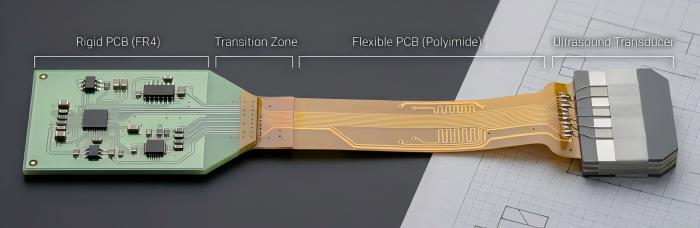
The CTE Mismatch Problem: FR4 vs. Polyimide
The coefficient of thermal expansion (CTE) describes how much a material's dimensions change per degree of temperature change, expressed in ppm/°C. In a typical rigid-flex stack-up:
FR4 (rigid sections) has an in-plane CTE generally in the 14–18 ppm/°C range. Its out-of-plane (Z-axis) CTE is typically 50–70 ppm/°C below Tg and can exceed 200 ppm/°C above the laminate's glass transition temperature (Tg).
Polyimide film (flex sections) typically exhibits an in-plane CTE in the 12–20 ppm/°C range, depending on film formulation, orientation, and copper content.
Copper sits around 16–17 ppm/°C — reasonably close to FR4, but increasingly mismatched against polyimide as temperature climbs.
On a monolithic rigid board, a CTE mismatch between copper and laminate is a known, manageable concern. In a rigid-flex assembly, the problem compounds. Two materials with different expansion rates are mechanically bonded at a fixed interface — the rigid-flex transition zone. As the assembly heats through the reflow profile toward 240°C–250°C peak temperature for lead-free SAC305 solder, the polyimide region wants to expand at a different rate than the adjoining FR4 region. Because the two are bonded, this differential expansion can't resolve freely — it generates shear stress concentrated at the transition boundary, propagating directly into any solder joints located near it.
During cooling, the mismatch reverses direction. A single reflow cycle therefore puts joints near the rigid-flex boundary through stress in both directions — on top of whatever residual stress already exists from lamination and bonding.
Why This Matters Specifically for Ultrasound Probe Boards
Ultrasound probe PCBs compound the geometric difficulty further. The flex sections are often narrow, curved, and routed around tight bend radii to follow the contour of the probe housing or to connect to the transducer array at an angle. Components placed near these transitions and bend zones — fine-pitch BGAs for beamformer ASICs, 0201/01005 passives in the analog front-end, and connectors to the acoustic stack — sit directly in the highest-stress region of the assembly.
If the panel isn't mechanically constrained during reflow, CTE mismatch manifests as localized warpage: the flex section lifts or twists relative to the rigid section as the board moves through the soak and reflow zones. Even relatively small localized deflections occurring while solder is in its liquidus state can contribute to:
Head-in-pillow (HiP) defects, where the solder ball and the paste deposit reflow separately and never fully coalesce — often invisible to two-dimensional inspection.
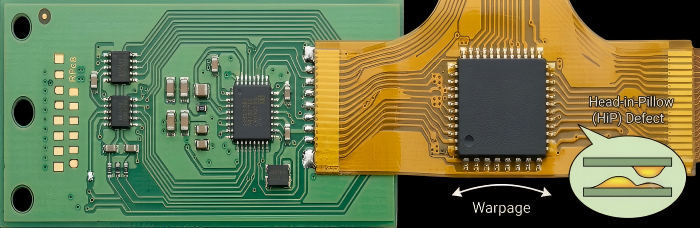
Joints exhibiting insufficient wetting or solder coverage relative to IPC Class 3 acceptance criteria, particularly on the ball row closest to the flex boundary, where geometric stress is highest.
Micro-cracking in the solder fillet that passes initial X-ray and optical inspection but propagates under the repeated mechanical flexing and thermal cycling the probe experiences in clinical use — repeated cleaning and disinfection cycles, skin-contact warming, and cable strain at the probe handle.
This is the core reliability concern for life sciences buyers: a joint that's marginally out of spec at time-zero doesn't necessarily fail functional test. It fails months later, in the field, as an intermittent channel dropout — one of the hardest failure modes to root-cause once a device is in clinical deployment.
Process Control 1: Custom Vacuum Fixtures and Synthetic Stone Carriers
The primary mitigation is mechanical, not chemical: constrain the panel's geometry during reflow so CTE mismatch can't express itself as uncontrolled warpage at the joint level.
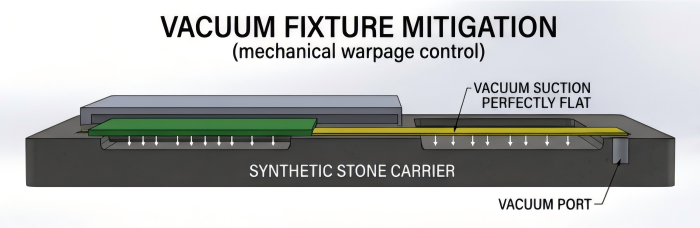
This is done with a custom-machined carrier fixture, designed per board outline rather than as a generic frame — typically built from synthetic stone (a dimensionally stable ceramic composite) or precision-machined aluminum with integrated vacuum channels:
Vacuum ports positioned beneath the flex sections hold the flex material flat against the carrier surface throughout the entire thermal profile, preventing it from lifting or curling independently of the rigid section as the assembly heats.
Pocketed cavities machined to the exact rigid-section thickness provide full-surface support, so the FR4 region doesn't bow under its own thermal expansion during the ramp-to-soak phase.
Synthetic stone is selected for its low thermal expansion and dimensional stability across the room-temperature-to-250°C reflow range, so the fixture itself doesn't introduce a third expansion variable. Its thermal mass also helps dampen local temperature gradients across the panel during the ramp.
The practical effect: the fixture converts a multi-material, mechanically compliant assembly into something that behaves, during the critical liquidus window, much closer to a single rigid panel. The CTE mismatch between FR4 and polyimide still exists at the material level — the fixture redistributes the resulting stress mechanically, rather than letting it concentrate at unsupported solder joints near the transition zone.
Fixture performance is verified directly through 3D Solder Paste Inspection (SPI) before reflow and 3D Automated Optical Inspection (AOI) with closed-loop feedback after reflow, checked specifically at the rigid-flex transition rather than relying on panel-average data. Any deviation in paste height or post-reflow joint geometry at that boundary signals that the fixture design needs iteration before a production run proceeds — and for BGA and QFN packages near the transition, off-line X-ray inspection confirms void levels and ball geometry that optical inspection can't see.
Process Control 2: Precision Pre-Bake (Typically 4–8 Hours)
The second control addresses moisture — which interacts directly with the CTE problem rather than standing alone as a separate failure mode.
Polyimide and the resin systems used in flex and rigid-flex constructions are hygroscopic: they absorb ambient moisture during storage, transit, and handling. When a moisture-laden panel enters reflow, trapped moisture vaporizes rapidly as the board crosses 100°C. In a rigid-flex assembly, this vapor pressure builds at material interfaces — particularly the bondline between polyimide coverlay and copper, or between flex layers — and compounds the stress already present from CTE mismatch at the rigid-flex transition. The combined effect increases the risk of interlayer delamination and bond-line degradation.
The pre-bake conducted prior to SMT placement addresses this directly:
Duration of 4–8 hours, scaled to the panel's layer count, flex thickness, and moisture exposure history since the bare boards arrived from the qualified supply chain.
Bake temperature held below the laminate's glass transition temperature, so absorbed moisture is driven out without inducing thermal stress or prematurely curing adhesive systems within the flex stack-up.
A controlled handling window between bake and placement — typically within the same shift — to prevent the panel from re-absorbing ambient moisture before it reaches the SMT line.
This step is logged against the specific material lot via Smart MES, linking moisture-sensitive handling time to the component lot and date codes used on that build, with full traceability carried through to the laser-marked serialization on the finished assembly.
CTE mismatch between FR4 and polyimide is not a defect to be caught after the fact — it is a structural variable that must be managed during the reflow process itself. For portable ultrasound transducers, where rigid-flex boards are folded into bend radii and packed with fine-pitch components near the rigid-flex transition, uncontrolled differential expansion during the 240°C–250°C reflow window translates directly into warpage, head-in-pillow defects, and sub-Class 3 joints that may pass initial test but fail under field-level thermal and mechanical cycling. Custom vacuum/synthetic stone carrier fixtures and lot-specific pre-bake protocols address this at the source — converting a multi-material, compliant assembly into something that behaves predictably through the liquidus window, and removing the moisture that would otherwise compound CTE-driven stress with vapor pressure. Together, these two controls determine whether a rigid-flex ultrasound board ships with latent risk or with verified joint integrity at the points that matter most.
Few EMS providers treat fixture design and pre-bake scheduling as board-specific engineering variables — most run rigid-flex panels on generic carriers with standardized bake times, which is sufficient for low-density consumer boards but leaves exactly the failure modes described above unaddressed for high-density medical assemblies. PCBCart's process engineering team builds fixture and thermal profiles around the specific stack-up, bend geometry, and component placement of each design during DFM review, and ties pre-bake duration and inspection data back to material lots through Smart MES for full traceability. If your team is developing a rigid-flex board for an ultrasound probe or similar space-constrained life sciences application, reach out to PCBCart.


