



For life sciences and medical instrumentation electronics, assembly workmanship directly correlates with device safety, continuous operational stability and patient safety. IPC-A-610, the global mainstream electronic assembly acceptance standard, defines three quality classes based on product reliability requirements. Among them, Class 3 is mandatory for mission-critical medical PCBA, where assembly failure is completely unacceptable. This article conducts an in-depth quantitative comparison between IPC-A-610 Class 2 and Class 3 core indicators, and elaborates on how our EMS workshop implements full digital closed-loop inspection and process control to meet Class 3 stringent requirements.
1. Overview of IPC-A-610 Classification & Applicable Scenarios
IPC-A-610 formulates unified visual and workmanship acceptance criteria for solder joints, component mounting, cleanliness and assembly integrity, without restricting production processes, but clarifying the final acceptance thresholds for finished assemblies.
Class 2 (Dedicated Service Electronics): Oriented to products requiring long service life but non-continuous critical operation. Minor assembly imperfections that do not affect electrical performance are allowed, widely used in general industrial control and consumer commercial electronics.
Class 3 (High-Reliability Electronic Products): The highest grade of the standard, applicable to life-support medical equipment, diagnostic instrumentation and other high-risk life sciences products. It demands extreme structural stability, fatigue resistance and environmental adaptability, with the strictest acceptance criteria for all assembly links.
Our workshop relies on IATF 16949 automotive zero-defect quality system, migrating FMEA risk analysis, PPAP process approval and SPC statistical control mechanisms to medical PCBA production, to fully match and exceed the reliability requirements of Class 3 life sciences electronics. We do not produce bare PCBs internally, and all base boards are sourced from Tier 1 qualified suppliers with full incoming quality inspection.
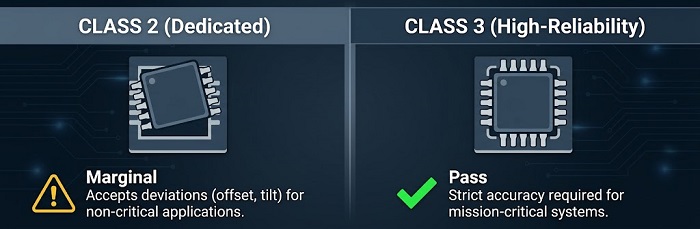
2. Quantitative Indicator Comparison: Class 2 vs Class 3 Core Hard Metrics
The core difference between the two classes lies in the dimensional tolerance of solder joints, component placement offset and solder wetting state. Combined with IPC-A-610 solder joint acceptance specifications, the key quantified indicators are sorted as follows.
2.1 Through-Hole (THT) Soldering Indicators
Through-hole components are common in medical power modules and signal acquisition units, and the filling rate and wetting angle of plated holes are core assessment items.
Plated hole filling rate: Both Class 2 and Class 3 enforce a minimum fill rate of 75%, which is a basic reliability requirement for through-hole assemblies.
Component-side solder wetting angle: Class 2 requires ≥180° circular wetting, while Class 3 is upgraded to ≥270°, ensuring uniform solder coverage and avoiding local virtual soldering caused by insufficient wetting.
Solder-side fillet wetting angle: Class 2 standard is 270°, and Class 3 is strictly increased to ≥330°, effectively improving the mechanical shock and vibration resistance of solder joints in long-term continuous operation.
Our Automated Selective Wave Soldering Systems adopt nitrogen protection and programmable temperature curve control (240°C–250°C lead-free soldering temperature), which eliminates thermal damage to adjacent SMD devices and stably meets the Class 3 through-hole soldering angle and hole filling standards.
2.2 Chip Component Mounting & Solder Joint Criteria
Chip resistors, capacitors and other passive components are the most numerous parts on medical PCBA, and offset and solder joint size are key inspection points.
Component termination/pad maximum overhang: Class 2 allows overhang less than 50% of the termination or pad width; Class 3 tightens the tolerance to ≤25%, and end overhang is completely prohibited.
Minimum end joint width: Class 2 requires 50% of the termination width, while Class 3 raises the standard to 75%, ensuring sufficient solder contact area.
Minimum end overlap: Class 2 only requires visible overlap; Class 3 mandates a minimum overlap of 25% of the termination length to prevent component falling off under thermal cycling.
2.3 Gull Wing & J-Lead Active Components
For medical communication chips, operational amplifiers and other pin-intensive devices, the side overhang and heel fillet height directly affect long-term fatigue resistance.
Pin side maximum overhang: Both Class 2 and Class 2 limit it to ≤50% of the pin width; Class 3 is reduced to ≤25%, with zero tolerance for excessive offset.
Heel fillet minimum height: Class 2 requires solder thickness plus 50% of pin thickness; Class 3 is upgraded to solder thickness plus 100% of pin thickness, enhancing the solder joint’s ability to resist thermal expansion and contraction.
Toe overhang: Class 2 prohibits toe overhang that violates electrical clearance; Class 3 enforces zero tolerance for toe overhang in all scenarios.
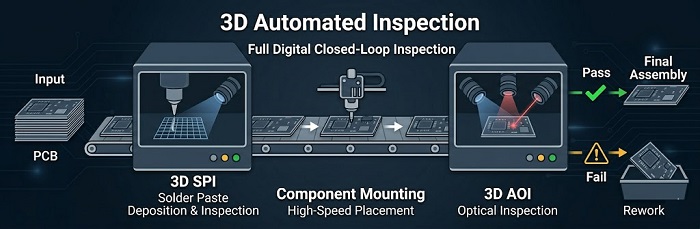
3. Digital Quality Execution: Class 3 Full-Cycle Inspection & Control
Class 3 standards cannot be guaranteed by manual inspection alone. Our QA/QC team matches high-precision automated inspection equipment to realize digital assessment of all indicators, forming a closed-loop quality control system.
3.1 Front-End Solder Paste Control: 3D SPI
The quality of solder paste directly determines the yield of subsequent solder joints. We deploy 3D SPI (Solder Paste Inspection) equipment to conduct full-station detection on solder paste thickness, offset and volume. For Class 3 products, the system sets tighter paste volume tolerance than Class 2. Once deviation occurs, the closed-loop system immediately alarms and feeds back to the printing equipment for parameter correction, eliminating hidden dangers of insufficient solder and bridging at the source.
3.2 Post-Mounting Appearance Inspection: 3D AOI
3D AOI (Automated Optical Inspection) covers all SMD components. Based on the quantified dimensional standards of IPC-A-610 Class 3, the system automatically identifies component overhang, offset and insufficient solder fillet. All unqualified products are locked and isolated, and inspection data is synchronized to the MES system for defect classification and process optimization. Compared with Class 2, Class 3 inspection sampling is upgraded to 100% full inspection, with no sampling exemption.
3.3 Hidden Solder Joint Detection: Offline X-Ray
For BGA, QFN and other bottom-soldered chips widely used in high-precision medical circuits, offline X-Ray inspection machines are used to measure solder joint void rate. Class 3 life sciences electronics have stricter void rate limits than general Class 2 products. X-Ray forms test reports for each board, and all data is archived for quality traceability.
3.4 Full Lifecycle Traceability: Smart MES & Laser Marking
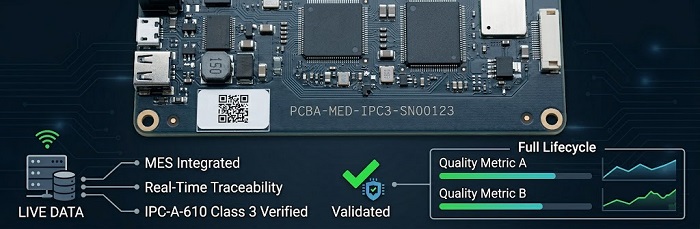
All Class 3 medical assemblies adopt unique Laser Marking SN serialization, cooperating with the Smart MES system to realize full tracking of component batch numbers, production time, equipment parameters and inspection records. Combined with IATF 16949 traceability requirements, each PCBA can be traced back to raw materials, production stations and inspectors, meeting the audit demands of life sciences industry quality management.
4. Process Control Differences: From Class 2 to Class 3 Production Management
In addition to inspection indicators, Class 3 puts forward higher requirements for production process control:
Process control strength: Class 2 allows appropriate process fluctuation; Class 3 adopts stricter SPC statistical process control to monitor soldering temperature, air pressure and transmission speed in real time, and trigger early warning when data drifts.
Rework restrictions: Class 2 permits multiple reworks of individual components; Class 3 strictly limits the number of reworks. For key solder joints and precision components, secondary rework is basically prohibited to avoid damaging the base board and solder joint structure.
Cleanliness requirements: Class 3 has higher standards for flux residue. The workshop strengthens the cleaning process to prevent residual flux from causing electrochemical corrosion during long-term operation of medical equipment.
5. Conclusion
IPC-A-610 Class 3 is the basic quality guarantee for high-reliability life sciences electronics. The gap between it and Class 2 is reflected in every quantified indicator such as solder joint angle, component offset and hole filling rate, essentially the difference between "allowing minor defects" and "zero hidden dangers".
Relying on IATF 16949 automotive-grade zero-defect management system, matched with 3D SPI, 3D AOI, X-Ray and other full-dimensional inspection equipment and selective wave soldering process, our workshop fully implements the quantified standards of IPC-A-610 Class 3. We convert mature automotive risk control and process control experience into reliable production capacity for medical PCBA, providing stable, compliant high-reliability assembly services for life sciences instrumentation and non-implantable medical equipment.


