



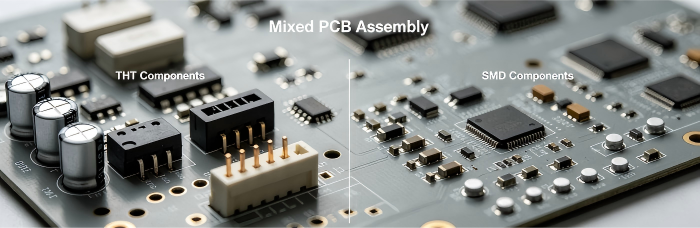
Modern medical power supply boards and EV Battery Management System (BMS) boards share a structurally demanding design profile: they are hybrid assemblies, populated simultaneously with high-mass through-hole (THT) components—bulk capacitors, transformer headers, power connectors, relay sockets—and fine-pitch, thermally sensitive SMD components such as ceramic capacitors (MLCC), μBGA ICs, and low-ESR polymer tantalum devices.
These two component families present very different thermal processing requirements. THT barrel joints require sufficient solder contact time to achieve complete wetting and adequate through-hole fill within the plated barrel. Per IPC-A-610 Class 3 criteria, a minimum acceptable through-hole fill of 75% is required, while 100% barrel fill remains the preferred target condition for high-reliability assemblies. Achieving this typically requires a lead-free solder wave operating in the 255°C–265°C range, with dwell times generally between 2 and 6 seconds depending on board thermal mass, conveyor speed, and hole geometry.
The challenge arises when these high-thermal-mass THT components are located close to fine-pitch SMT devices. Additional thermal exposure may increase stress on nearby MLCCs, BGAs, and other temperature-sensitive components, potentially affecting long-term reliability.
Why Manual Soldering and Conventional Wave Soldering Both Fail Here
Manual Soldering: The Consistency Challenge
Many contract manufacturers consider hand soldering to be a viable alternative to mixed tech boards. For prototypes, rework and low-volume production, manual soldering is useful, but issues of process control may arise when doing so in large quantities of assemblies.
Think about a few of the common sources of variation:
The temperature of the joints may deviate considerably from the iron setpoint, depending on the tip condition, thermal loading and operator technique.
The time that the joint spends inside the oven can differ depending on joint and operator, impacting on solder wetting and intermetallics.
Manual flux application is less repeatable than automated delivery techniques, which may make it more difficult to clean and provide some variability in residue.
The operator training, certification and supervision is crucial for achieving process reproducibility.
Ensuring statistical process capability using manual soldering is much more difficult than it is using automatic soldering processes for high-mix, low-volume (HMLV) manufacturing environments where repeatability of quality is paramount. Manual soldering can also be used for certain regulated industries like medical electronics; however it must be carefully validated, operator qualified, and controlled by inspections.
Conventional Full-Board Wave Soldering: The Thermal Exposure Challenge
The traditional wave soldering process involves using a SAC305 (Sn96.5/Ag3.0/Cu0.5) alloy that is kept around 260°C–265°C and allows the bottom of the entire PCB to be exposed to the molten solder wave. This adds an extra heat cycle to all of the mounted SMD components for assemblies that have been SMT reflowed at a peak temperature of approximately 245°C-250°C.
There are a number of well known reliability concerns that can arise:
MLCC Micro-Cracking: The difference between ceramic dielectric CTE (typically 6–12 ppm/°C) and FR-4 laminate CTE (typically 12–18 ppm/°C in the XY plane) can generate mechanical stress during repeated thermal cycling. These defects may remain latent and only emerge after extended field operation.
BGA Joint Degradation: Partial reheating of existing BGA joints may contribute to solder joint degradation mechanisms such as intermetallic growth, residual stress accumulation, or long-term fatigue susceptibility.
Component Delamination: Moisture-sensitive devices (MSDs) that are improperly stored or processed may experience internal package damage during additional thermal excursions.
If the assemblies are to be in operation for several years, it is also important to reduce thermal exposure as much as possible to improve reliability.
The Engineering Architecture of Automated Selective Wave Soldering
Selective soldering is not wave soldering with a mask. It is a fundamentally different process architecture that solves the thermal isolation problem at the physics level.
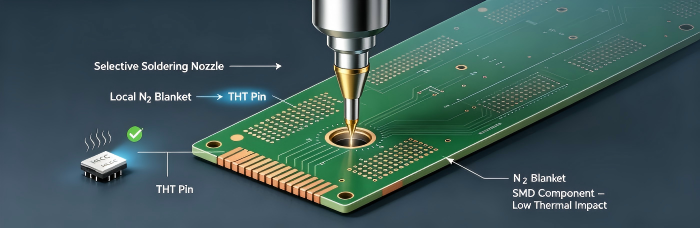
Our automated selective wave soldering systems operate on three independent precision axes, delivering a miniature solder fountain nozzle—typically 4mm to 10mm inner diameter—directly to each programmed THT joint or joint cluster. The board does not contact a bulk solder bath. Only the specific target pads are wetted.
Programmable Nozzle Control and Process Parameters
Each board design receives its own NC program defining, joint by joint:
XY travel path and dwell position (accuracy: ±0.05–0.10 mm repeatability)
Nozzle diameter selection matched to connector pitch and pad geometry
Solder contact time per joint or joint cluster (typical range: 2–8 seconds, precision-adjusted per thermal mass)
Flux spray volume and pattern: Precision micro-spray flux deposition, programmable per joint location, eliminates the excess flux flooding of full-board fluxers. Typical flux deposit volume: significantly lower and more repeatable flux deposition than typical manual application methods.
Solder pot temperature: Process-controlled at 260°C ±2°C (SAC305 lead-free), with real-time thermocouple feedback
The thermal energy delivered is exactly what the joint requires—no more. Adjacent SMD components at a standoff distance of ≥5mm from the nozzle perimeter typically experience substantially lower thermal exposure than under full-board wave soldering, depending on board design and process settings. This is empirically measurable with thermal imaging and remains below any damage threshold for standard MLCCs, polymer capacitors, or plastic-body ICs.
Nitrogen Atmosphere Protection
The solder fountain nozzle operates under a local nitrogen (N₂) blanket, maintaining oxygen concentration at typically below several hundred ppm in the soldering zone (versus ~21% O₂ in ambient air). The consequences are directly visible in joint quality metrics:
Solder wetting angle reduced by 15–25% compared to air-atmosphere wave soldering, producing flatter, more uniform fillet geometry
Dross formation suppressed by >80%, reducing solder contamination risk and extending bath life
IMC layer uniformity improved: The Cu₃Sn / Cu₆Sn₅ intermetallic stack at the pad interface forms more uniformly in inert atmosphere, ipromoting more uniform intermetallic layer formation and process consistency.
For IPC-A-610 Class 3 compliance, the through-hole fill criterion of minimum 75%—with our process targeting 100%—is consistently achieved and documented per lot.
Integrated Quality Architecture
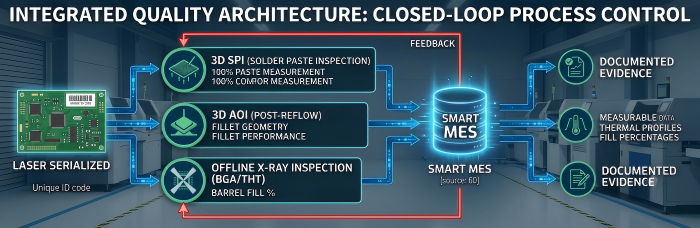
Selective soldering operates within a closed-loop quality system, not in isolation.
3D SPI (Solder Paste Inspection) — 100% solder paste measurement, with process capability targets established according to product requirements. Out-of-spec boards are rejected before placement, preventing compound defects from reaching reflow.
3D AOI with closed-loop SPC — Post-reflow inspection covering presence/absence, polarity, coplanarity, lifted leads, and 3D fillet geometry. Defect data feeds back in real time to upstream paste printing and placement equipment, enabling within-shift process correction.
Offline X-Ray Inspection — Post-selective soldering, cross-sectional X-ray analysis verifies THT barrel fill percentage, BGA void content, and QFN joint coverage. For power connectors where connector bodies physically block optical access, X-ray is the only non-destructive method to confirm fill depth — often the most effective non-destructive method for verifying hidden solder joints and fill characteristics in shielded or obstructed locations.
Smart MES with Laser Serialization — Every board assembly carries a laser-marked unique serial number linked to the MES database: component lot codes, date codes, reflow profile actuals, NC program version, and all SPI/AOI/X-ray inspection results. Full unit-level traceability is standard production infrastructure, not a premium option.
For any mixed-technology board carrying THT power components within 10mm of fine-pitch SMD devices — a common design scenario in many modern medical power and EV BMS assemblies — the soldering process selection is not a manufacturing cost variable. It is a product reliability architecture decision that will determine field failure rates, regulatory risk exposure, and ultimately, patient and passenger safety outcomes.
Automated selective wave soldering, executed within a complete closed-loop quality system, reduces the thermal damage mechanisms that both manual soldering and conventional wave soldering introduce to these assemblies. It delivers measurable, documented process evidence — fill percentages, thermal profiles, SPI Cpk values, AOI defect rates — that supports regulatory submissions, customer audits, and internal reliability engineering programs.
PCBCart specializes in high-reliability HMLV (High-Mix Low-Volume) PCBA for the medical, life sciences, and EV power electronics sectors. Our production floor operates automated selective wave soldering systems, 3D SPI and 3D AOI with closed-loop SPC feedback, offline X-ray inspection for BGA and THT verification, and a Smart MES with laser-serialized unit-level traceability — as standard production infrastructure for every assembly. If your next medical power supply or EV BMS board involves mixed THT and SMD technology, contact our engineering team for a DFM review and thermal risk assessment before your production run begins.


