



Industry: Healthcare / Life Sciences
Key Capabilities: Thermal Management · Advanced Stencil Engineering · X-ray Inspection · Solder Voiding Optimization · High-Reliability Assembly
Overview
In medical-grade electronics, thermal dissipation is as critical as electrical connectivity. For a high-performance power module project, the power devices exhibited excessive solder voiding during initial production. Solder voids directly impede heat transfer, risking component overheating and premature failure. PCBCart’s engineering team optimized the stencil architecture using a "bridge-type" aperture design. This strategic improvement successfully reduced the voiding rate to below 10%, ensuring stable thermal performance and meeting the stringent high-reliability standards required for life-critical medical applications.
Background
High-power devices handle significant thermal loads, and any air pockets (voids) trapped within the solder joint act as thermal insulators. For this medical project, the client required a zero-compromise approach to soldering quality. Initial X-ray inspections showed that the large, continuous thermal pads were trapping flux volatiles during the reflow process, with no clear path for outgassing. This resulted in voiding rates that exceeded the client's internal standards and IPC Class 3 guidelines.
The Challenges
Critical Voiding Rates: Large thermal pads act like a "seal," trapping gases during the liquidus phase of reflow.
Thermal Dissipation Risks: Voids reduce the effective contact area between the component and the PCB, leading to localized "hot spots."
Long-Term Reliability: Excessive voiding can lead to solder joint cracking under the stress of repeated thermal cycling.
Engineering Insight
The key to reducing voids in large-area pads is the creation of a "Gas Escape Path." By modifying a single large stencil opening into a segmented design with a mechanical "bridge," we create channels that allow flux vapors to exit before the solder fully coalesces. This ensures a more solid and consistent interface.
Optimization Strategy
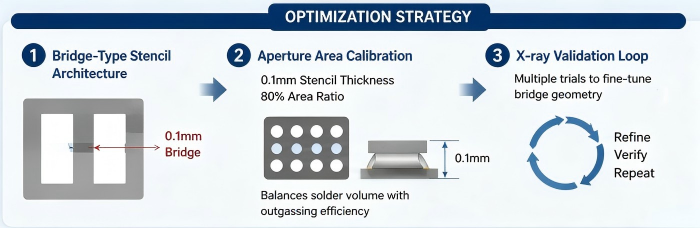
Bridge-Type Stencil Architecture: Re-engineered the stencil aperture with a 0.1mm "bridge" positioned in the center of the solder pads.
Aperture Area Calibration: Optimized the opening to an 80% area ratio using a 0.1mm thickness stencil to balance solder volume with outgassing efficiency.
X-ray Validation Loop: Fine-tuned the bridge geometry through multiple production trials until the voiding rate was consistently below 10%.
Results
Exceptional Solder Quality: Achieved a voiding rate of <10%, significantly improving heat dissipation.
100% IPC Compliance: Verified robust electrical and mechanical joint integrity via high-resolution X-ray inspection.
Zero Thermal Failures: The module demonstrated stable operating temperatures across all production batches.
Concerned About Solder Voids in Power Electronics?
Ensure maximum thermal reliability with PCBCart’s advanced stencil engineering and process control.


