



For most high-mix, low-volume builds, full turnkey assembly costs less in total and reaches first articles sooner than consigned assembly. The consigned quote looks cheaper because it only prices labor, but the buyer silently absorbs everything else: parallel purchase orders, inbound freight, kit reconciliation, shortage loops, and the full liability for counterfeit parts. Turnkey moves those tasks, and their risk, onto one accountable supplier.
Anyone who has managed a consigned build knows the labor quote was never the expensive part. The expense was the reel that arrived short, the second carton held at customs, and the email thread where nobody could confirm which BOM revision the distributors had shipped against. If you need the basic definitions first, our model-selection overview covers them. What follows is where consigned procurement actually loses time and money: freight and kitting, counterfeit exposure, and the cost of keeping several suppliers aligned.
Why does a consigned quote look cheaper than it really is?
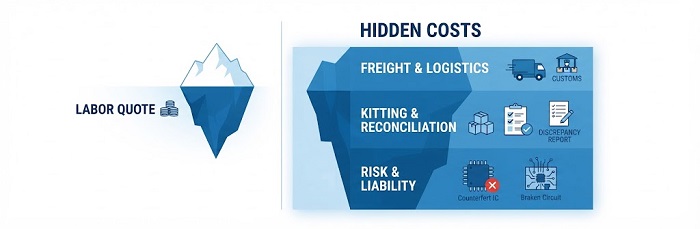
A consigned assembly quote is cheaper on paper because it excludes the work your team must do to deliver a complete kit. The labor line is real, but it is only one line of the true cost ledger. The table below lists the cost items that exist in both models and shows who carries each one.
| Cost item | Consigned: who carries it | Turnkey: who carries it |
|---|---|---|
| Quoting and PO issuance per distributor | Your purchasing team, once per supplier | Assembler, inside one quote |
| Inbound freight and customs to the assembly site | You, per shipment | Assembler, consolidated |
| Kit counting, labeling and discrepancy reports | You (send) and the assembler (receive) | Assembler internally |
| Attrition and overage for machine placement | You must estimate and over-buy | Assembler's buyer sizes it |
| Line stoppage when a single part is short | You, as schedule slip | Assembler resolves before build |
| Counterfeit or nonconforming parts | You, fully | Assembler, for parts it sources |
| Excess and leftover stock | You hold it | Defined in the quote terms |
None of these costs disappears under turnkey. They are performed once, by a buyer who does it every day, instead of being rebuilt from scratch by your team for every project.
What are the logistics costs of consigned procurement?
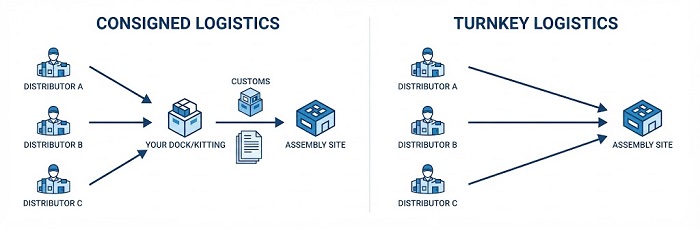
Consigned logistics fail at the interfaces: between each distributor and your dock, between your dock and the assembler, and between the packing list and what actually arrived. Every interface adds transit time and a chance for a mismatch that is only discovered when the line is set up.
Freight and customs, multiplied
With a consigned kit, parts typically travel twice: from each distributor to you, then from you to the assembly site. Each cross-border leg needs commercial documentation and customs clearance. PCBCart's own service description notes that turnkey eliminates the freight cost of delivering components to the assembly workshop, because parts ship directly to where they are used.
Kit completeness and packaging
Pick-and-place machines need parts in feedable formats, and moisture-sensitive devices need controlled packaging and handling records. PCBCart accepts consigned SMT parts as reels, tubes, trays, partial reels, cut tape, and bulk, but every non-standard format or missing overage becomes a question the assembler must raise with you before placement can start. One absent capacitor stops the whole kit.
The shortage loop
When a consigned kit arrives short, the correction runs through your purchasing team: confirm the shortfall, find stock, raise a new PO, ship, and re-receive. Under turnkey, the assembler's buyer discovers availability problems at quote stage, before the order is placed, and proposes customer-approved alternates or a schedule change.
How much counterfeit risk does a consigned buyer carry?
In a consigned build, the buyer carries 100% of the counterfeit risk for every part they supply, and the data shows this risk is neither rare nor confined to obsolete parts. Counterfeiters target where buyers are under pressure, and a project team chasing a shortage outside authorized channels is exactly that target.
What the industry data says
• ERAI logged 1,055 suspect counterfeit and nonconforming parts in 2024, a 25% increase over 2023 and the highest total since 2015. Source: EDFAS summary of the ERAI 2024 Annual Report
• In the same 2024 data, active parts readily available through authorized sources were reported more than twice as often as long-lead active parts, which means availability status alone does not protect a buyer.
• Reports fell to 748 parts in 2025, but roughly 24% of those suspect parts passed electrical testing and were only caught by further verification such as visual inspection and solvent resistance checks. Source: ERAI Counterfeit Parts Reporting and Annual Reports
• ERAI also found that 23.37% of the brands reported in 2025 were newly targeted, so a buyer's list of "risky brands" goes out of date quickly.
Why this lands on the consigned buyer
If a counterfeit part reaches the line in a consigned kit, the assembler builds exactly what it was given. The resulting failure analysis, scrap, rework, and schedule loss belong to the party that bought the part. For buyers in industrial automation, life sciences instrumentation, and semiconductor test equipment, a field failure traced to a fake IC brings failure analysis, rework, and customer exposure that the buyer alone must absorb.
PCBCart's component sourcing service purchases from leading authorized distributors by default, and makes no substitutions without the customer's approval. If a customer instead asks PCBCart to buy from a customer-nominated lower-cost channel, PCBCart states plainly that it does not guarantee those parts. That distinction is the point: in turnkey, the channel decision is explicit and documented, rather than improvised under deadline pressure.
What does multi-vendor communication really cost?
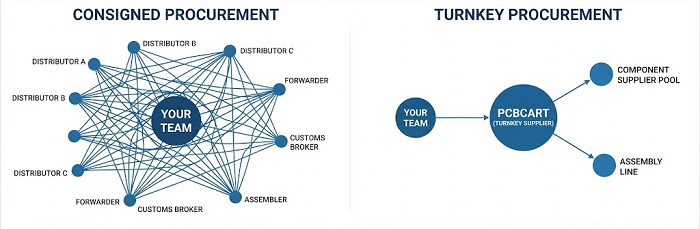
Communication overhead in consigned procurement grows with the square of the number of parties, not linearly. Every distributor, forwarder, and the assembler is a node your team must keep aligned on quantities, dates, packaging, and revisions.
The number of possible pairwise communication channels among n parties is n(n−1)/2. The table below applies that formula to a consigned project with your team, one assembler, one freight forwarder, and k component suppliers (so n = k + 3). These are combinatorial counts, not survey figures, but they explain why a "simple" consigned build consumes so many email threads.
| Component suppliers (k) | Parties involved (n) | Possible channels n(n−1)/2 |
|---|---|---|
| 3 | 6 | 15 |
| 6 | 9 | 36 |
| 10 | 13 | 78 |
| Turnkey (you + assembler) | 2 | 1 |
PCBCart describes the same effect in practical terms: a traditional build requires a separate quote-and-confirm cycle with each supplier involved, often across time zones and working habits. Turnkey collapses those rounds into one, with manufacturing issues raised in a single consolidated quote.
Engineering changes amplify the gap. When a BOM revision lands mid-project, a consigned buyer must re-check every open PO and in-transit shipment. A turnkey buyer sends one revised BOM to one supplier.
How does turnkey shorten time-to-market?
Turnkey shortens time-to-market by removing entire stages from the critical path, not by making any single stage faster. Use the two formulas below with your own project numbers to see where your schedule is actually spent.
| Model | Critical-path time to kit-ready |
|---|---|
| Consigned | T = max over suppliers of (Q + L) + F + R + (S × C) |
| Turnkey | T = Q(pcbcart) + P + (S′ × C′) |
| Term | Meaning |
|---|---|
| Q | Time to quote and issue a PO with each supplier; your team often does these in series |
| L | That supplier's delivery lead time; the slowest supplier sets the pace |
| F | Inbound freight and customs from your site to the assembly site |
| R | Receiving, counting, and reconciling the kit against the BOM |
| S × C | Number of shortage or discrepancy loops times the length of each loop |
| Q(pcbcart) | PCBCart's published assembly quote turnaround: 1–2 working days |
| P | PCBCart's published sourcing time: typically about one week from order to parts in hand, as short as 5 days, depending on part difficulty |
| S′ × C′ | Loops still possible under turnkey, but resolved at quote stage by the assembler's buyer rather than on the production floor |
Two honest caveats apply. First, a part with a 20-week factory lead time is a 20-week part in either model; turnkey cannot shorten a manufacturer's allocation. Second, if you already hold a complete, verified kit on the shelf, consigned can start sooner. For everything else, the turnkey formula simply has fewer terms: F and R disappear, and Q collapses from many cycles into one.
|
Price your build as turnkey and compare the real number. Upload your BOM to PCBCart's online turnkey quote system and set it beside your full consigned cost ledger, including freight, internal purchasing hours, and counterfeit exposure. The quote is free and non-obligation, and PCBCart returns it within 1–2 working days. Submitting takes minutes: basic project details, assembly options such as custom testing and IC programming, and your BOM file. |
When is consigned or partial turnkey still the right choice?
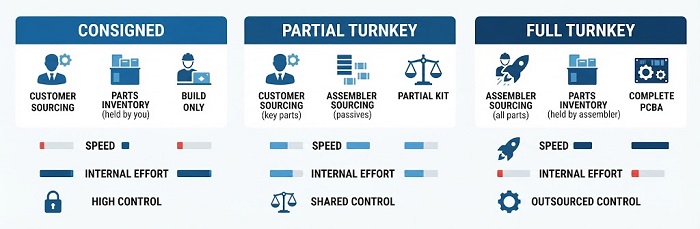
Consigned assembly remains the better fit when you already own the parts or when a part must never leave your control. Typical cases include proprietary or custom components, large existing inventory you need to consume, and pre-programmed or security-sensitive devices.
For mixed situations, partial consignment is usually the most efficient answer: you supply the few controlled or high-value items, and the assembler sources the long tail of passives and standard ICs. PCBCart offers both consigned and partial consigned assembly for exactly this reason. The goal is not to eliminate consignment, but to stop consigning parts your team gains nothing from buying.
How should a project manager decide?
Run a three-question check before choosing a model:
• Is the kit already complete and verified? If yes, consigned may be fastest. If you still need to buy more than a handful of lines, turnkey removes F, R, and most of Q from your schedule.
• Can you prove the provenance of every part you supply? If any line would come from an independent or broker channel under deadline pressure, the counterfeit data above applies directly to you.
• How many suppliers would your team coordinate? Past three or four, the channel count in the table above usually costs more in engineering and purchasing hours than the turnkey procurement margin.
FAQ
1. Can I get a turnkey price and a consigned price for the same board to compare?
Yes. The same PCBCart assembly quote form handles both, so you can request the build with and without component sourcing. Compare the turnkey figure against the consigned labor price plus your own freight, purchasing time, and overage, not against labor alone.
2. What happens if a part on my BOM is unavailable during turnkey sourcing?
PCBCart does not substitute parts without customer approval. Listing approved alternates and marking which lines are critical in your BOM lets the buyer resolve availability issues in one exchange instead of several.
3. Does turnkey make sense for prototypes whose BOM keeps changing?
Often, yes, because each revision is handled as one updated BOM rather than a set of changed POs across several distributors. If parts change daily during very early exploration, a small consigned build of known parts can still be quicker for that phase.
4. Who is responsible if a turnkey-sourced part turns out to be nonconforming?
For parts sourced through its default authorized-distributor channel, the assembler is the accountable party. Confirm the specific warranty and remedy terms in writing at order stage, especially for parts sourced from customer-nominated channels, which PCBCart does not guarantee.
5. Can I supply only my pre-programmed or controlled ICs and let PCBCart source the rest?
Yes. That is partial consignment, and it is usually the best balance of control and speed for builds with a few sensitive parts.
Helpful Resources
• Full Turnkey PCB Assembly
• How to Quote and Order PCB Assembly Services
• How to Create a BOM (Bill of Materials)


