



Industry: Industrial
Key Capabilities: DFM Analysis · Valor NPI · Virtual Assembly · Yield Optimization · Component Spacing Analysis
Overview
In complex industrial electronics, design-to-process mismatches are the leading cause of low yields and soldering defects. PCBCart utilizes Valor NPI—the industry’s leading New Product Introduction software—to perform comprehensive "Virtual Assembly" before a single board is manufactured. By identifying risks such as 6mil spacing violations and diode wetting issues early, we ensure a seamless transition from design to mass production.
Background
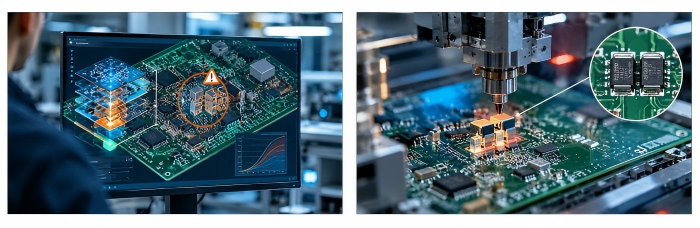
An industrial client faced recurring short circuits and AOI detection failures on their controller. Initial analysis showed that the component spacing was extremely tight, and traditional design-rule checks (DRC) were insufficient to capture the subtle interactions between pad geometry, stencil thickness, and solder paste flow.
The Challenges
Critical Spacing Violations: Resistor spacing (R5 to R6) was as low as 6mil, creating a high risk of solder bridging.
AOI Limitations: Extremely tight spacing made it difficult for AOI cameras to accurately inspect the solder fillets.
Component Skewing: Design-process mismatches led to diode tilting and poor wetting during reflow.
Yield Instability: Inconsistent production quality leading to high rework costs and delayed shipments.
Engineering Insight
Traditional DFM is often reactive. By using Valor NPI, we shift to a proactive model. We simulate the entire manufacturing process—from stencil apertures to reflow temperatures—to identify where "tolerance stack-up" will cause failures. This allows us to request design modifications before the first prototype is ever built.
Optimization Strategy
Valor NPI Virtual Assembly: Ran the client’s Gerber data through over 900 DFM check rules to identify latent manufacturing risks.
Targeted Design Modifications: Recommended specific pad-size adjustments to increase the R5-R6 clearance, successfully mitigating the 6mil bridge risk.
Solder Paste Optimization: Engineered a custom stencil design using laser-cut apertures to control the exact volume of paste, preventing diode tilting and wetting issues.
Simulation-Based Validation: Validated the new design via virtual reflow simulation to ensure all thermal profiles remained within component specifications.
Results
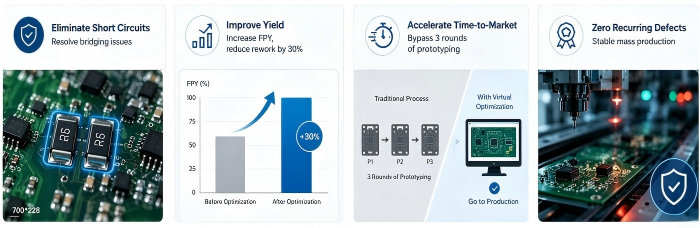
Elimination of Short Circuits: Resolved the recurring bridging issues on high-density sections of the board.
Yield Enhancement: Significant increase in First Pass Yield (FPY), reducing scrap and rework costs by 30%.
Accelerated Time-to-Market: By resolving issues in the virtual phase, we bypassed three rounds of physical prototyping.
Zero Recurring Defects: The optimized design has moved into stable mass production with no further DFM-related abnormalities.
Concerned About DFM Risks Before Production?
Identify and eliminate manufacturability issues early with PCBCart’s advanced Valor NPI analysis and virtual assembly.


