



Choosing a chip packaging approach shapes almost everything downstream in a project — board size, assembly cost, testability, and how easily a design can be reworked or updated. Chip-on-Board (COB), Surface-Mount Technology (SMT), and Ball Grid Array (BGA) each solve the same basic problem — connecting a die or component to a PCB — in different ways, and each comes with its own set of tradeoffs.
Quick Overview of Each Method
Chip-on-Board (COB) mounts a bare, unpackaged die directly onto the PCB substrate, then connects it to the board using wire bonding. Following this the die is then usually sealed with an epoxy "blob". COB features a very small footprint and a very small layer height, which makes it very common in consumer designs like LED modules, RFID tags and more.
Surface-Mount Technology (SMT) is less a single packaging type and more an assembly method: components — already packaged in forms like QFN, SOIC, or discrete passives — are placed and reflow-soldered directly onto the board surface, with no through-holes required. Most modern PCB assembly relies on SMT, and encompasses an extensive variety of components and sizes, from a passive resistor to a fine pitch IC.
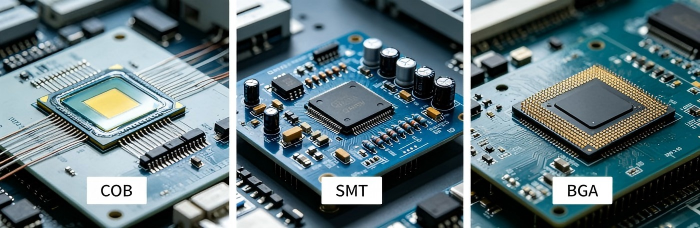
Ball Grid Array (BGA) is a specific SMT package type built for components with a high pin count. The leads on the edge of the package are eliminated in favor of a pattern of solder balls on the bottom, providing many more I/O in a smaller package area than would be possible with a leaded package. They are used in processors, FPGAs and memory modules where the density of the pins is the limiting factor.
Side-by-Side Comparison
Die packaging: COB features a bare and unpackaged die directly mounted on the substrate. The SMT components come packaged as QFN, SOIC or discretes. BGA components are also pre-packaged, but the solder-ball array is on the bottom rather than the edges.
Connection method: In COB, the wire bonding of the die/substrate is used. For general SMT parts, the reflow soldering is used to attach to the surface pads. BGA parts are also soldered by reflow soldering, except that it is done under a solder-ball grid, not surface pads or leads.
Footprint: The lowest profile and smallest footprint of the three is COB, as there is no package around the die. The footprint of a general SMT is variable and generally standardized. BGA has a small number of pins compared to its size, but is typically larger than a COB implementation for the same functionality.
Typical use case: COB is most frequently used in LED arrays, RFID tags and other consumer modules that are very thin and high volume. General SMT is used in most of the day-to-day assembly operations for virtually all product categories. Because I/O density is the limiting factor, BGA is used only for high pin-count ICs, including processors, FPGAs, and memory modules.
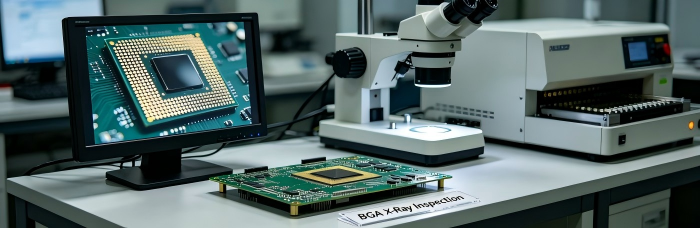
Rework difficulty: COB is extremely difficult to rework, and typically the wire and die bonds are not repairable after being encapsulated. General SMT components are moderately reworkable, as most can be reflowed, and replaced using standard equipment. BGA rework is also challenging as specific BGA rework stations and X-ray inspection is required to ensure the quality of the solder joint behind the package.
Cost considerations: COB tends to be more cost-effective at high volume, with additional process steps for encapsulation and handling of bare dies. With standard production lines there are major general SMT cost scales with the number of components and complexity of their positioning. The initial investment in stencils, reflow profiling, and inspection is higher with BGA, but can be balanced by the space savings from increased I/O density.
These are broad generalizations and real-life cost and rework results vary widely based on volumes, board complexity and component type.
How to Decide
It is important to note that there is no "best" solution between COB, SMT or BGA — it depends on the actual project and its requirements. Here are a couple of questions to help narrow it down:
What are your board size and height restrictions? When the design requires the smallest footprint and profile, COB is worth considering, however, for a wide range of component types, general SMT is typically the more practical foundation to consider.
How many units do you plan to make? As volume increases, COB is likely to be more viable, as the encapsulation and bare-die handling stages can be spread out across more dice. Packaged components tend to be more convenient to source and requalify, which is ideal for lower-volume or prototype runs.
What is your level of rework tolerance? Generally packaged SMT components are easier to replace than a wire-bonded die or a BGA that will need special rework equipment if the design is going to change multiple times, or if field repair is possible.
What is your budget based on, unit cost or NRE? BGA packages may have higher inspection and tooling expenses in the beginning, but could save board size and layers for high I/O components, potentially resulting in a lower per-piece board cost in the long run.
It is best to answer these questions truthfully, before a schematic is completed, to avoid a redesign later.
COB is optimized for small size and height in high volume products, SMT is optimized for large variety of components and moderate reworkability for most product lines, and BGA is optimized for high pin count components, while the BGA footprint is more manageable, it has more stringent rework and inspection requirements. Which one is best is determined by the requirements of the board's size, anticipated usage, rework needs, and budget, not by which method is superior.
If you're weighing COB or die-level assembly against packaged alternatives for an upcoming design, our team can walk through the tradeoffs for your specific board. Contact PCBCart to discuss your project in more detail.
Helpful Resources
• High Volume Assembly
• Low-Volume PCB Assembly (HMLV)
• Advanced PCB Assembly
• Package on Package Assembly
• Four Steps to Know BGA
• An Introduction of BGA Packaging Technology
• Factors Affecting the Quality of BGA Assembly


