



In the ever-evolving landscape of electronic technology, the demand for smaller, more powerful, and high-performance devices has driven the development of advanced printed circuit board (PCB) technologies. High-Density Interconnect (HDI) PCBs have emerged as a cornerstone innovation, redefining the possibilities of circuit design by offering unparalleled wiring density, compactness, and electrical performance. Unlike traditional PCBs, HDI PCBs are engineered to pack more interconnections, components, and functionality into a minimal footprint, making them indispensable for modern electronics across consumer, industrial, automotive, medical, and aerospace sectors. This comprehensive guide explores every facet of HDI PCBs, from their core characteristics and design principles to manufacturing processes, advantages, applications, and key considerations for successful implementation.
What Are HDI PCBs?
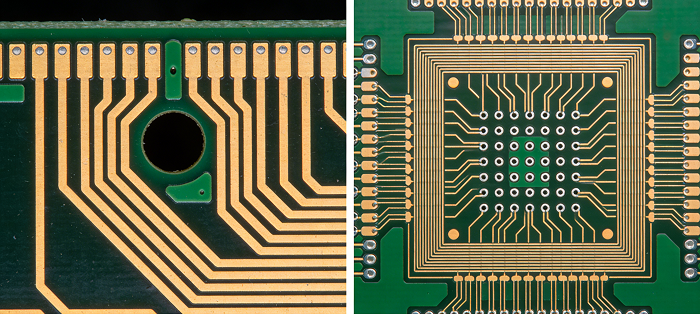
HDI PCBs are specialized circuit boards with a significantly higher wiring density per unit area than conventional PCBs, achieved through advanced design techniques and manufacturing processes. They feature finer line widths and spaces (often below 100 μm, and as low as 25–50 μm in ultra-high-density designs), smaller vias (including microvias, blind vias, and buried vias), higher connection pad density, and optimized layer stack-ups. A defining trait of HDI PCBs is their ability to integrate the functionality of multiple traditional PCBs into a single board, thanks to dense component placement on both sides of the substrate and efficient interlayer connections.
Key physical features that set HDI PCBs apart include microvias with diameters typically below 150 μm (and as small as 6 mils or 0.006 inches in high-precision designs), blind vias that connect surface layers to inner layers, and buried vias that link only inner layers—eliminating the need for through-holes that consume valuable surface space. Additionally, HDI PCBs utilize sequential lamination and via-in-pad technology, further enhancing their density and signal performance by bringing components closer together and streamlining interconnections.
Core Types of HDI PCBs
HDI PCBs are classified based on their stack-up configurations and via structures, each tailored to specific application requirements for density, complexity, and performance. The three primary types are defined by their microvia layers and interconnection capabilities:
Type 1 HDI PCBs
This entry-level configuration features a single layer of microvias on one or both sides of a core laminate, with no buried vias (blind vias or plated through-hole vias may be used). It adheres to a hole length-to-diameter ratio of less than 10 and requires thin FR-4 dielectric materials compatible with lead-free soldering. Type 1 HDI PCBs are ideal for small boards with limited pin counts and simple design requirements, offering a cost-effective high-density solution for less complex applications.
Type 2 HDI PCBs
An upgrade from Type 1, this design includes single-layer microvias (blind or buried) on one or both sides of the core, supporting larger, denser boards and fine-pitch components. While it maintains limitations on the number of laminated core layers, it enables more complex interconnections than Type 1. A key consideration is that microvias on the outer layers prevent these layers from acting as power junctions, making it unsuitable for single-layer stack power requirements.
Type 3 HDI PCBs
The most advanced standard HDI configuration, Type 3 features at least two layers of microvias on one or both sides of the core, with both blind and buried vias for maximum interconnection flexibility. It supports large boards, multiple fine-pitch components, and adjustable stack-ups, with microvias on inner layers allowing outer layers to serve as power junctions. This type is the preferred choice for high-performance, high-density applications requiring intricate routing and multiple I/O connections.
Beyond these three core types, HDI PCBs also include advanced stack-up architectures such as 1+N+1 and 2+N+2, where the numbers represent microvia layers on either side of the core (N), and Every Layer Interconnect (ELIC/Any-Layer HDI), which enables direct routing between all layers using copper-filled microvias—ideal for ultra-high-density applications like CPUs, smartphones, and high-speed communication devices.
Key Vias and Interconnection Technologies in HDI PCBs
Vias are the lifeline of HDI PCBs, facilitating electrical connections between layers while minimizing space usage. Unlike traditional PCBs that rely solely on through-hole vias, HDI PCBs use a diverse set of via types, each designed for specific interconnection needs:
1. Through-hole vias: Extend from the top to the bottom layer, suitable for simple interconnections but less efficient for high density due to surface space consumption.
2. Blind vias: Connect a surface layer to one or more inner layers, stopping short of the opposite surface—eliminating unnecessary through-board connections and saving space.
3. Buried vias: Link two or more inner layers with no exposure to the board’s surface, critical for dense inner-layer routing and reducing surface clutter.
1. Through-hole vias: The smallest via type (diameter ≤150 μm, often 6–20 μm in laser-drilled designs), used to connect adjacent layers or small groups of layers. Manufactured via laser drilling, microvias have a low aspect ratio (typically ≤1:1, up to 2:1 for reliable designs), ensuring mechanical stability and resistance to thermal stress.
Specialized Via Technologies
· Via-in-pad: Places vias directly under component pads, followed by plating, filling (with conductive or non-conductive epoxy), capping, and re-plating. This 10–12 step process creates a planar surface, improving solder joint quality and allowing closer component placement—critical for fine-pitch BGAs (ball grid arrays) with a pitch of less than 0.65 mm.
· Stacked/staggered vias: Stacked vias connect multiple layers by aligning microvias vertically, while staggered vias offset microvias to avoid structural stress. Stacked vias offer higher routing efficiency but increase manufacturing costs, while staggered vias improve reliability for high-cycle applications.
· Thermal vias: Small vias used for heat dissipation, strategically placed under high-power components to transfer heat from surface layers to inner ground/power planes—essential for thermal management in compact, high-performance devices.
HDI PCB Design Principles and Best Practices
Designing HDI PCBs is a complex process that requires careful consideration of density, signal integrity, manufacturability, and cost. Unlike traditional PCB design, HDI design prioritizes minimizing space, optimizing interconnections, and mitigating electrical interference—with every decision impacting performance and production feasibility. Below are the core design guidelines for successful HDI PCB development:
1. Optimize Via Selection to Reduce Complexity
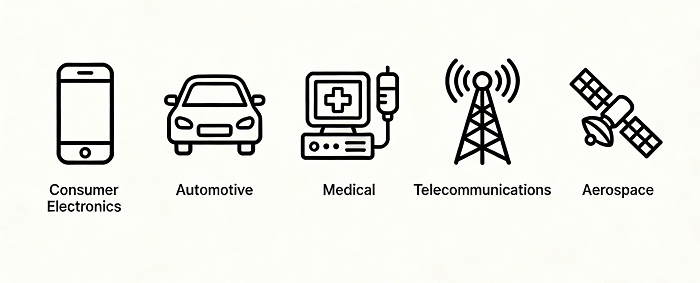
The choice of via type directly impacts manufacturing steps, equipment requirements, and costs. Microvias, blind vias, and buried vias reduce layer counts and material expenses, while through-hole vias and via-in-pad increase complexity but deliver higher density. Designers should select the simplest via structure that meets performance needs—e.g., using laser-drilled microvias for adjacent layer connections and avoiding unnecessary stacked vias to cut production time and costs.
2. Strategic Component Selection
Component choice dictates trace widths, hole sizes, stack-up design, and overall manufacturability. HDI PCBs use small, fine-pitch components (e.g., BGAs, CSPs) with a pitch of less than 0.65 mm, and designers must balance performance with packaging, traceability, and availability. Replacing components or redesigning layouts post-initial design drastically increases costs and lead times, so early validation of component supply and compatibility is critical. Additionally, minimizing the number of components (while maintaining functionality) streamlines routing and reduces signal interference.
3. Minimize Stress, EMI, and Signal Integrity Issues
Asymmetric via placement causes uneven mechanical stress and board warpage, reducing production yield—designers must ensure symmetric via placement for structural stability.
Dense component spacing and high-power signals generate electromagnetic interference (EMI), which degrades signal quality. EMI modeling during the design phase, combined with proper isolation of digital, analog, and power signals, is essential to mitigate this. Parasitic capacitance and inductance from nearby pins/pads also impact signal integrity, so maintaining adequate spacing between high-speed and low-speed components is critical.
Optimize routing for short, direct trace lengths, consistent impedance paths, and adequate ground planes. HDI PCBs use narrower traces for compactness, but trace widths must be designed to maintain controlled impedance—especially for high-speed signals (e.g., 5G, RF). Isolating power and signal traces prevents crosstalk, and using ground planes as a shield further enhances signal integrity by reducing noise and parasitic effects.
4. Design Stack-Ups for Cost and Performance Balance
PCB stack-ups (the arrangement of copper layers, dielectric materials, and prepregs) significantly impact manufacturing costs and electrical performance. The number of layers, material types, and lamination cycles directly influence production time and expenses, so designers should aim for the most efficient stack-up that meets performance requirements—e.g., reducing layer counts by leveraging HDI’s high wiring density (a well-designed 4-layer HDI PCB can match or exceed the functionality of an 8-layer traditional PCB). Balancing layer symmetry (even numbers of signal and plane layers) also prevents warpage during lamination and soldering, while selecting low-dielectric constant (Dk) and low-dissipation factor (Df) materials reduces signal delay and energy loss for high-speed applications.
5. Prioritize Thermal Management and Material Compatibility
High component density in HDI PCBs leads to increased heat generation, making thermal management a key design consideration. Following IPC-2226 guidelines, designers can place thermal vias under high-power components, use thermally conductive dielectric materials, and design ground/power planes to dissipate heat efficiently. Additionally, material compatibility is critical: the coefficient of thermal expansion (CTE) of copper foils, dielectric materials, and prepregs must be matched to avoid structural instability and delamination under thermal stress (e.g., during reflow soldering). Using consistent materials across all layers ensures a stable stack-up and long-term reliability.
6. Adhere to IPC Standards for Manufacturability
HDI PCB design is governed by strict IPC standards that ensure manufacturability, performance, and reliability:
· IPC-2226: Defines material characteristics, design rules for microvias (e.g., line spaces ≥100 μm, via diameters ≤150 μm), and connection pad density (≥20 pads per cm²).
· IPC-2315: Provides layout guidelines for high-density components and microvia structures.
· IPC-4104: Identifies dielectric materials for stack-ups to meet high-precision interconnect requirements.
· IPC-6016: Specifies performance standards for high-density substrates.
Adhering to these standards ensures that HDI designs are compatible with mainstream manufacturing processes and reduces the risk of production errors or yield loss.
HDI PCB Materials Selection
The choice of materials is pivotal to HDI PCB performance, as they must support fine-line routing, microvia formation, high-speed signal transmission, and mechanical stability. Key materials used in HDI PCB fabrication include:
1. Copper Clad Laminate (CCL)
CCLs form the core of HDI PCBs, consisting of copper foil laminated to one or both sides of a cured (C-stage) dielectric material. Common types include FR4 (the most widely used, cost-effective option for general HDI applications), FR-5 (higher heat resistance for industrial/automotive use), and PTFE (low Dk/Df for high-frequency/RF applications). Rigid CCLs provide structural stability, while thin-core CCLs (for ultra-compact designs) reduce board thickness and signal transmission loss.
2. Resin Coated Copper (RCC)
RCC consists of copper foil coated with a resin dielectric material, which can be directly bonded to the PCB core or sub-composite. It is ideal for microvia formation, as non-wet processable RCC allows laser or plasma drilling of tiny, precise microvias without damaging the substrate. RCC also improves adhesion between layers and supports sequential lamination— a key process for HDI stack-ups.
3. Prepreg (PP)
Also known as B-stage bonding sheet, prepreg is a fiberglass fabric impregnated with partially cured resin. During the lamination process, prepreg melts under heat and pressure, flowing to bond copper foils, CCLs, and other layers together while filling gaps (e.g., in buried vias). The choice of prepreg thickness and resin content impacts board thickness, mechanical strength, and signal integrity—low-flow prepregs are used for fine-line routing to avoid resin smearing on traces, while high-flow prepregs ensure full layer adhesion.
4. Dielectric Materials
HDI PCBs use dielectric materials with low Dk (≤4.0) and low Df (≤0.02) for high-speed signal transmission, as these properties reduce signal delay, distortion, and energy loss. Beyond FR4 and PTFE, advanced dielectrics include polyimide (PI) and BT resin—both offer high heat resistance, mechanical strength, and chemical stability, making them suitable for harsh-environment applications (e.g., aerospace, automotive, and medical devices). Thin-core dielectric materials (≤0.1 mm) further reduce board thickness and enable ultra-compact designs.
5. Thin Copper Foils
HDI PCBs utilize thin copper foils (≤1 oz, or 35 μm) to create finer traces and reduce trace resistance/inductance—critical for high-speed and high-density routing. Thin copper enables line widths and spaces down to 3/3 mils (0.0762 mm) and improves signal integrity by minimizing parasitic effects. Manufacturing with thin copper requires precise etching control to avoid over-etching (which narrows traces) or under-etching (which causes short circuits).
HDI PCB Manufacturing Processes
HDI PCB manufacturing is a highly specialized process that combines advanced precision techniques with sequential steps to achieve the high density and performance characteristic of these boards. Unlike traditional PCB manufacturing, which uses a single lamination step and mechanical drilling, HDI production involves multiple sequential laminations, laser drilling, and fine-line fabrication—with strict control over every step to ensure accuracy and reliability. The core manufacturing processes are as follows:
1. Fine-Line Fabrication
Fine-line fabrication creates the ultra-thin traces and small pads that define HDI PCBs, using high-precision photolithography and etching:
· Photolithography: A photoresist layer is applied to the copper-clad laminate, and circuit patterns are exposed onto the resist using high-resolution UV equipment. The exposed resist is developed to form a mask that protects the desired copper traces.
· Etching: The unprotected copper is removed using a controlled etchant (e.g., ferric chloride solution), leaving behind fine traces with precise widths and spaces. Strict control of exposure time, developer concentration, and etch rate is critical to avoid trace defects (e.g., jagged edges, uneven width).
2. Laser Drilling for Microvias
Mechanical drilling is limited to via diameters above 6 mils, so HDI PCBs use laser drilling to create microvias, blind vias, and buried vias with diameters as small as 20 μm. Laser drilling uses high-energy infrared or ultraviolet laser beams to ablate dielectric material, with precision control over beam spot size, energy, and pulse width to ensure accurate via diameter, depth, and verticality. Lasers can stop precisely at copper layers, making them ideal for blind via formation, and offer non-contact processing that avoids mechanical damage to the substrate—improving production yield. Advanced laser drilling systems can produce thousands of microvias per minute with an accuracy of ±5 μm.
3. Via Metallization and Filling
After drilling, vias are metallized to create a conductive path between layers:
· Desmearing: Debris from drilling is removed from via walls to ensure good copper adhesion.
· Electroless copper plating: A thin layer of copper is deposited on via walls to create a base conductive layer.
· Electroplating: Additional copper is plated to thicken the via walls for mechanical and electrical stability.
· Via filling: Vias (especially via-in-pad) are filled with conductive epoxy, copper, silver, or non-conductive epoxy to create a planar surface, prevent solder wicking during assembly, and improve mechanical strength. Non-conductive epoxy is the most common fill type for cost-effectiveness, while conductive fills are used for high-power or thermal applications.
4. Sequential Lamination
Sequential lamination is the defining manufacturing process for HDI PCBs, replacing the single lamination step of traditional PCBs with multiple layers of lamination to build complex stack-ups. The process involves bonding the PCB core with copper foils, prepregs, and RCC layers in stages—each stage followed by drilling, plating, and patterning—before the final lamination step. Sequential lamination prevents layer shifting and breaking during drilling, ensures precise alignment of microvias and traces across layers, and enables the creation of advanced stack-ups (e.g., 1+N+1, ELIC). Temperature, pressure, and lamination time are carefully controlled for each stage to ensure strong layer adhesion and avoid voids or delamination.
5. Surface Finishing
Surface finishing protects the copper surface from oxidation, improves solderability, and enhances long-term reliability. HDI PCBs avoid rough finishes like HASL (Hot Air Solder Leveling), which are incompatible with fine-pitch components and can weaken copper traces. Instead, they use smooth, high-precision finishes:
· ENIG (Electroless Nickel Immersion Gold): The most common finish for HDI PCBs, offering excellent solderability, corrosion resistance, and planarity for fine-pitch BGAs.
· Immersion Tin/Silver: Cost-effective alternatives to ENIG, with good solderability and planarity.
· OSP (Organic Solderability Preservative): A low-cost, environmentally friendly finish for low-volume or general-purpose HDI applications.
· Soft Gold: A premium finish for wire bonding applications (e.g., semiconductor packaging), offering high conductivity and bond strength.
6. Quality Control and Testing
HDI PCBs undergo rigorous quality control and testing to ensure compliance with design specifications and performance standards. Key tests include:
· Electrical testing: Continuity and isolation tests to detect open circuits or short circuits.
· Impedance testing: Verification of controlled impedance traces to ensure high-speed signal integrity.
· Mechanical testing: Warpage, flexure, and thermal stress tests to validate structural stability.
· Microsection analysis: Inspection of microvias and layer adhesion via cross-sectional microscopy to ensure no voids, delamination, or plating defects.
Advantages of HDI PCBs
HDI PCBs offer a multitude of advantages over traditional PCBs, making them the preferred choice for modern, high-performance electronic devices. These benefits stem from their high density, advanced design, and specialized manufacturing processes, and span electrical performance, mechanical design, cost-effectiveness, and reliability:
1. Unmatched Miniaturization and Compactness
HDI PCBs enable the design of ultra-small, lightweight electronic devices by packing more functionality into a minimal footprint. The use of microvias, blind/buried vias, and double-sided component placement eliminates wasted surface space, while fine-line routing and reduced layer counts (enabled by high wiring density) further shrink board size. This miniaturization is critical for portable consumer electronics (smartphones, wearables, tablets), medical devices (implantable equipment, portable diagnostics), and aerospace/automotive systems (where weight and space are at a premium).
2. Superior Signal Integrity and High-Speed Performance
Shorter signal paths (from closer component placement), controlled impedance routing, and the elimination of through-hole stubs (via blind/buried vias) drastically reduce signal reflection, crosstalk, and noise in HDI PCBs. Low-Dk/Df dielectric materials and thin copper foils further enhance signal integrity by minimizing signal delay, distortion, and energy loss—making HDI PCBs ideal for high-speed applications such as 5G, RF, AI computing, and high-performance networking. Additionally, HDI technology reduces parasitic capacitance and inductance, ensuring clean, reliable signal transmission even at GHz frequencies.
3. Enhanced Reliability and Mechanical Stability
Microvias in HDI PCBs have a low aspect ratio, making them more robust and resistant to thermal and mechanical stress than traditional through-hole vias. Sequential lamination ensures precise layer alignment and strong adhesion, reducing the risk of delamination or warpage during assembly and operation. The use of high-quality materials (e.g., PI, BT resin) and advanced surface finishes further improves long-term reliability, even in harsh environments (extreme temperatures, vibration, chemical exposure). For critical applications like medical devices and aerospace systems, this reliability is non-negotiable.
4. Reduced Power Consumption and Improved Thermal Management
Shorter trace lengths and lower trace resistance in HDI PCBs reduce power consumption, extending battery life for portable and battery-powered devices (e.g., wearables, smartphones, medical implants). Additionally, strategic thermal via placement and ground plane design enable efficient heat dissipation, preventing overheating in high-density, high-power components. This thermal management not only improves device performance but also extends component lifespan by reducing heat-related degradation.
5. Cost-Effectiveness with Optimized Design
While HDI PCBs have higher per-unit manufacturing costs than traditional PCBs (due to advanced processes and materials), optimized design makes them more cost-effective overall. A single HDI PCB can replace multiple traditional PCBs, reducing material costs, assembly time, and device complexity. Additionally, reducing layer counts (e.g., 4-layer HDI vs. 8-layer traditional) cuts material and production costs significantly, offsetting the premium for HDI processing. For high-volume production, the economies of scale further reduce the total cost of ownership (TCO) of HDI-based devices.
6. Design Flexibility and Scalability
HDI PCBs support a wide range of design configurations, from simple Type 1 stack-ups to ultra-complex ELIC/Any-Layer designs, making them scalable for all application needs—from low-cost consumer electronics to high-end aerospace systems. They are compatible with fine-pitch components (BGAs, CSPs), high-pin-count ICs, and advanced packaging technologies (SiP, System-in-Package), enabling designers to integrate new features and technologies without compromising size or performance. This flexibility is critical for keeping pace with the rapid evolution of electronic technology.
Key Applications of HDI PCBs
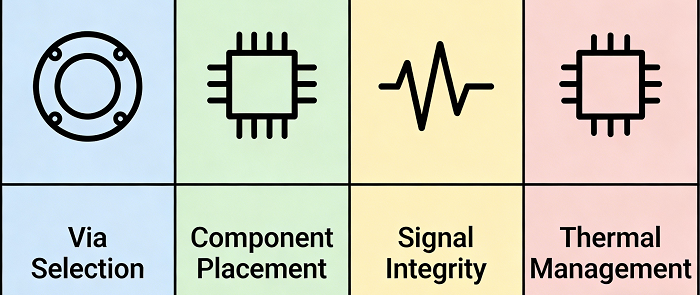
HDI PCBs are ubiquitous in modern electronics, powering devices across virtually every industry where miniaturization, high performance, and reliability are required. Their unique combination of density, signal integrity, and compactness makes them indispensable for next-generation technologies, with key applications including:
Consumer Electronics
The largest application area for HDI PCBs, consumer electronics relies on miniaturization and high performance to drive innovation. HDI PCBs are the backbone of smartphones, tablets, laptops, wearables (smartwatches, fitness trackers), and smart home devices—enabling features like 5G connectivity, high-resolution cameras, powerful processors, and long battery life in slim, portable designs. They also power IoT (Internet of Things) gadgets, providing the high density and low power consumption needed for connected devices.
Automotive and Aerospace
In the automotive industry, HDI PCBs support the shift toward electrification and autonomy, powering Advanced Driver Assistance Systems (ADAS), infotainment systems, electric vehicle (EV) battery management systems (BMS), and motor controllers. Their compactness and reliability make them ideal for vehicle interiors (where space is limited) and under-hood applications (where thermal and mechanical stress is high). In aerospace, HDI PCBs are used in avionics, satellite electronics, and missile guidance systems—delivering lightweight, high-performance interconnections that withstand extreme temperatures, radiation, and microgravity, while reducing launch costs through weight savings.
Medical Devices
Medical technology demands the highest levels of precision, reliability, and miniaturization—all hallmarks of HDI PCBs. They are used in portable diagnostic devices (glucose meters, blood pressure monitors, digital stethoscopes), imaging equipment (X-ray, CT scanners, MRI machines), and implantable devices (pacemakers, insulin pumps). For implantable devices, HDI PCBs enable complex functionality in a tiny, biocompatible footprint, with long-term reliability critical for patient safety. In imaging equipment, they provide high-speed, low-noise signal transmission for accurate image data acquisition and processing.
Telecommunications and Networking
5G and next-generation networking require high-speed, low-latency signal transmission, making HDI PCBs essential for telecommunications infrastructure. They power 5G base stations, routers, switches, and semiconductors, supporting the high bandwidth and low interference needed for modern digital media and network connectivity. HDI PCBs also enable the miniaturization of networking devices, making them suitable for edge computing and compact data center deployments.
Industrial and High-Performance Computing
In industrial applications, HDI PCBs power IoT devices, smart sensors, and manufacturing automation systems—providing reliable, high-density interconnections for harsh industrial environments (extreme temperatures, vibration, dust). For high-performance computing (HPC), they are used in servers, AI accelerators, and GPUs, delivering the high-speed signal integrity and density needed for massive parallel processing and data-intensive workloads.
Cost Considerations for HDI PCBs
While HDI PCBs offer significant long-term cost benefits, their advanced manufacturing processes mean that design decisions directly impact production costs. To optimize cost-effectiveness without compromising performance, designers and manufacturers should consider the following key factors:
1. Via size and quantity: Smaller vias (e.g., laser-drilled microvias) and more vias increase precision requirements and production time, driving up costs. Designers should use the largest feasible via size and minimize via count where possible.
2. Stack-up complexity: More layers, complex sequential lamination cycles, and stacked vias increase material and manufacturing costs. Optimizing stack-ups to the minimum layer count needed for performance is critical.
3. Material selection: Premium materials (e.g., PTFE, soft gold) offer superior performance but come at a higher cost. Selecting cost-effective alternatives (e.g., FR4, ENIG) for non-critical applications reduces expenses.
4. Surface finish: Premium finishes (soft gold, ENEPIG) for wire bonding are more expensive than standard finishes (ENIG, OSP)—choose finishes based on assembly requirements.
5. Turnaround time: Rush orders require expedited manufacturing and testing, increasing costs. Planning production ahead of time and aligning with manufacturer lead times saves money.
6. Manufacturability: Designing for manufacturing (DFM) by adhering to a manufacturer’s capabilities (e.g., minimum trace width, via size) reduces production errors, yield loss, and rework costs.
Future Trends in HDI PCB Technology
HDI PCB technology is continuously evolving to meet the growing demands of electronic miniaturization and high performance, with several key trends shaping its future:
1. Ultra-Fine Lines and Microvias: The push for even higher density is driving the development of ultra-fine line widths/spaces (25 μm and below) and microvias with diameters under 10 μm—enabled by advanced laser drilling and photolithography techniques.
2. Any-Layer HDI/ELIC: This advanced architecture, which enables direct routing between all layers, is becoming more mainstream for ultra-high-density applications like AI chips, 6G communication, and advanced semiconductor packaging.
3. Integration with SiP (System-in-Package): HDI PCBs are increasingly being integrated with SiP technology, combining multiple ICs, sensors, and passive components into a single package—further miniaturizing devices and improving performance.
4. Sustainable Manufacturing: The industry is shifting toward eco-friendly processes and materials, including low-waste laser drilling, recyclable dielectrics, and lead-free/halogen-free finishes—reducing the environmental impact of HDI PCB production.
5. High-Temperature and Harsh-Environment Compatibility: Development of new dielectric materials (e.g., ceramic-filled polymers) and surface finishes is expanding HDI PCB use in extreme environments (e.g., automotive under-hood, aerospace, and industrial high-temperature applications).
6. AI-Driven Design and Manufacturing: Artificial intelligence is being used to optimize HDI PCB design (e.g., automatic routing, impedance optimization) and manufacturing (e.g., real-time quality control, process optimization), improving efficiency and reducing costs.
Partnering with a Trusted HDI PCB Manufacturer
Designing and manufacturing HDI PCBs requires expertise, advanced equipment, and strict quality control—making the choice of a manufacturing partner critical to project success. For businesses and designers seeking reliable, high-quality HDI PCB fabrication and assembly, pcbcart is the ideal solution. Specializing in both PCB fab and PCB assembly, pcbcart leverages advanced laser drilling, sequential lamination, and strict IPC-compliant quality control processes to deliver consistent, cost-effective HDI solutions. We support standard HDI configurations including 1+N+1 and 2+N+2 stack-ups, laser-drilled microvias (≤150μm), blind/buried vias, fine traces (down to 3mil), impedance control, and HDI-compatible surface finishes (ENIG, immersion silver, OSP, ENEPIG). Our engineering team provides professional DFM reviews to ensure your design is manufacturing-ready, avoiding costly reworks. Whether for consumer, industrial, automotive, or medical applications—from prototype to volume production—pcbcart delivers on-time, high-yield HDI PCBs. As your trusted partner for PCB fab and PCB assembly, we help you bring your high-performance electronic products to market with confidence.
Get HDI PCB Fabrication Price Online
Helpful Resources
• Something You Must Know about HDI
• 3 Keys to Designing a Successful HDI PCB
• PCB Design File Requirements For Efficient HDI PCB Fabrication
• High-Speed Layout Tips
• Advanced PCB Assembly


