



Electronics manufacturing services (EMS) business is changing fast due to the pressure of customization, shorter products life cycle, and faster innovation. High-Mix Low-Volume (HMLV) manufacturing has emerged as a prevalent manufacturing paradigm, especially in areas like industrial electronics, medical devices, and IoT products.
Most manufacturers continue to work using production systems that were initially set up to give high-volume/low-variation output. These rigid production lines although effective in a stable environment, have a lot of difficulties when they are utilized in small-batches projects. The outcome is increased costs, inefficiency and loss of market opportunities.
Flexibility ceases to be a side benefit—it is a fundamental ability. The reason behind the failure of rigid systems and the solution of flexible manufacturing to these problems is the key that every EMS provider should have to be able to stay competitive.
The Unique Demands of HMLV Manufacturing
HMLV productionis not like the conventional mass manufacturing. Manufacturers are forced to deal with high diversity in designs in small batches rather than a large volume of a single product and specifications may change frequently.
This complexity is manifested in EMS settings in several aspects:
Regular engineering change orders (ECOs)
Various and ever-changing bill-of-material (BOMs)
Reduced product life cycles and quick development
Increasing demand for customization and quick turnaround
These attributes form a very dynamic production environment of which there is less predictability. HMLV efficiency is based on flexibility, unlike mass production where the efficiency lies in repetition.
The Reason why Rigid Production Lines Fail
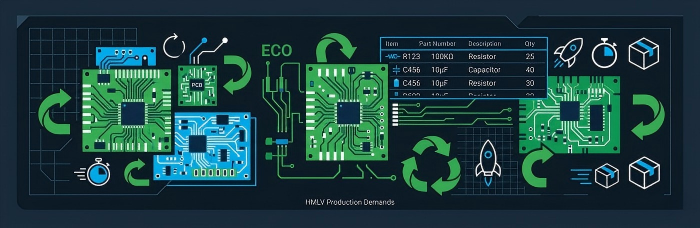
Excessive Changeover Time
Rigid production lines are designed to have long continuous runs. However, in small-scale production, frequent changeovers are inevitable. Every change of product will need to program the machine, make changes to the tooling, change material, and check quality.
These repeated changes bring about a lot of downtime. Equipment consumes a lot of time in resettling instead of creating value. This causes significant productivity loss and higher operational expenses in a series of batches.
Rigidity in Dealing with Product Change
The HMLV environment needs systems which can be easily adjusted to various product configurations. Rigid lines do not have this flexibility. They are generally constructed on fixed working procedures and standard procedures and it is hard to adapt them without disturbing them.
The more diverse the products, the more the bottlenecks. It makes scheduling more complicated, allocation of resources less efficient and predictability of lead times less predictable. This unresponsiveness may eventually impact customer satisfaction and performance in delivery.
Poor Cost Structure of Small Batches
Small-batch production per-unit costs are naturally high because there is a lack of economies of scale. This is aggravated by rigid systems.
Installation expenses, material wastage between operations and machine downtimes are some of the factors that increase costs. These inefficiencies are very likely to destroy profitability in already tight margins industries.
Furthermore, inflexible systems usually have higher batch sizes to recoup the cost of the set up, which is incompatible with the low-volume manufacturing of HMLV.
Limited Support for Customization and Innovation
The contemporary markets are becoming more and more demanding to customized solutions. Customers are demanding products that satisfy certain requirements and in many cases with short cycle times.
Rigid production lines, which are designed to produce uniformly, find it difficult to accommodate this type of customization. They are not as agile as required when it comes to making design changes or launching new products in a short time.
This restriction does not only slow down innovation, but also diminishes a manufacturers capability to compete in the rapidly moving markets.
Advantages of Flexible Manufacturing
Less Setup Time with Modular Design
Modularity is in consideration in the construction of flexible manufacturing systems. It is also able to quickly reconfigurate equipment and processes to fit various products.
This greatly saves on changeover time and enables manufacturers to change batches without much disturbance. This results in a general increase in equipment utilization and low-volume production becomes efficient.
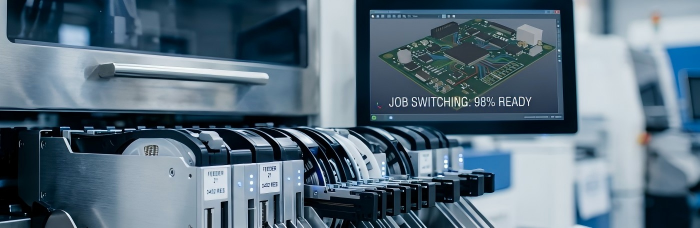
Adaptive Automation and Smart Technologies
Flexible automation, in contrast to traditional automation, which can be inflexible and task-focused, employs technologies like programmable systems, collaborative robots, and decision support tools based on data.
Such systems have the ability to respond dynamically to the fluctuating production needs. As an example, machine programs are easily updated, and production data are able to be utilized to improve scheduling and resource allocation.
Digitalization also improves visibility throughout the production process, allowing coordination and quicker problem resolutions.
Improved Time-to-Market
Speed is an important competitive variable in the HMLV environment. Flexible manufacturing allows quick prototyping, accelerated new product introduction (NPI), and reduced production cycles.
The manufacturers are able to react to the market in a fast manner, experiment with new designs with less risk, and launch products in the market earlier than the competitors. Agility is especially useful in short-cycle innovation industries.
Enhanced Resource Efficiency
Adaptable systems utilize the available resources better. Manufacturers will be able to be more efficient with smaller batch sizes since they can reduce waste and minimize downtimes.
Further, the production can be flexible to enable a more accurate inventory control. Manufacturers can more closely match production with real demand as opposed to producing huge volumes that might not be required at that specific time.
A Continuous Improvement Foundation
Flexibility is not only regarding equipment but also processes and organizational culture.
Continuous improvement often finds its way with manufacturers who embrace flexibility and are interested in making small steps in efficiency, quality and responsiveness. This attitude is vital in HMLV environments, as situations are dynamic.
The continuous improvement of workflows and the use of data insights allow EMS providers to keep the performance high regardless of variability.
Converting Small-Batch Problems into Opportunities
While small-batch manufacturing introduces complexity, it also creates opportunities. Customization allows flexible EMS providers to accommodate niche markets, highly specialized applications, and establish a close relationship with customers.
Moreover, being able to manage various products effectively can decrease reliance on a specific market segment and enhance stability to the demand variability.
The potential of flexible manufacturing is further increased by the advancements in the Industry 4.0 technologies, including real-time data analytics, and intelligent production systems. These tools can help manufacturers work more precisely and responsively even in a very complicated environment.
With the current trend towards HMLV production in the EMS industry, it becomes apparent that traditional production lines suffer from certain constraints which increase costs and hamper competitiveness. The inflexibility associated with traditional production lines results in less effective management of changeovers and customization needs. On the contrary, flexible manufacturing processes are capable of ensuring shorter transition times, better resource allocation, and a more dynamic response to market demands. In an environment characterized by shrinking product lifecycles and rapid innovation, flexibility ceases to be a luxury but rather a requirement for success.
PCBCart offers a combination of effective HMLV production capabilities and responsive services making it possible to offer excellent services to customers engaged in complex and small batch PCB manufacturing activities.
Helpful Resources
• How Much Does PCB Assembly Cost: A Complete Guide From Basics to Optimization Approaches
• Design for Manufacture and Assembly of PCBs and General Rules it Conforms to
• Some Handy Methods in Evaluating SMT Assembler’s Capabilities
• PCBCart's Advanced Turnkey PCB Assembly Service With Multiple Value-added Options


