



In today’s fast-paced electronics manufacturing landscape, choosing the right PCB assembly model is a critical decision that directly impacts your project’s cost, timeline, quality, and operational complexity. Two dominant options—full turnkey and partial turnkey PCB assembly—have emerged to cater to diverse business needs, from startups launching their first product to established enterprises scaling production. Each model offers distinct advantages and tradeoffs, and the optimal choice depends on your team’s resources, project requirements, and strategic priorities. This guide dives deep into both assembly models, comparing their processes, benefits, limitations, and ideal use cases to help you determine which aligns best with your goals.
What Is Turnkey PCB Assembly?
Before exploring the differences between full and partial turnkey, it’s essential to define what turnkey PCB assembly entails. At its core, turnkey assembly is a comprehensive manufacturing solution where a single service provider manages multiple or all stages of the PCB production lifecycle. The term “turnkey” derives from the idea of delivering a finished product that the customer can “turn the key” and use immediately—no additional assembly or procurement required.
Traditional PCB production often involves coordinating with multiple vendors: a PCB fabricator for bare boards, component distributors for parts, and an assembly house for soldering and testing. This disjointed approach leads to miscommunication, delays, quality inconsistencies, and hidden costs—especially for teams with limited supply chain expertise. Turnkey assembly eliminates these pain points by consolidating procurement, fabrication, assembly, and quality control under one roof, creating a streamlined, single-point accountability system.
Turnkey services typically support a wide range of applications, including quick-turn prototyping, low-to-medium volume production, and high-volume manufacturing. They also accommodate advanced assembly requirements, such as SMT (Surface Mount Technology), through-hole assembly, mixed-technology boards, and complex components like BGAs, QFNs, and 01005-sized parts.
Full Turnkey PCB Assembly: The Hands-Off, End-to-End Solution
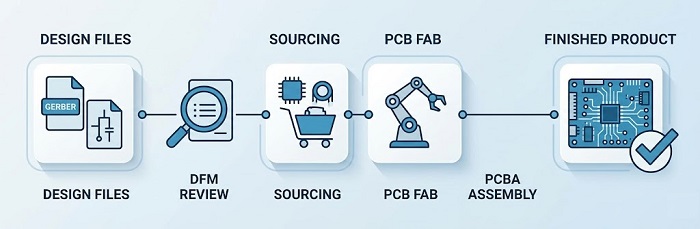
Full turnkey PCB assembly is the most comprehensive turnkey model, where the service provider manages every single stage of the PCB production process—from initial design review to final product delivery. For customers, this is a truly hands-off experience: you only need to submit essential design files (Gerber files, BOM, and component placement data), and the provider handles the rest.
Core Process of Full Turnkey Assembly
Design for Manufacturability (DFM) Review: Engineers analyze your design to identify potential manufacturing issues (e.g., component spacing errors, solder mask conflicts) before production, reducing rework risks.
Component Sourcing & Procurement: The provider sources all components (standard, specialized, and rare parts) through authorized distributors, ensuring authenticity, traceability, and compliance with industry standards like RoHS. Bulk purchasing power often secures lower component prices than individual businesses can negotiate.
PCB Fabrication: Bare PCBs are manufactured according to your specifications (layers, material, size, finish) with strict quality checks.
Assembly & Soldering: Automated equipment (pick-and-place machines, solder paste printers, reflow ovens) mounts and solders components onto the PCB, supporting high precision and consistency.
Inspection & Testing: Rigorous quality control processes—including AOI (Automated Optical Inspection), X-ray inspection (for hidden solder joints), ICT (In-Circuit Testing), and functional testing—ensure the final board meets performance and reliability standards.
Packaging & Delivery: Finished boards are cleaned, packaged, and shipped directly to your desired location, with complete documentation (test reports, compliance certificates) included.
Key Benefits of Full Turnkey Assembly
Unmatched Convenience & Minimal Oversight: With a single point of contact, you avoid coordinating multiple vendors, freeing your team to focus on core tasks like product design, marketing, and innovation. This is especially valuable for startups and small teams with limited bandwidth.
Faster Time-to-Market: Streamlined workflows eliminate delays from vendor handoffs. Prototypes can be completed in as little as 3–7 working days, and standard orders typically ship within 10–16 working days—critical for time-sensitive product launches.
Consistent Quality & Reliability: The provider controls every stage of production, reducing the risk of errors from miscommunication or inconsistent component quality. Strict testing ensures compliance with IPC Class 2/3 standards, minimizing post-production failures.
Predictable Budget & Cost Efficiency: While upfront costs may appear higher, full turnkey pricing is all-inclusive (no hidden fees for sourcing, labor, or testing). Bulk component discounts and reduced rework costs often lower the total cost of ownership compared to piecemeal sourcing.
Reduced Supply Chain Risk: Authorized component sourcing mitigates counterfeit risks, and the provider’s established supplier network minimizes disruptions from component shortages.
Limitations of Full Turnkey Assembly
Less Control Over Component Selection: You cannot choose specific suppliers or proprietary components, which may be a drawback for projects requiring specialized or custom parts.
Higher Upfront Costs: All-inclusive pricing means initial quotes are higher than partial turnkey, which may be challenging for ultra-tight budgets.
Limited Flexibility for Last-Minute Changes: Design or BOM modifications mid-production may incur additional fees or delays, as the provider has already sourced components and scheduled production.
Partial Turnkey PCB Assembly: The Flexible, Collaborative Model
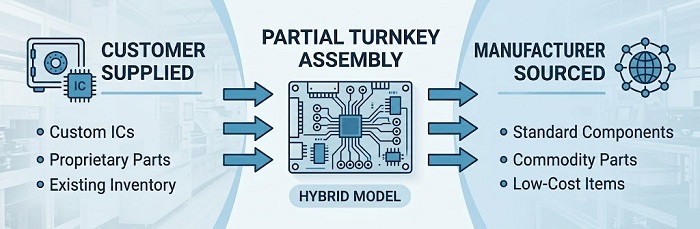
Partial turnkey PCB assembly—also called “hybrid” or “consignment” turnkey—is a collaborative model where responsibilities are split between the customer and the service provider. In short, you supply some components, and the provider handles the rest (sourcing remaining parts, fabrication, assembly, testing, and delivery). This model balances control and convenience, making it a popular choice for teams with existing resources or specific component requirements.
Core Process of Partial Turnkey Assembly
Customer Component Sourcing: You source and supply critical, proprietary, or hard-to-find components (e.g., custom ICs, high-value parts, or components with exclusive supplier agreements). You are responsible for verifying the quality, compatibility, and timely delivery of these parts.
Provider Component Sourcing: The provider sources all standard, commodity, or low-cost components (resistors, capacitors, connectors) using their global supplier network.
Component Inspection & Storage: The provider inspects your supplied components for defects or compatibility issues and stores them in ESD-safe environments to prevent damage.
PCB Fabrication, Assembly & Testing: Identical to full turnkey— the provider manufactures bare PCBs, assembles all components (yours and theirs), and conducts full inspection and testing.
Packaging & Delivery: Finished boards are packaged and shipped, with documentation provided.
Key Benefits of Partial Turnkey Assembly
Greater Control Over Critical Components: You retain ownership of key parts, ensuring they meet your exact specifications, quality standards, or brand requirements—ideal for products with proprietary technology.
Cost Savings: Using existing inventory or leveraging exclusive supplier relationships for high-value components reduces sourcing costs, making partial turnkey more budget-friendly than full turnkey for many projects.
Flexibility for Custom or Rare Parts: It accommodates components that are unavailable through standard distributors or require special certifications (e.g., medical-grade parts).
Reduced Upfront Investment: Since you supply some components, the provider’s quote (covering labor, standard parts, and services) is lower than full turnkey, easing budget pressure.
Limitations of Partial Turnkey Assembly
Increased Customer Responsibility: You must manage component sourcing, quality control, and logistics for your supplied parts. Delays or defects in your components can derail the entire project timeline and incur rework costs.
Variable Quality Consistency: The final board’s reliability depends on the quality of your supplied components. The provider tests assembly quality but cannot guarantee the performance of parts you supply.
Longer Lead Times: Production timelines depend on when you deliver your components. Late part delivery can extend lead times beyond full turnkey’s predictable schedule.
Higher Coordination Effort: You must align with the provider on component specifications, delivery dates, and quality standards, increasing communication overhead.
Head-to-Head Comparison: Full Turnkey vs. Partial Turnkey
To simplify your decision, here’s a detailed comparison of the two models across critical factors:
| Factor | Full Turnkey PCB Assembly | Partial Turnkey PCB Assembly |
|---|---|---|
| Service Scope | End-to-end: Design review, component sourcing, fabrication, assembly, testing, delivery | Hybrid: Customer supplies some components; provider handles sourcing, assembly, testing |
| Customer Involvement | Minimal (submit design files only) | High (source, inspect, and deliver critical components) |
| Ideal For | Startups, tight deadlines, complex designs, teams with no procurement expertise | Teams with existing inventory, proprietary components, or exclusive supplier relationships |
| Upfront Cost | Higher (all-inclusive pricing) | Lower (covers labor, standard parts, and services) |
| Total Cost of Ownership | Lower (bulk discounts, reduced rework, no hidden fees) | Variable (savings on components, but risk of rework costs for defective parts) |
| Lead Time | Predictable (10–16 working days; prototypes 3–7 days) | Variable (depends on customer’s component delivery; assembly takes 1–5 days) |
| Quality Consistency | High (provider controls all components and testing) | Variable (depends on customer-supplied component quality) |
| Component Control | None (provider selects all parts) | High (customer controls critical/proprietary parts) |
| Supply Chain Risk | Low (provider mitigates shortages and counterfeit risks) | Moderate (customer bears risk for their supplied components) |
How to Choose: Key Factors to Guide Your Decision
The choice between full and partial turnkey assembly ultimately hinges on four core factors: your project timeline, budget, team resources, and component requirements. Below is a framework to help you decide:
Choose Full Turnkey If:
You’re a startup or small team with no dedicated procurement or supply chain expertise.
Time-to-market is your top priority (e.g., product launches, seasonal deadlines).
Your project involves complex designs (high-layer PCBs, mixed SMT/through-hole, or advanced components like BGAs).
You want a predictable budget with no hidden costs or rework risks.
You prefer a hands-off approach to focus on core business activities.
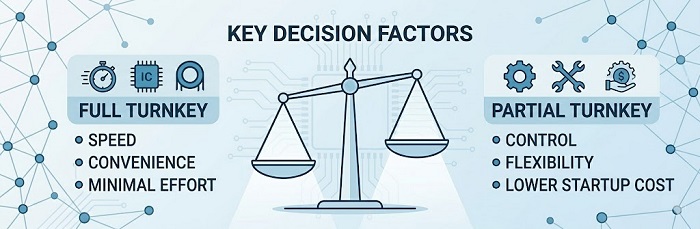
Choose Partial Turnkey If:
You already have inventory of critical components or exclusive supplier relationships.
Your product requires proprietary, custom, or hard-to-find components.
You need strict control over component quality or certifications (e.g., medical, aerospace).
You’re working with a tight budget and want to reduce upfront costs.
You have a dedicated procurement team capable of managing component sourcing and logistics.
Conclusion
Full turnkey and partial turnkey PCB assembly are both powerful solutions designed to simplify electronics manufacturing—but they cater to different needs. Full turnkey is the ultimate hands-off, speed-focused option for teams prioritizing convenience, reliability, and fast time-to-market. Partial turnkey offers flexibility and cost savings for teams with existing resources, proprietary components, or a need for greater control over critical parts.
There is no “one-size-fits-all” answer—your decision should align with your project’s unique requirements and long-term business goals. Whether you’re launching a prototype or scaling mass production, partnering with a reliable assembly provider ensures you get the expertise, quality, and support needed to succeed.
If you’re ready to explore turnkey PCB assembly solutions tailored to your project, PCBCart is here to help. As a trusted provider of full and partial turnkey PCB assembly services, PCBCart combines decades of manufacturing expertise, advanced production facilities, and a global sourcing network to deliver high-quality, cost-effective solutions for startups, SMEs, and enterprises worldwide. From quick-turn prototypes to high-volume production, PCBCart handles every detail—so you can focus on bringing your electronic products to life. Contact PCBCart today to discuss your project and request a personalized quote!
Helpful Resources
• Design for Manufacturability (DFM) Checklist for PCB Projects
• PCB Prototype & Standard PCB Manufacturing Services Comparison
• PCB materials
• How to Design Blind/Buried Vias in High-Speed Digital Circuits


