



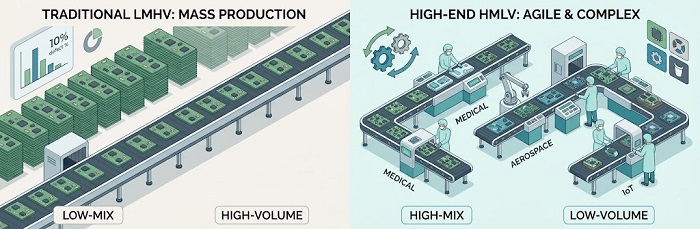
For decades, the electronics manufacturing industry revolved around a single mantra: mass production at scale. Factories churned out identical products on endless conveyor belts, optimizing every process for maximum throughput and minimal unit cost. This "low-mix, high-volume (LMHV)" model defined success by how many units could be produced, mirroring the iconic factory scenes from Charlie Chaplin’s Modern Times. But today, the ground has shifted dramatically. Consumer demand for customization, exponential growth in niche technologies, and rapid product lifecycles have rendered traditional mass production obsolete for a growing number of sectors. The future of electronics innovation lies in High-Mix, Low-Volume (HMLV) manufacturing—and more importantly, in high-end HMLV Electronic Manufacturing Services (EMS) that transcend basic PCB assembly to deliver end-to-end engineering, agility, and precision.
The Rise of HMLV: A Market Revolution Driven by Customization and Agility
HMLV manufacturing—defined as producing a wide variety of products (high mix) in small, flexible batches (low volume)—is no longer a niche trend. It has become the new normal of electronics production, reshaping industries from medical devices and industrial robotics to aerospace components and startup wearables. The catalyst for this shift is the fragmentation of consumer preferences and the acceleration of technological change. Unlike the era of "hit products" that dominated mass markets, today’s demand is for diverse, tailored solutions. Medical device manufacturers require patient-specific diagnostic tools; industrial automation firms need custom control systems for unique factory layouts; aerospace engineers demand precision components for specialized missions; and tech startups iterate rapidly on prototypes to test market response. None of these sectors need millions of units—they need dozens to thousands of highly customized, rigorously tested products delivered fast.
Data underscores this revolution: Over 60% of North American EMS production is now HMLV, and the global HMLV EMS market is projected to grow at 7.2% annually through 2032, outpacing the stagnant mass-production segment. This growth is fueled by three irreversible trends:
Product Lifecycle Compression: Technologies that once took years to develop now evolve in months, requiring frequent design updates and small-batch production runs.
Regulatory and Precision Demands: Medical, aerospace, and automotive sectors demand strict compliance (ISO 13485, AS9100) and traceability—requirements incompatible with mass production’s statistical quality controls.
Supply Chain Resilience: Post-pandemic volatility has shifted priorities from cost to agility, with OEMs favoring small, frequent production runs over large, risky bulk orders.
The Limitations of Traditional EMS: Why Basic PCB Manufacturing Falls Short
Traditional EMS providers were built for LMHV production. Their facilities, workflows, and business models are optimized for long production runs of identical PCBs, with setup costs amortized over millions of units. When faced with HMLV demands, these providers struggle with crippling limitations that derail innovation:
Slow, Costly Changeovers: Switching between product variants requires hours (or days) of reconfiguring SMT lines, reprogramming equipment, and resetting quality standards. Each changeover eats into profitability and delays time-to-market.
Shallow Engineering Support: Most traditional EMS offer only assembly services, lacking the expertise to collaborate on design for manufacturability (DFM), bill of materials (BOM) optimization, or new product introduction (NPI). This forces OEMs to manage disjointed vendors for design, sourcing, and assembly.
Component Sourcing Chaos: HMLV projects rely on rare, custom, or long-lead components. Traditional EMS lack the global networks and just-in-time (JIT) inventory systems to source small batches efficiently, leading to delays or inflated costs.
Inconsistent Quality: In mass production, 1% defects are manageable; in a 200-unit HMLV batch, 1% defects sink trust. Traditional EMS lack the rigorous, project-specific quality control (QC) needed for small runs.
These limitations create a critical gap: OEMs need manufacturing partners that understand complexity, not just quantity. High-end HMLV EMS providers fill this void by redefining what EMS can be—moving beyond PCB assembly to act as strategic engineering partners.
What Defines High-End HMLV EMS? Engineering-Driven Agility, Not Just Assembly
High-end HMLV EMS is not just about making small batches—it’s about mastering complexity at scale. Unlike traditional EMS, these providers integrate advanced engineering, flexible automation, and end-to-end supply chain expertise to deliver a holistic solution. Their core capabilities set them apart:
1. Advanced DFM and Virtual Validation: Mitigate Risk Before Production
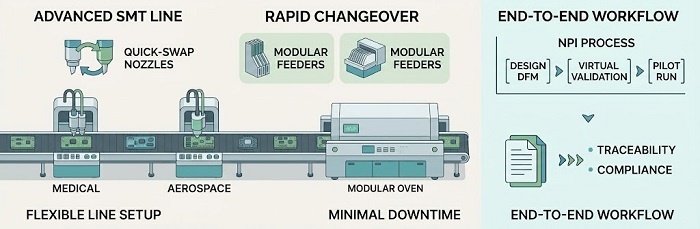
High-end HMLV EMS leverage process-aware virtual validation (not just basic geometric checks). Using industry-leading tools like the Siemens Valor NPI ecosystem, they create digital twins of production lines to simulate every stage—from solder paste printing to reflow profiling. This allows engineers to identify and resolve up to 90% of potential issues (e.g., tombstoning, bridging) before physical production, eliminating costly rework. They also validate BOM-component compatibility, ensuring every part aligns with PCB footprints—a critical step for HMLV’s diverse component mix.
2. Flexible, Rapid-Changeover Production Lines
Modular SMT lines and reconfigurable workcells are the backbone of high-end HMLV EMS. These lines use quick-swap tooling, offline programming, and dedicated multi-skilled teams to switch between product variants in hours, not days. Unlike traditional fixed lines, they support mixed-technology assembly (SMT, through-hole, hand assembly) and handle batch sizes as small as 1 unit up to 10,000 units.
3. End-to-End Supply Chain Mastery
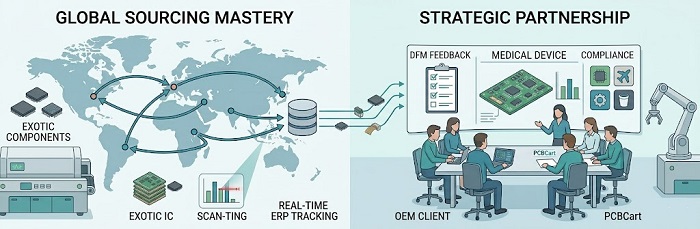
Sourcing is the biggest HMLV challenge. High-end EMS maintain global supplier networks and advanced ERP/MES systems to track components in real time. They specialize in sourcing rare, obsolete, or custom parts, offer alternative component validation, and use JIT inventory to avoid excess stock. This ensures 95%+ BOM fulfillment and eliminates last-minute sourcing delays.
4. Rigorous, Project-Specific Quality Assurance
Quality is non-negotiable in HMLV. High-end EMS deploy 3D solder paste inspection (SPI), 3D automated optical inspection (AOI), X-ray for hidden joints, and functional testing. Every batch—whether 10 or 500 units—undergoes the same rigorous QC, with full traceability for medical, aerospace, and automotive compliance.
5. Engineering Partnership, Not Just Assembly
High-end EMS embed engineers into OEM teams from design inception. They provide DFM feedback, optimize BOMs for cost and availability, streamline NPI workflows, and support design iterations. This "engineering-driven manufacturing" turns EMS providers into extensions of the OEM’s R&D team.
Why High-End HMLV EMS Is the Future of Electronics Innovation
The future of electronics is custom, fast, and complex—and high-end HMLV EMS is the only manufacturing model that can deliver this future. For OEMs, partnering with these providers unlocks three transformative advantages:
1. Accelerated Time-to-Market
Innovators can no longer wait months for production. High-end HMLV EMS reduce lead times from 4–8 weeks (traditional EMS) to 2–4 weeks for small batches, enabling rapid prototyping, iteration, and market testing. This speed is critical for startups racing to launch and established firms updating products to stay competitive.
2. Reduced Total Cost of Ownership (TCO)
While HMLV unit costs are higher than mass production, high-end EMS eliminate hidden costs: rework, delays, supply chain risk, and disjointed vendor management. Their DFM expertise cuts production risk, their supply chain networks avoid premium rush fees, and their one-stop service reduces handoff errors. For high-value products, this results in lower long-term TCO.
3. Unmatched Innovation Enablement
High-end HMLV EMS thrive on complexity. They support the most cutting-edge technologies—from AI sensor boards and flexible circuits to medical-grade devices and aerospace subsystems—that traditional EMS cannot handle. By removing manufacturing barriers, they let OEMs focus on what matters: innovation, not production logistics.
The Future Is High-End HMLV—Choose the Right Partner
As electronics innovation accelerates, the divide between traditional EMS and high-end HMLV providers will widen. Mass production will persist for commodity products, but all high-value, innovative electronics will rely on HMLV EMS. The key to success is selecting a partner that combines engineering depth, flexible automation, and a proven track record in complex projects.
PCBCart stands at the forefront of this high-end HMLV revolution. With decades of expertise in precision electronics manufacturing, PCBCart transcends basic PCB assembly to deliver engineering-driven HMLV EMS. Leveraging the Siemens Valor NPI ecosystem and a team of senior engineers, PCBCart provides virtual validation, advanced DFM, rapid-changeover production, global component sourcing, and rigorous quality assurance—all tailored to the unique needs of high-mix, low-volume projects. Whether you’re a startup launching a wearable prototype or an established firm developing medical-grade devices, PCBCart acts as your strategic manufacturing partner, turning innovative ideas into reliable, market-ready products.
In the age of customization and speed, PCB manufacturing is just the beginning. The future of electronics innovation is high-end HMLV EMS—and PCBCart is your gateway to that future.
Helpful Resources
• Design for Manufacture and Assembly of PCBs and General Rules it Conforms to
• How to Evaluate A PCB Manufacturer or A PCB Assembler
• Essential Elements of SMT Assembly
• A Comprehensive Introduction of PCBA
• Full Feature PCB Manufacturing


