



The recent accelerated development of worldwide telecommunications, with the introduction of 5G, new 6G studies, cloud computing, and AI-enhanced networks, has compelled an unprecedented requirement in infrastructure performance. This transformation centers on the printed circuit board (PCB) which has been developed as a passive interconnect platform to an important facilitator of high-speed signal transmission and system reliability.
With telecom systems now moving to the ultra-high frequency and data rate ranges of over 100 Gbps, high-speed PCB assembly is no longer a production process. Rather, it is a multifaceted, accuracy-focused process that directly influences the signal integrity, thermal stability, and operational resilience.
The Increasing Need of High-Speed Telecom PCBs
Telecommunication infrastructure, particularly base stations, routers and optical transmission systems need PCBs that can support high frequency signals, high density of integration and continuous process. PCB materials and designs should be designed to reduce signal distortion and loss because 5G frequencies are up to 100 GHz, and higher.

Simultaneously, the world data traffic is expected to become exponentially larger, and additional load on networking equipment is expected. High speed PCBs should be able to support:
Ultra-high data transmission (10 -100 Gbps and more)
Minimal signal degradation and low latency
Extremely high reliability in continuous operation
Compact, high-density configurations
These needs underscore the reason why PCB assembly has emerged as a strategic consideration in the telecom infrastructure performance.
Core Challenges in High-Speed PCB Assembly
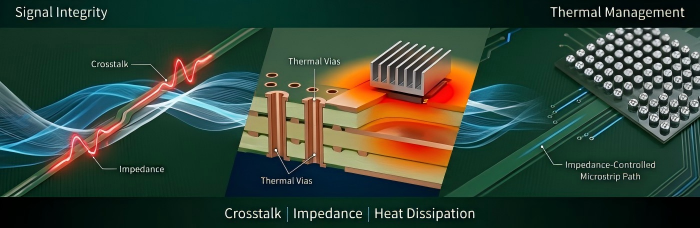
Signal Integrity and Transmission Loss
One of the most critical challenges in high-speed PCB assembly is maintaining signal integrity. Even slight differences in the trace geometry, by design or solder quality, can cause serious performance issues at high frequencies.
Signal reflections can be due to impendence mismatches
Crosstalk between adjacent traces increases with density
Even minor physical variations can significantly affect the rates of bit errors
Indicatively, at 112 Gbps data rates a trace design error of 1 mm may cause significant signal degradation.
In addition, inconsistencies during assembly, including solder joints that are defective or improperly placed components, may cause disruption in well-planned impedance-controlled pathways.
Advanced Material Integration
Telecom High-frequency applications demand special materials like low-loss laminates and substrates composed of PTFE. The materials have low dielectric constants and low dissipation factors which are vital in preserving signal fidelity.
Nevertheless, they are accompanied by new assembly challenges:
Thermal stress sensitivity in soldering.
Incompatibility with normal manufacturing processes.
Increased material expenses that need to be optimized.
The performance versus manufacturability becomes a major issue in large scale telecom deployments.
High-Density Interconnect (HDI) and Miniaturization
The current telecom equipment requires a design that is small without affecting functionality. This is made possible by high-density interconnect (HDI) technology using microvias, small traces and multilayer structures.
HDI is good at performance and space usage but difficult to assemble:
Greater likelihood of defects because of smaller tolerances.
Increased inspection and testing needs.
More sensitive to changes in manufacturing.
With smaller component dimensions and higher levels of integration, a steady quality in assembly becomes more challenging.
Thermal Management
Telecommunication networks are run with high-speed systems that produce a lot of heat because of the tight arrangements of the components and constant use. Inadequate thermal control may result in:
Signal instability
Reduced component lifespan
Malfunctions of important infrastructure.
The PCB assembly should thus guarantee effective heat dissipation by:
Optimized layer stack-ups
Heat sinks and thermal vias.
High thermal conductivity materials.
The consideration of thermal factors is particularly critical when it comes to base stations and data center networking systems.
Precision and Process Control manufacturing
High-speed telecom PCBs are sensitive to the assembly precision of the performance. The change in the amount of solder, accuracy of placement or finish can interfere with transmission of signals.
To solve this, manufacturers should use:
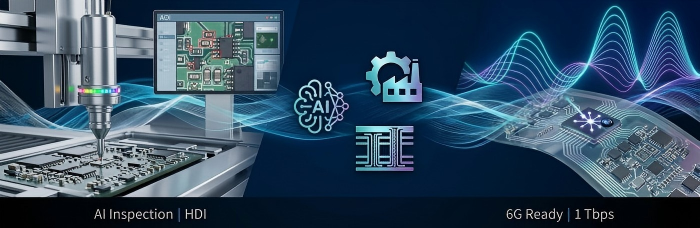
X-ray analysis and automated optical inspection (AOI).
Close control of processes in SMT assembly.
Design for manufacturability (DFM) and design for assembly (DFA) practices.
The error margin is very low in comparison with the normal manufacture of electronics.
Scalability and Cost Effectiveness
Telecom infrastructure projects are usually large-scale in nature, and cost control is a significant issue. But advanced assembly methods and high-performance materials make it more expensive to produce.
Manufacturers must balance:
Performance vs. cost
Advanced materials vs. scalability
Innovation vs. efficiency in production.
The modular design strategies and hybrid material strategies frequently serve to maximize cost-performance ratios.
Emerging Solutions and Innovations
Advanced Simulation and Design Tools
Simulation software is a key component in modern PCB design as it allows prediction of signal behaviour, impedance and thermal performance prior to production. This minimizes expensive redesigns and enhances first-pass success.
Smart Manufacturing and Automation
PCB assembly is changing with Industry 4.0 technologies, including the use of AI-based inspection and real-time monitoring of the process. These systems enhance yield, lessen defects, and enhance traceability.
Flexible and 3D PCBs
Flexible PCBs and new 3D PCB designs allow a more efficient use of space and better functioning of small telecom devices.
High-Speed Material Innovation
Ongoing enhancement of low-loss material enables increased frequencies and data rates, leading to 6G and beyond.
Future Prospects: To 6G and Beyond
With the telecommunications sector gravitating towards 6G, which promises to provide data rates reaching up to 1 Tbps, the requirements of PCB assembly will be even more demanding.
Future trends include:
Materials with ultra-low-loss in the terahertz.
The design and manufacturing of PCBs with AI help.
Further photonics-electronics integration.
Increased focus on environmental responsibility and sustainability.
The speed of PCB assembly will also continue to be an element of telecom innovation, as it facilitates the infrastructures that will support next-generation connectivity.
It takes more than the design innovations to futureproof telecom infrastructure; it takes the best PCB assembly at high speed. In terms of preserving signal integrity and addressing thermal issues as well as precision of manufacturing, every step is crucial to the performance of the system.
With the ever-increasing need of data, the capability to produce high-quality, dependable PCB assemblies will determine the future of telecommunications networks all over the globe.
The key to successfully sailing through these requirements is to have a competent and mature PCB partner. What sets PCBCart apart is its proficiency in high-speed PCB manufacturing and assembly processes, as well as the use of advanced process controls and a dedication to excellence. By accommodating complicated designs, high-frequency substrates, and stringent standards, PCBCart offers a specialized solution for today’s telecommunications market.
Helpful Resources
• Applications and Types of PCBs for Telecommunications Industry
• Key Rules for High-Frequency PCB Layout
• Solving Signal Integrity Issues in HDI PCBs
• High-Speed PCB Routing Techniques to Reduce the Influence of EMI


